For Indian travelers, the prospect of a cruise holiday raises one immediate, practical question: will the food work for me? Whether you follow a strict Jain diet, prefer pure vegetarian meals, or simply want the comfort of a good butter chicken or dosa after a long day at sea, the quality and availability of Indian cuisine onboard can make or break the entire experience.
The good news is that the cruise industry has evolved considerably. Major lines such as Royal Caribbean, Celebrity Cruises, Princess Cruises, and Holland America now regularly feature Indian and vegetarian dishes across their fleets. Carnival has gone a step further by launching Masala Tiger, a branded Indian specialty restaurant on select ships. Norwegian Cruise Line and several regional operators have also expanded their menus to cater to Indian passenger demand, particularly on itineraries and sailings where that demographic is well represented.
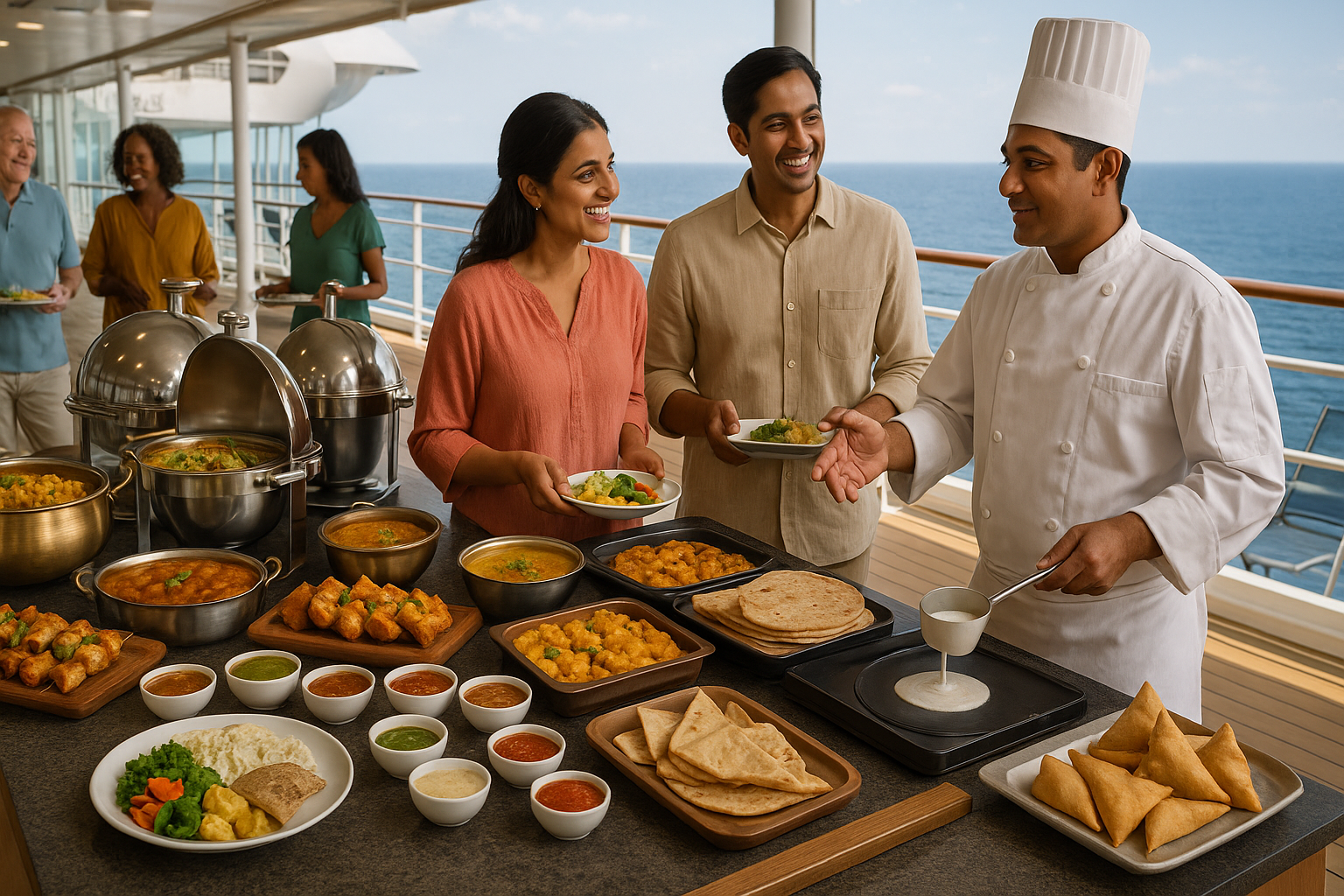
Indian, vegetarian, and Jain meals can be found across a range of onboard venues : from the main dining room and the Lido buffet to specialty restaurants, room service, and themed event nights. Expect North Indian staples like butter chicken, korma, and biryani alongside South Indian favourites such as dosa, idli, and sambar. Street-food snacks, tandoor preparations, and paneer dishes also feature regularly. For Jain travelers, adaptations without onion or garlic are possible on most major lines, though they almost always require advance notice : typically 48 hours or more before the meal is needed.
Securing the right dining experience starts well before you board. Dietary requests should be submitted at the time of booking, followed up with written confirmation from the cruise line, and then reconfirmed directly with the ship's dining team on embarkation day. This guide walks you through every stage of that process : from choosing the right ship and verifying what's actually on the menu, to meeting the chef onboard and placing your daily meal preorders.
Not sure which ship or sailing actually guarantees Indian, vegetarian, or Jain food? Chat with our cruise specialists on WhatsApp : we'll confirm it before you book.
Chat on WhatsApp
Which cruise lines and ships offer authentic Indian cuisine?
Several of the world's largest cruise operators now make Indian cuisine a regular part of their dining programmes, though the depth and consistency of those offerings varies significantly from line to line, and sometimes from ship to ship within the same fleet.
Royal Caribbean, Celebrity Cruises, Princess Cruises, and Holland America Line are the most reliable choices for travelers who want Indian food available throughout their voyage, not just on the occasional themed night. On these lines, Indian and vegetarian dishes appear in the main dining room on a rotating or nightly basis, and the buffet typically maintains an Indian section throughout the cruise. Carnival has taken a different but equally significant approach: rather than spreading Indian dishes across the fleet, it has concentrated the experience into a dedicated specialty venue, Masala Tiger, currently operating on Carnival Celebration, Carnival Jubilee, and Mardi Gras. Norwegian Cruise Line sits in a middle ground, with Indian options available on certain ships and itineraries but without the fleetwide consistency of the lines above.
-
Fleetwide examples:
- Royal Caribbean : Indian dishes appear regularly in the Main Dining Room and Windjammer across many ships, with Southampton sailings often featuring an expanded Indian selection.
- Celebrity Cruises : Elevated Indian-style and vegetarian options are woven into the fleet's dining venues, reflecting the line's focus on global culinary variety.
- Princess Cruises : Indian and vegetarian items feature consistently in both buffet and main dining rotations across the fleet.
- Holland America Line : Structured vegetarian and Indian-friendly menus are available across many ships, with documented special vegetarian lists available on request.
-
Select-ship / itinerary-specific examples:
- Carnival Cruise Line : Masala Tiger is a branded Indian specialty restaurant currently listed on Carnival Celebration, Carnival Jubilee, and Mardi Gras.
- Norwegian Cruise Line (NCL) : Indian options appear in buffets or main dining on certain ships or itineraries rather than as a fleetwide standard.
- Regional and niche operators (for example, Genting Dream and some Halong Bay cruise operators) : Indian-style and Jain/vegetarian meals may feature on particular sailings, especially those marketed to South and Southeast Asian passengers.
Because dining rosters can change by season and sailing, it is always worth completing a two-step verification before booking:
- Review the ship's official dining pages and the specific sailing's specialty-restaurant roster, paying attention to any posted sample menus for Indian, vegetarian, Jain, or halal offerings.
- Request written confirmation from the cruise line's reservations team or the ship's dining manager, by phone or email, that your required cuisine will be available on that particular sailing.
Fleetwide vs select‑ship offerings: which lines regularly serve Indian food?
Understanding whether a line offers Indian food fleetwide or only on select ships is one of the most important distinctions to make when comparing cruise options. A fleetwide offering means you can book with confidence regardless of which ship operates your itinerary. A select-ship or specialty-only offering means you need to choose your vessel carefully : booking the wrong ship in the same fleet could leave you without the cuisine you were counting on.
- Fleetwide
- Royal Caribbean : Regular Indian dishes in the Main Dining Room and Windjammer; Southampton sailings often include an expanded Indian menu reflecting the UK's large South Asian passenger base.
- Celebrity Cruises : Elevated Indian and vegetarian items appear across dining venues, consistent with the line's premium culinary positioning.
- Princess Cruises : Indian and vegetarian dishes regularly feature in buffet and main dining rotations throughout the fleet.
- Holland America Line : Fleetwide vegetarian and Indian-friendly menus are documented, with a special vegetarian list available on request in the main dining room on many ships.
- Select-ship / specialty venues
- Carnival Cruise Line : Masala Tiger specialty restaurant operates on Carnival Celebration, Carnival Jubilee, and Mardi Gras; Indian dishes may also appear in buffet selections on other ships.
- Norwegian Cruise Line (NCL) : Indian options appear in buffets or as main dining features on certain ships or itineraries; availability is less predictable and should be confirmed before booking.
- Luxury and regional operators : Indian and Jain menus may be available when demand, passenger demographics, or local provisioning supports them; these are best confirmed directly with the operator.
Itineraries and homeports that increase the likelihood of Indian/vegetarian menus
The route a ship sails and the port it departs from have a direct influence on what ends up on the menu. Cruise lines calibrate their catering to their passenger mix, so sailings with a higher proportion of South Asian guests are considerably more likely to feature expanded Indian and vegetarian offerings.
Cruises departing from Southampton are a particularly strong example. The UK has one of the largest South Asian diaspora communities in the world, and cruise lines sailing from British ports respond by offering broader Indian menus, additional vegetarian choices, and sometimes dedicated Indian buffet stations. Similarly, Asian homeports, Singapore, Hong Kong, Mumbai, and Dubai among them, frequently see ships provision specifically for Indian and Jain dietary needs. Themed voyages marketed to Indian travelers, round-trip sailings from Indian ports, and itineraries visiting destinations with strong Indian cultural ties are all worth prioritising if authentic cuisine is a priority.
How to verify ship‑level availability before booking
Advertising at the cruise line level does not always translate into guaranteed availability on a specific ship or sailing. A line may prominently feature Indian cuisine in its marketing while that offering is limited to a handful of ships or seasonal itineraries. Verifying at the ship level, before you pay a deposit, avoids disappointment.
Steps include:
- Reviewing the ship's official dining pages and the "All Dining Options" or specialty-restaurant roster for your specific vessel; examining any posted sample menus for Indian, vegetarian, Jain, or halal items.
- Obtaining written confirmation from reservations or the ship's dining manager (by phone or email) that Indian cuisine and any required vegetarian, Jain, or halal accommodations will be provided on the sailing you intend to book.
What to do if your preferred ship doesn't confirm Indian cuisine
If a cruise line cannot confirm Indian or vegetarian options on your specific sailing, you have a few practical paths forward. First, ask whether a sister ship on the same itinerary carries Masala Tiger or a comparable venue, and consider switching. Second, ask whether the galley can prepare custom meals if dietary requirements are submitted in writing well in advance : many ships will accommodate this even without a published Indian menu. Third, consider whether the buffet will meet your needs for most meals, even if the main dining room menu is limited. If none of these options provide adequate assurance, it is worth choosing a different line or sailing rather than relying on optimism.
What dining venues onboard provide Indian, vegetarian, and Jain meals?
Indian, vegetarian, and Jain dishes are not confined to a single area of the ship. On the lines that cater well to these diets, you will encounter suitable options across multiple venues throughout the day : from an early breakfast at the buffet to a late dinner in the main dining room or a specialty restaurant.
Primary onboard venues and typical locations of Indian/Jain options:
- Main dining room : Nightly or rotating menus commonly include at least one Indian and one vegetarian entrée; Jain adaptations without onion and garlic are typically available on request with advance notice.
- Buffet/Lido/Windjammer : Self-service stations frequently feature Indian dishes and may host dedicated Indian-themed evenings; the buffet is usually the most flexible venue for sampling a wide variety of dishes at any given mealtime.
- Specialty restaurants : Ship-specific Indian restaurants, sometimes with a cover charge, offer more authentic tandoor items and regional preparations than the buffet or main dining room.
- Room service and special events : Pre-arranged orders, private dining experiences, and cultural themed events may include Indian, vegetarian, or Jain meals; strict Jain preparation typically requires advance notice of at least 48 hours.
Venue types explained: main dining, buffet, specialty restaurants and events
Each onboard dining venue operates differently and serves a distinct role in your daily eating routine. Understanding how each one works helps you plan which venues to rely on and when to make special arrangements.
- Main dining room: Waiter-served with nightly or rotational menus; the main dining room typically lists at least one Indian or vegetarian entrée per service. Staff can often accommodate changes to dishes on request, and this is the most appropriate setting for arranging Jain adaptations through the dining manager.
- Buffet / Lido / Windjammer: Self-service stations and live counters make the buffet the most flexible everyday dining option. On many ships, dedicated Indian stations operate throughout the cruise, and themed Indian evenings concentrate a larger variety of regional dishes onto a single night's spread.
- Specialty restaurants: À la carte service, often with a cover charge or reservation requirement. When an Indian specialty venue like Masala Tiger is available, it provides the most focused and authentic experience onboard, with tandoor preparations and regional dishes that the main dining room cannot always replicate.
- Events and themed nights: Scheduled buffet or table-service events run by the cruise line, sometimes tied to cultural occasions or regional destinations on the itinerary. Indian-themed nights on Royal Caribbean's Windjammer, for example, are well-documented by passengers as a highlight for Indian food lovers.
Typical dishes and regional varieties found
The range of Indian food available on cruise ships has expanded well beyond a token curry. On the lines that invest in Indian catering, the menu covers multiple regions, cooking styles, and meal occasions.
- North Indian classics: butter chicken, chicken korma, biryani, tandoori items, and a variety of paneer dishes are the most consistently available. These appear in main dining rooms and specialty restaurants, with vegetarian variants commonly turning up in buffet selections.
- South Indian specialties: dosa, idli, sambar, and coconut-based curries are typically offered at breakfast and in the buffet or Lido; they are usually prepared vegetarian and represent a welcome alternative to North Indian-only menus.
- Coastal and seafood curries: regional fish and prawn curries occasionally appear on specialty menus or buffet seafood stations. While not suitable for vegetarians, they reflect the genuine regional variety some ships aim to represent.
- Street food and snacks: samosas, vada pav, chaat-style items, and seekh kebabs are offered as starters, snacks, or buffet choices throughout the day.
- Jain adaptations: simple vegetable preparations without onion or garlic, plain dals, and plain rotis are the most reliably available Jain options, but they almost always require 48 or more hours' advance notice to prepare correctly and safely.
Specialty-restaurant examples (branded instances)
Dedicated Indian specialty restaurants onboard a cruise ship offer a meaningfully different experience from the buffet or main dining room. They typically employ kitchen staff with specific expertise in Indian cooking, maintain a focused menu of regional dishes, and use tandoor ovens and authentic spice preparations that are impractical to replicate at buffet scale.
Masala Tiger, operated by Carnival Cruise Line on select ships, is the most prominent branded example currently in operation. It showcases tandoor items, vegetarian sides, and classic North Indian dishes. Other lines have occasionally offered branded, pop-up, or dedicated Indian specialty venues; these tend to appear on ships with itineraries serving high-demand markets. Because specialty restaurant availability is ship-specific and can change between seasons, it is essential to verify the current dining roster for your specific vessel before booking, and to check whether a cover charge applies or whether the venue is included in your fare.
How to secure vegetarian, Jain or halal meals : pre‑cruise and onboard
Securing the right meals on a cruise requires a systematic approach that begins at the point of booking and continues through embarkation and into the first day onboard. The earlier you communicate your requirements and the more clearly you document them, the better the galley can prepare.
The process has two distinct phases: the pre-cruise preparation that puts your requirements formally on record with the cruise line, and the onboard follow-up that ensures the kitchen team is aware, prepared, and equipped to deliver throughout the voyage.
Pre‑cruise requests and menu customization (what to tell reservations)
When booking, the most important step is to enter your dietary requirements formally into the reservation record using the cruise line's own language and processes. Vague requests, "I prefer vegetarian food", are less reliable than precise, written statements that use the terminology the galley team recognises.
Checklist for booking:
- The booking notes field should contain the exact dietary label: "pure vegetarian," "Jain (no onion/garlic)," or "halal."
- Prohibited ingredients should be listed explicitly : for example: onion, garlic, gelatine, egg (if applicable), alcohol in cooking.
- Any special-diet forms provided by the cruise line should be completed in full and attached to your reservation.
- The reservations team or the ship's dining desk should be notified directly : many lines recommend providing at least 48 hours' notice before departure for any custom meal preparation, though earlier is always better.
- Ask specific questions about ingredient sourcing for halal and about procedures for separate vegetarian or Jain preparation, including whether dedicated utensils and prep areas are used.
Onboard procedures: meeting the chef, speaking to dining managers, and daily preorders
Arriving onboard with a confirmed reservation note is a strong start, but it is not sufficient on its own. The most reliable way to ensure your dietary needs are met throughout the voyage is to make direct contact with the dining team as early as possible : ideally on embarkation day, before the first dinner service.
Request a meeting with the maître d' or head chef on day one. This conversation allows the galley to formally record your requirements, confirm their understanding of Jain or halal restrictions, review ingredient lists, and plan special preparations for the days ahead. It also gives you the opportunity to confirm which venues can reliably accommodate your diet and which to avoid. Many experienced cruise travelers with dietary requirements also use this meeting to establish the daily preordering process : placing your order for the following day's meals each evening. This gives the kitchen adequate time to prepare alternatives, source any special ingredients, and avoid cross-contamination with non-vegetarian dishes.
Booking tips and confirmation: written proof and follow‑ups
Written confirmation of any special dietary request is not a formality : it is your primary protection if something goes wrong onboard. An email confirmation or a printed booking-note entry gives you documented evidence that you notified the cruise line in advance, which matters both practically and contractually if your requirements are not met.
Checklist for written proof and follow-up:
- Obtain written confirmation of your special dietary request, by email or as a booking-note entry, and retain it with your travel documents.
- Reconfirm your requirements at check-in and again with the reservations desk during the boarding process.
- Where possible, choose ships, sailings, or itineraries known for Indian or vegetarian offerings, or vessels with kitchen staff experienced in these diets.
- Keep copies or screenshots of all correspondence, including any completed special-diet forms, in a folder you can access easily during the trip.
- On embarkation day, notify the dining staff onboard and arrange a meeting with the maître d' or ship's chef to finalise preorders, verify ingredient sourcing, and confirm which dishes can be safely prepared to your specification.
How to evaluate and compare cruise lines for Indian/vegetarian/Jain dining
Choosing the right cruise line for Indian, vegetarian, or Jain dining involves more than checking whether a line has Indian food on the menu. The depth, consistency, authenticity, and flexibility of that offering varies considerably, and making the wrong choice can mean spending two weeks navigating a ship that was never designed with your diet in mind.
A structured evaluation using objective criteria, rather than relying on headline marketing claims, will give you a much clearer picture of which lines are genuinely equipped to serve your needs.
Objective criteria: authenticity, menu depth, chef expertise, and vegetarian/Jain support
The most reliable way to compare cruise lines before booking is to apply a consistent set of measurable factors to each option. The checklist below covers the areas that most directly affect day-to-day dining quality for Indian, vegetarian, and Jain travelers.
- Authenticity : are there trained Indian chefs onboard, or does the line maintain a dedicated Indian menu with customisable spice levels? Lines with genuine culinary expertise in Indian cuisine typically deliver a noticeably different result from those that simply add a curry to a western menu rotation.
- Menu depth : how many Indian, vegetarian, vegan, and Jain dishes are available on a typical day? A single token option per meal is materially different from a line like Oceania that documents hundreds of plant-based items.
- Chef expertise : does the head chef have experience with regional Indian cuisine, or are there Indian cooks in the galley who specialise in these preparations?
- Ingredient sourcing : is the ship stocked with basmati rice, paneer, and a range of Indian spices? Are there separate vegetarian prep areas to prevent cross-contamination?
- Specialty venues and events : does the ship carry a dedicated Indian restaurant such as Masala Tiger, or run well-regarded Indian-themed buffet nights like those documented on Royal Caribbean's Windjammer?
- Dietary-support processes : does the line have a clear preorder policy and a documented procedure for handling Jain and halal requests in writing?
- Frequency and consistency : how often do Indian dishes appear in the main dining room, and are they genuine daily options or only occasional theme-night features?
- Documentation and communication : can the line provide written sample menus, a special-needs desk contact, and confirmed access to the dining manager onboard?
Passenger feedback and forum evidence: what reviewers say about leading lines
Passenger reviews and travel community discussions offer a valuable layer of evidence that official line marketing cannot replicate. They reflect real onboard experience, including the practical details that rarely appear in brochures : spice levels, portion sizes, staff willingness to accommodate Jain requests, and the difference between what is advertised and what is actually served.
Royal Caribbean consistently receives positive mentions from Indian and South Asian travelers, with reviewers on Reddit and Cruise Critic frequently highlighting the accessibility and consistency of Indian dishes in the Windjammer and main dining room. Carnival's Masala Tiger is frequently praised in vacation blogs and passenger reports as a genuinely satisfying specialty dining experience, particularly for tandoor items and vegetarian options. Holland America, Celebrity, and Oceania draw consistent praise for vegetarian and vegan menu depth, though reviewers on these lines commonly note that spice levels are calibrated for a broad international audience : meaning you may need to ask for dishes to be prepared spicier. For Jain meals on all lines, reviewer consensus is clear: advance notice is essential, and boarding-day follow-up with the dining team dramatically improves the outcome.
Forum and blog evidence is anecdotal by nature, and individual experiences vary by ship, sailing, and season. Use it to inform your shortlist, but always verify current menus and policies directly with the cruise line.
Line‑by‑line comparison for vegetarian and Jain travellers
The table below compares representative cruise lines across three key factors: the depth of their Indian and vegetarian menu offering, the likelihood of being able to accommodate strict Jain requirements, and the complexity of the preordering process.
| Cruise line / operator | Menu depth (Indian / veg) | Jain accommodation likelihood | Preorder complexity (Jain / special diets) | Check availability |
|---|---|---|---|---|
| Oceania Cruises | High : hundreds of vegan and plant-based items reported | Varies by sailing; accommodation is possible with advance notice | Contacting the special-needs team before sailing is recommended; strong vegetarian offerings reported | Get a quote |
| Holland America Line | High : a documented 22-dish vegetarian and vegan menu is available in the main dining room | Possible; Indian and Jain meals typically require a special order | Indian and Jain meals reported to require 24 hours' advance notice | Get a quote |
| Celebrity Cruises | Moderate–High : documented vegetarian menus and regional dishes across the fleet | Varies; vegetarian menus are documented fleetwide | May require preordering or a discussion with the chef upon boarding | Get a quote |
| Royal Caribbean | Moderate : daily Indian items often in the main dining room and Windjammer; frequently praised in forums | Varies by ship and itinerary; the presence of Indian crew can assist with custom requests | Varies by sailing; Indian-themed nights and buffet stations can reduce reliance on advance preorders | Get a quote |
| Carnival Cruise Line | Moderate : Masala Tiger specialty restaurant on select ships; Indian items appear in buffets | Varies; the specialty venue may offer suitable vegetarian and Jain options | Specialty restaurant reservations or a request to the dining manager may be required | Get a quote |
| Princess Cruises | Moderate : vegetarian and vegan menus documented fleetwide | Varies; vegetarian menus are present across the fleet | Varies by ship; advance notice improves accommodation | Get a quote |
| Halong Bay / regional operators | Variable : some operators explicitly advertise Indian-vegetarian and Jain menus | Likely possible when booked directly; some operators advertise Jain options as a selling point | Advance notice and direct booking are commonly advised; operators may require prebooking for Jain requirements | Get a quote |
Where evidence in the table is limited, the cells reflect variability or the need to contact the operator directly. For travelers with strict Jain requirements, submitting written instructions at the time of booking and reconfirming with the dining manager upon boarding is the most reliable approach across all lines.
Supplementary FAQs and branded/edge cases
The sections below address specific questions that come up frequently for Indian, vegetarian, and Jain cruise travelers, including how to handle halal requirements, what to expect from the buffet, and how to navigate niche situations such as river cruises and regional Asian operators.
Can cruises accommodate Jain or halal dietary requirements when requested in advance?
Most mainstream cruise lines can accommodate both Jain and halal dietary requirements, but the key word is requested : and requested well in advance. Neither Jain nor halal meals are typically available on a walk-in basis at the buffet. They require prior arrangement through the cruise line's special-needs or dining team, usually at the time of booking and confirmed no later than 48 hours before departure. Many experienced travelers recommend submitting these requests as early as possible, ideally weeks before sailing, so the ship can provision appropriate ingredients.
On arrival, reconfirming your requirements with the dining team at embarkation is strongly recommended. For Jain travelers, this is also the right moment to clarify specifics such as the use of root vegetables, the handling of five pungent vegetables beyond onion and garlic, and whether cross-contamination controls are in place. For halal requirements, it is worth asking whether the line sources formally certified halal ingredients or simply avoids pork and alcohol : the distinction matters for some passengers.
Do cruise buffets typically include Indian dishes (Lido/Windjammer)?
On many mainstream cruise ships, the buffet is actually the most reliable everyday source of Indian food. Venues like Royal Caribbean's Windjammer regularly feature dedicated Indian sections with rotating curries, rice dishes, and breads. Some ships run dedicated Indian-themed evenings in the buffet, during which a wider than usual variety of regional dishes is served; these evenings are well-regarded by Indian passengers as one of the dining highlights of the cruise.
That said, availability varies meaningfully by ship, itinerary, and the demographic profile of the sailing. A Caribbean sailing predominantly marketed to North American passengers may carry fewer Indian buffet options than the same ship's Southampton-departure equivalent. Checking the daily menu displayed at the buffet entrance on your first full day will quickly give you a sense of what to expect for the rest of the voyage.
Which ships carry Carnival's 'Masala Tiger' and similar branded venues?
Masala Tiger is currently listed on select Carnival ships. The following vessels are confirmed examples, though you should always verify availability on the specific ship's dining page before booking, as lineup changes between seasons:
- Carnival Celebration
- Carnival Jubilee
- Mardi Gras
Masala Tiger operates as a specialty restaurant, meaning a separate reservation and potentially a cover charge may apply. Bookings can typically be made before sailing through the cruise line's online dining portal or onboard once you embark. As a dedicated Indian venue with tandoor equipment and a focused regional menu, it represents a meaningfully different experience from the buffet and is worth reserving early on popular sailings.
Destination edge case: Halong Bay and other regional operators offering vegetarian/Jain‑friendly cruises
Halong Bay overnight and multi-day cruises are a popular choice for travelers exploring Vietnam, and a number of operators in this space have responded to Indian and Jain traveler demand by explicitly advertising vegetarian and Jain-friendly menus. Unlike large ocean cruise ships, these vessels operate on a much smaller scale, which can actually work in your favour : menus are often more customisable, and the kitchen team can be briefed directly and personally before the voyage begins.
If you are booking a Halong Bay cruise with Jain or vegetarian requirements, book directly with the operator rather than through a third-party aggregator, and state your requirements explicitly : using the word "Jain" if applicable, along with a clear list of prohibited ingredients. Request written confirmation that onion and garlic-free preparation can be guaranteed. Several reputable operators publish sample vegetarian and Jain menus and are accustomed to preparing meals without the five pungent vegetables on request. As with ocean cruises, advance notice and a personal conversation with the kitchen team at embarkation will produce the best results.