Cruise refers to cruise ship travel. This section describes where Indian tea and snack items (samosas, pakoras, masala chai, and related high‑tea offerings) appear across cruise ship dining formats and how passengers access them. Main dining rooms commonly serve complimentary, mild‑to‑medium Indian entrées such as butter chicken, chicken curry, tadka dal and biryani with naan/roti and steamed basmati rice.
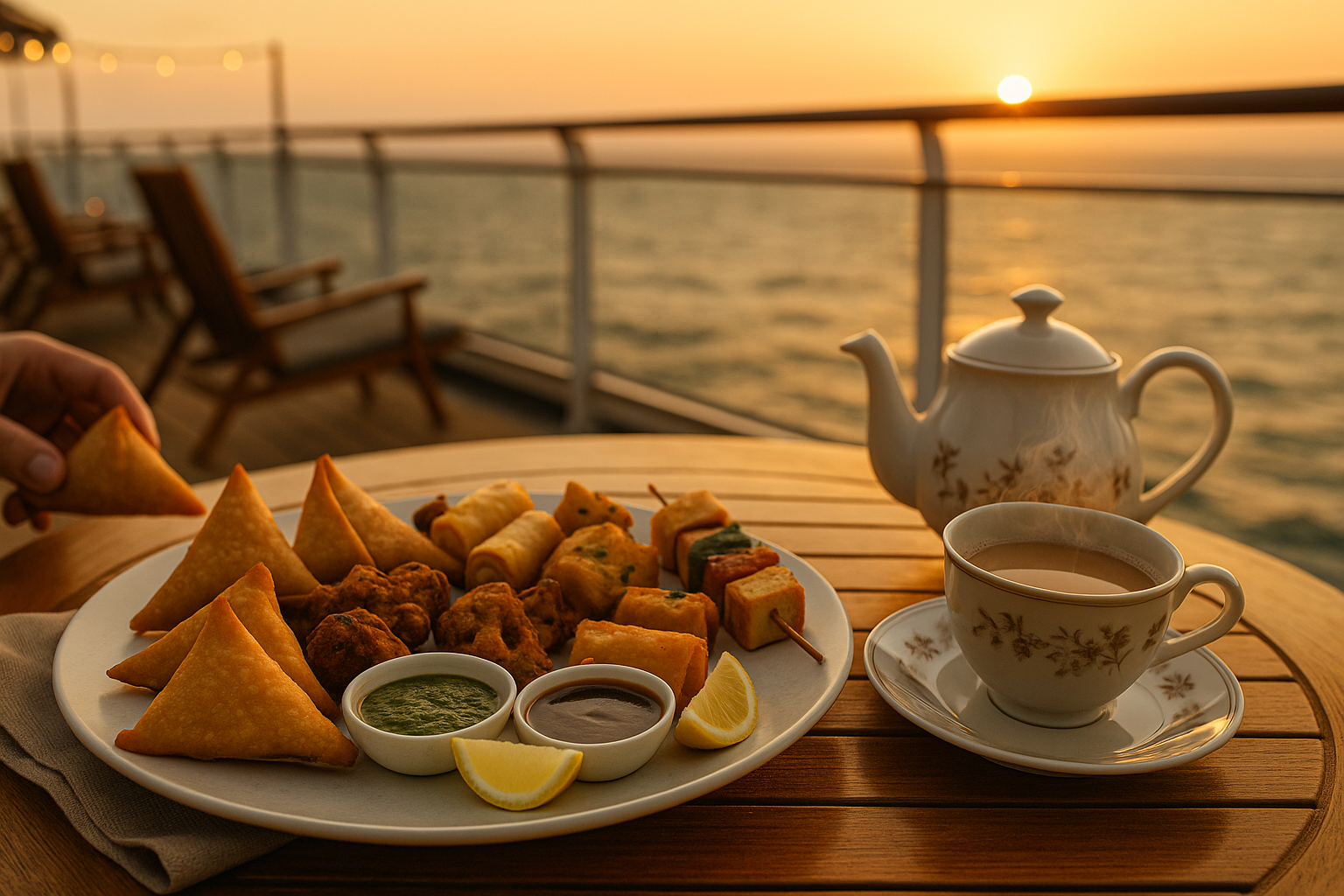
Indian offerings appear across venues: complimentary main dining rooms, buffet/Windjammer‑style stations (including Indian‑theme nights), paid specialty restaurants, and sometimes as evening high tea or snack service with samosas, pakoras and masala chai. Buffets often run dedicated Indian stations or "Indian night" evenings; Royal Caribbean and Norwegian frequently expand buffet offerings for Indian cuisine. Specialty restaurants typically deliver deeper, tandoor‑focused authenticity for a fee; main dining provides fewer, milder included options.
Vegetarian, vegan and many Jain requests are accommodated; special meals should be requested at least 48 hours before sailing and dining staff onboard should be notified. Some ships offer dedicated Indian venues — for example, Masala Tiger on Carnival Splendor is tandoor‑focused (tandoori meats, naan, biryani, butter chicken, chutneys and masala chai) with a complimentary rotating lunch buffet and a paid à la carte dinner (sample mains cited around $15 with premium items up to about $38). Availability can be confirmed via the ship dining page or PDF menus, by reviewing the booking or itinerary, or by contacting the cruise line or a travel agent.
Common Indian dishes in the main dining room on cruise ships
Main dining rooms on many cruise lines present familiar, mild-to-medium Indian staples in complimentary service: curries such as butter chicken and chicken curry, dal, biryani, and vegetarian mains accompanied by rice and naan. Menus rotate, and some ships feature Indian-themed nights or dedicated buffet stations; Royal Caribbean commonly lists Indian curries daily in the main dining room and Windjammer. Ship daily menus and onboard apps list the exact dishes scheduled for each sailing.
Typical main-dining Indian dishes (examples: butter chicken, dal, biryani, curries)
Expect butter chicken, chicken curry, tadka dal, vegetable biryani and mild curries in the complimentary main dining room.
Common examples include:
- Butter chicken — creamy, tomato-based curry served mild-to-medium and paired with basmati rice or naan.
- Chicken curry / korma — lightly spiced, stew-style entrées prepared in a homestyle method.
- Tadka dal / dal makhani — lentil-based sides or mains, usually seasoned but not fiery.
- Vegetable biryani — layered rice dish with vegetables and mild aromatics.
- Naan/roti and steamed basmati rice as standard accompaniments.
Preparation is usually toned down to mild-to-medium heat to suit a broad audience; Royal Caribbean and other lines commonly temper spice levels.
Regional dishes commonly found (North, South, coastal, and street-food examples)
Regional items appear on rotating menus and during themed nights.
- North — butter chicken, paneer dishes (paneer tikka, saag paneer), aloo gobi: dishes are often creamy or tandoori-style.
- South — dosa, sambar, idli: South Indian dishes commonly feature during specialty events and breakfast service.
- Coastal — prawn and fish curries, Malabar-style dishes: seafood curries reflect coastal recipes and are frequent on seafood nights.
- Street-food/snacks — samosa, chaat, pani puri: snack items are commonly offered in buffets or at themed evenings.
Availability varies by ship, itinerary, and evening.
Are vegetarian, vegan, or Jain Indian options available in the main dining room?
Vegetarian, vegan, and frequently Jain meals are accommodated in the complimentary main dining room. Vegetarian mains (dal, aloo gobi, paneer, vegetable biryani) commonly appear on daily menus; vegan options may be available, but ingredients and preparation methods vary by line and by dish. Advance requests for special meals are typically accepted; many lines advise submitting custom-meal requests at least 48 hours before sailing. Requests can be made to the head chef or dining staff once onboard. Menus are sometimes labeled for vegetarian items; confirmation of preparation methods with dining staff is recommended.
How are Indian offerings served onboard (main dining, buffet stations, specialty venues, and high tea)?
Indian food appears in main dining rooms, buffet/Windjammer-style stations (including theme nights), paid specialty restaurants, and sometimes as evening high tea/snack service with samosas and pakoras. Expect complimentary, milder Indian entrees in the main dining room; buffet/Windjammer-style stations often feature rotating Indian items or an "Indian night"; specialty venues provide deeper, paid menus; and some ships offer Indian snacks and chai during tea or evening events.
Buffet and Windjammer-style stations — what to expect and which lines commonly feature them
Buffet/Windjammer-style stations often host dedicated Indian stations or themed "Indian night" evenings, and Royal Caribbean and Norwegian frequently expand buffet offerings for Indian cuisine. On those nights, the buffet/Windjammer-style spread may include multiple curries, rice, chutneys, breads, and a strong selection of vegetarian dishes; "Indian night" often appears on Windjammer menus on Royal Caribbean, and Norwegian buffets are frequently reported to include a dedicated Indian section.
Specialty Indian restaurants vs main dining — authenticity, menu depth, and pricing
Specialty Indian restaurants typically offer deeper, more authentic menus for a fee. Main dining rooms provide fewer, milder complimentary Indian options. Specialty venues commonly feature tandoor cooking and fuller à la carte selections (Carnival’s Masala Tiger, for example, offers included lunch but a paid dinner menu). Specialty chefs and dedicated venues increase regional variety and authenticity; main dining offerings tend to be broadly palatable and less regionally specific.
Evening high tea and snack service — samosas, pakoras, masala chai and service context
Evening high tea may include samosas, pakoras, and masala chai served in a lounge or during a scheduled tea/snack service. High tea may be offered as a complimentary shipboard event or as part of a paid specialty or themed event depending on the ship; high tea should be checked on the daily schedule or app for exact times and whether snacks are included.
Which cruise lines offer dedicated Indian restaurants onboard?
Some cruise lines offer dedicated Indian restaurants on select ships; examples include Carnival’s Masala Tiger and Indian-focused venues or expanded Indian menus on select Royal Caribbean, Celebrity, Norwegian, and Princess ships. Availability is ship-specific rather than fleetwide.
Lines and notable venues (examples and one-line description per venue)
Several lines offer dedicated Indian venues or pronounced Indian offerings on select ships; examples include:
- Carnival — Masala Tiger: a tandoor-focused specialty venue that Carnival’s Masala Tiger page lists as “Available on” specific ships; independent reports note Masala Tiger service on Carnival Splendor, with a tandoor menu and a mix of complimentary lunch and optional paid dinner.
- Royal Caribbean — Main Dining/Windjammer Indian nights on select ships: Indian entrées commonly appear in the Main Dining Room and the Windjammer buffet, with occasional Indian-themed buffet nights rather than a fleetwide stand‑alone Indian specialty restaurant.
- Celebrity — Indian menus on select ships: Celebrity offers elevated Indian dishes and regional/vegetarian options on some ships as part of specialty or main-dining programming rather than a guaranteed fleetwide dedicated restaurant.
- Norwegian — Buffet and specialty options on select ships: Norwegian often features Indian stations in the buffet and Indian choices in main dining on some ships, rather than a consistently available dedicated Indian specialty restaurant fleetwide.
- Princess — Buffet/main-dining Indian stations on some ships: Princess ships frequently include Indian selections in the Horizon or buffet and on rotating menus on certain ships rather than a guaranteed dedicated venue across the fleet.
How reservation and pricing models typically work for dedicated Indian restaurants
Dedicated Indian venues commonly provide a complimentary lunch buffet and charge for a specialty à la carte dinner; reservations are commonly recommended. Masala Tiger is described by independent sources as offering lunch included in the cruise fare and an optional paid dinner service, with main-course dinner prices commonly around $15 and premium items up to $38. Variations occur by ship: lunch may be part of standard dining; dinner may operate as a specialty venue with cover or à la carte pricing and a reservation or walk‑in policy set by each ship.
How to check if a specific ship has a dedicated Indian restaurant
Ship-level availability can be verified by consulting official ship dining pages, ship PDF menus, the booking or itinerary, or by contacting the cruise line or the booking agent.
Verification steps:
- Consult the cruise line’s “All Dining Options” or the ship-specific dining page for the vessel in question (Carnival’s Masala Tiger page provides an example of listed availability).
- Download ship-specific PDF menus or the dining guide from the ship page and search for venue names or keywords such as “Indian,” “Masala,” or “tandoor.”
- Review booking or itinerary entries in the cruise app or passenger portal for listed specialty restaurants and reservation options.
- Contact the travel agent or cruise line customer service to confirm current availability and any reservation or pricing details.
For a broader overview of Indian offerings across cruise lines and what to look for, see Cruises with Indian Cuisine: What to Expect Onboard for Indian Travelers.
How to find and access Indian dishes and request special diets (menus, apps, pre-orders)
Most ships publish real‑time menus in the cruise-line app and at dining venues; these indicate scheduled Indian dishes. Special meals typically require pre-ordering at least 48+ hours before sailing via the booking portal or the dietary request form. Onboard dining staff or the head chef may be notified during boarding to confirm and implement Jain, vegan, or other restricted-diet requirements.
How to pre-order custom Indian or Jain meals (timing, required details, and expectations)
Special Indian or Jain meals are typically requested at least 48 hours before sailing via the booking portal or the dietary form; requests may be submitted by telephone to customer service. Include booking reference, contact information, allergies, strict ingredient exclusions, preferred spice level, and the label "Jain" when applicable.
Pre-cruise and onboard steps:
- Pre-cruise: submit the request through the booking portal, dietary form, or customer service phone line; provide booking reference and contact details to allow linkage to the reservation.
- Pre-cruise: allow a minimum of 48 hours lead time to enable the galley to source ingredients and plan preparation.
- Onboard: on embarkation day, notify dining staff and reconfirm the pre-order; servers typically verify receipt with the galley.
- Onboard: if immediate fulfillment is not possible, standard escalation is to the head chef or dining manager; the galley may prepare adapted dishes when feasible, but availability varies by ship and itinerary.
Using cruise apps, daily menus, and talking to dining staff or the head chef
Cruise apps and printed daily menus list scheduled Indian dishes and themed offerings. When an item is not listed, serving staff can be asked to check the galley for availability of unlisted items. Escalation to the head chef or dining manager is appropriate for specialized Jain, allergy‑sensitive, or complex custom requests; use established dining channels (server, guest services, or dining desk) to submit such requests.
Menu rotation and Indian-themed event nights — when authenticity and variety typically increase
Menu rotations and Indian-themed nights typically increase authenticity and variety—"Indian night" in buffets or main dining may feature expanded regional dishes and street‑food snacks.
Cruise lines use menu rotations and themed events to concentrate more authentic Indian options on specific nights, and Indian night often brings additional regional dishes, chaats, samosas, and other snack‑style offerings that don't appear on regular menus. These themed nights may vary by ship and itinerary, but they typically offer the best chance to find greater variety and more authentic preparations.
Which cruise lines offer the best Indian food onboard?
Cruise lines can be evaluated using four criteria: authenticity, menu variety, presence of dedicated venues or chefs, and value. Authenticity and chef expertise indicate how closely dishes reflect regional Indian flavors; menu variety and dedicated venues indicate the frequency and breadth of Indian offerings; value considers whether Indian meals are included in the fare or incur an extra charge. Offerings vary by ship and itinerary; verify a specific ship's dining roster to confirm available Indian options before finalizing travel arrangements.
Criteria to judge authenticity, menu variety, chef expertise, and value
Assessment criteria for Indian cuisine onboard include authenticity, menu variety, presence of dedicated venues or trained Indian chefs, frequency of Indian-themed events, and price/value balance.
Scoring and weighting criteria:
- Authenticity — Evaluate ingredient sourcing, regional dishes offered, and inclusion of recognizable items (for example, butter chicken, dosa, biryani). Assign higher scores when dishes reflect identifiable regional techniques and spice profiles.
- Menu variety — Assess availability across outlets (main dining room, buffet, specialty restaurant) and inclusion of vegetarian, vegan, and Jain options.
- Dedicated venues & events — Record presence of a dedicated Indian restaurant or regular Indian-theme nights; such features indicate a deeper commitment to Indian cuisine.
- Chef expertise — Favor ships with trained Indian chefs and chef-led demonstrations, which tend to improve authenticity and consistency.
- Price & value — Account for whether Indian lunches or buffet stations are included and whether specialty dinners carry extra fees; give greater weight to included offerings for value evaluations.
Trade-offs: price, ship-to-ship variation, and specialty vs complimentary offerings
Specialty restaurants typically offer greater authenticity at an additional cost; complimentary options vary by ship and are often milder but included in the fare.
Specialty venues commonly present deeper regional flavors and chef-driven menus and frequently require a cover charge or à la carte pricing. Complimentary main-dining and buffet stations may feature Indian dishes daily or during themed nights; recipes are often adjusted to milder spice levels for a broad audience and can differ markedly between ships. Carnival's Masala Tiger has provided an included lunch buffet on some vessels and a paid dinner service on others, illustrating the included-versus-paid trade-off. Verification of a ship's dining options and reservation requirements is recommended; specialty dining typically requires advance booking, particularly for passengers seeking authentic regional dishes.
Masala Tiger — a ship-specific example (Carnival Splendor)
Masala Tiger on Carnival Splendor is Carnival's tandoor-focused Indian specialty with complimentary lunch (rotating buffet) and paid à la carte dinner featuring tandoori, curries, chutneys and masala chai.
Which Carnival ships currently have Masala Tiger?
Masala Tiger is listed on Carnival Splendor. Carnival's official "AVAILABLE ON" listings and independent ship dining guides identify Carnival Splendor as hosting Masala Tiger; availability is subject to change. Refer to Carnival's Masala Tiger page or the specific ship's dining guide for the most recent ship-level information.
Masala Tiger's signature dishes and tandoor cooking methods
Masala Tiger's signature dishes include tandoori chicken/fish, kebabs, naan, biryani, butter chicken and masala chai; the tandoor (traditional clay oven) imparts char and smoky flavor and Carnival describes the tandoor as cooked at over 1000 degrees.
Below are signature menu items and method notes:
- Tandoori meats: tandoori chicken and fish, kebabs and skewers — cooked in the tandoor for char and a smoky finish.
- Breads and accompaniments: hot naan (including garlic naan), paratha, chutneys and raita for dipping and balance.
- Curries and mains: butter chicken (murgh makhani), Malabar prawn curry, biryani and regional-style stews with basmati rice.
- Street-food and starters: pani puri, samosas, chaat variations and lamb galawati or seekh kebabs as starters.
- Sides and vegetables: tadka dal, gunpowder potatoes and vegetable biryani or Punjabi chana/rajma options for vegetarians.
- Desserts and drinks: kulfi, gulab jamun and masala chai to finish.
The tandoor method (traditional clay oven) creates higher-heat searing, smoky aromas and slightly charred edges that shape both flavor and rustic presentation.
Is lunch included and is dinner an extra-cost specialty at Masala Tiger?
Lunch at Masala Tiger is included as a daily rotating buffet. Dinner is an extra-cost sit-down à la carte service. Independent menu guides indicate the lunch buffet is complimentary with the cruise fare; dinner is offered as a paid specialty menu (sample mains reported around $15, premium items up to about $38). Passengers should confirm current prices and service format onboard or via Carnival's official dining information.