This page defines "Cruise" — specifically cruise travel and cruise ship travel — and explains how on‑board dining environments, operations and passenger actions affect allergy risk and accommodation when dining on Indian, vegetarian, and Jain cuisine.
Main onboard venues are the main dining room, buffet/Lido, specialty restaurants and room service; cook‑to‑order venues pose lower risk while buffets pose higher risk. The main dining room is an assigned‑table, cook‑to‑order environment where a head waiter and the kitchen can adapt meals, so it is generally easiest to manage allergies. Buffets and Lido decks carry higher cross‑contamination risk because food is self‑serve, utensils are shared and dishes rotate; specific mechanisms include shared utensils, reused tongs, salad bars, drifting crumbs and station swaps. Room service is often cook‑to‑order and may be low‑to‑moderate risk when the kitchen is informed.
Cruise lines typically ask about allergies at booking and again before sailing and route requests to a special‑diet or accessibility team; onboard the head waiter meets the chef to plan and label special meals. You should notify the line as early as booking—many lines recommend 30–45 days' notice and complex or kosher requests may need up to 90 days—and you should carry personal epinephrine and sufficient medications because ship medical centre capacities and stocks vary.
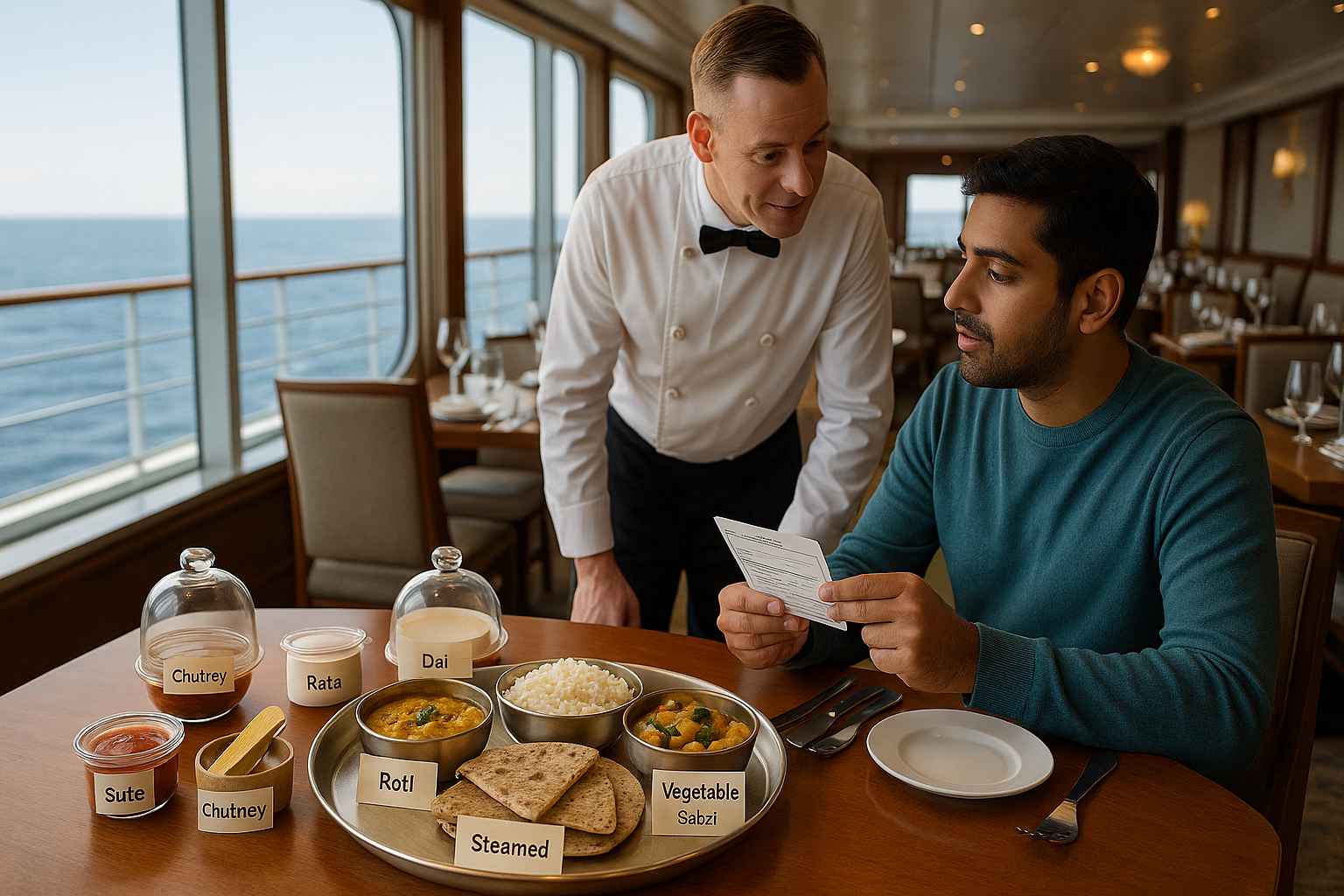
What are the main dining options on a cruise and how do they affect allergy risk?
Main venues—main dining room, buffet/Lido, specialty restaurants and room service—vary by control: cook-to-order = lower risk; buffet = higher risk.
The main dining room is an assigned-table, cook-to-order environment where a head waiter and kitchen can adapt meals, so it is generally easiest to manage allergies. Buffets and Lido decks carry higher cross-contamination risk because food is self-serve, utensils are shared and dishes rotate. Specialty restaurants can be adapted but practices vary by venue and cruise line; room service is often cook-to-order and may be low-to-moderate risk when the kitchen is informed. Major lines such as Disney Cruise Line and Royal Caribbean train dining teams and commonly advise advance notification and a meeting with dining staff on embarkation day to reduce risk.
Which onboard dining venues are safest for guests with food allergies?
Main dining room and room service are generally safest; specialty restaurants vary; buffet/Lido is highest risk.
Compare how much kitchen control exists and whether food is self‑serve—those factors drive cross‑contamination risk.
- Main dining room — assigned-table, cook-to-order environment; lower risk because the head waiter and chef can modify recipes and plan safe preparation.
- Buffet / Lido deck — higher risk due to shared utensils, open stations and frequent dish changes; buffet users should speak to a chef or station attendant before eating.
- Specialty restaurants — variable risk: many kitchens adapt after advance notice, but safety depends on the restaurant and cruise line practices.
- Room service — low-to-moderate risk: often cook-to-order with limited menus; safer when you notify the kitchen and confirm ingredient handling.
How should I choose between main dining, buffet, specialty restaurants and room service?
If you have severe allergy you should choose cook-to-order main dining or room service and avoid the buffet/Lido.
Main dining should be your first choice because the assigned-table system and head waiter let the kitchen adapt meals and reduce cross-contact. You should notify the cruise line at booking and again before sailing, and request a meeting with the head waiter or maitre d' on embarkation day so the chef can review your needs and preview menus. You should avoid buffet stations when cross-contamination matters; if you must use the buffet, speak to the station chef to verify ingredients. You should use specialty restaurants only after confirming chef access and giving advance notice, and you should carry documentation and emergency medication and reconfirm arrangements daily.
What is cross-contamination — and why are buffets higher risk on cruise ships?
Cross‑contamination is transfer of allergens via utensils, hands, airborne crumbs or shared surfaces; buffets increase those transfer points, raising exposure risk. Cross‑contact is used interchangeably with cross‑contamination in food‑allergy guidance.
Shipboard safety policies and passenger behavior focus on preventing that transfer. Kitchens and dining teams aim to limit shared touchpoints so allergens do not hitch a ride from one dish to another. Main dining rooms allow more control because waitstaff and a dedicated kitchen can prepare plated meals with fewer transfer points, while buffets create open, multi‑station environments where the same utensils, hands, or drifting crumbs can move allergens between offerings. Cruise lines and travel guides encourage advance notification of allergies and direct communication with station chefs because verification is the primary mitigation step you can rely on at sea. You should prioritise verification, hand hygiene, and chef‑served or pre‑packaged alternatives when buffet conditions are ambiguous.
What specific buffet practices cause cross-contact and how can I avoid them?
Shared utensils, reused tongs, salad bars, drifting crumbs and station swaps cause cross‑contact; you should avoid unverified dishes, ask a chef, and use packaged or chef‑served options.
The following buffet mechanisms create transfer points and how to avoid them:
- Shared utensils: Guests or staff can use the same spoons or ladles across dishes. Avoid any dish where serving utensils are shared and ask a chef to confirm if separate utensils were used.
- Reused tongs: Tongs commonly move between proteins, breads, and salads. Do not trust tongs that appear to have been used across plates; request the chef plate the food or use packaged items instead.
- Salad bars: Loose toppings, dressings, and shared scoops permit crumbs and oils to transfer allergens. Choose single‑ingredient items you can verify or ask the station chef to prepare a salad for you.
- Drifting crumbs and airborne contact: Open displays and nearby dessert stations can deposit crumbs onto otherwise safe items. Inspect plates and serving areas and favour sealed or individually portioned options when available.
- Station swaps and frequent dish changes: Staff may replace or refill items without updating labels, causing unpredictability. If ingredients are unclear, ask a chef and avoid dishes you cannot verify.
Are there quick checks I can do before serving myself at a buffet?
Quick checks: look for clear ingredient labels, watch whether tongs or spoons are swapped between dishes, ask the station chef for ingredient details, and avoid unlabeled items.
Before you serve yourself, scan labels and posted ingredient lists and watch how utensils are handled — if a spoon or tong moves between two different foods, that dish may be cross‑contaminated. Ask the station chef to confirm preparation methods and to plate or prepare the item separately if possible; allergy‑travel guides and Cruise Critic recommend speaking with buffet chefs or senior staff when in doubt. You should also check whether staff are nearby (they can swap utensils or plate for you), choose items that are isolated from busy stations, and avoid unlabeled or frequently refilled dishes. Ask the chef and, if you remain unsure, skip it.
How do cruise ships typically accommodate food allergies?
Cruise ships accommodate allergies through advance notification, dining‑team coordination (head waiter and chef), special meal preparation, labeling and sometimes dedicated menu items.
Most major cruise lines ask about allergies at booking and again before sailing and route requests to a special‑diet or accessibility team. Onboard, the dining team — led by the head waiter — meets the chef to plan and prepare safe options, label approved plates, and offer alternatives in the main dining room or via room service. Guests should notify the line early, confirm notes at embarkation, and use the head waiter as their daily point of contact.
What should I include when notifying a cruise line about my dietary needs?
Include specific allergens, cross‑contact sensitivity, emergency medications and dosages, a doctor/prescription letter, and contact details.
You should include the following in your pre‑cruise notification:
- Every specific allergen (for example: peanuts, tree nuts, shellfish, dairy, gluten, sesame).
- Whether trace amounts and cross‑contact are dangerous to you (i.e., “must avoid traces/cross‑contact”).
- Severity of past reactions and whether you carry epinephrine and antihistamines.
- A doctor’s letter or prescription explaining the medical need.
- Reservation/booking reference and preferred contact phone/email.
- Any preferred accommodations (e.g., gluten‑free bread, separate plating, avoid shared fryers).
- A note that you will request to meet the head waiter on embarkation day and will bring printed copies of this information.
Sample request wording (neutral, copyable):
Hello — I have the following food allergies and cannot eat even trace amounts: specific allergens: [list]. I am sensitive to cross‑contact and carry emergency medication (epinephrine auto‑injector and antihistamine); a doctor’s letter is attached. Please add this to reservation [number] and arrange for me to meet the head waiter on embarkation day to review menus. Thank you, [Name, phone, email].
How will the dining team coordinate meals for guests with allergies (head waiter, chef, labeling)?
Dining teams coordinate via an embarkation meeting where the head waiter and chef plan special meal preparation, label special meals, and manage cross‑contact procedures.
On embarkation day the head waiter typically meets allergy passengers to record restrictions and relay them to the chef; the chef then plans special meal preparation and assigns kitchen staff to avoid shared equipment when possible. The head waiter acts as the liaison each night, reviewing the next day’s menu with the chef, arranging substitutions or dedicated dishes, and ensuring approved plates receive clear labeling in the galley or dining room. Guests should ask to meet the head waiter and confirm that the chef has noted their dietary needs.
What should I look for in ingredient labeling and menu transparency?
Expect basic allergen labeling in main dining rooms and buffets; when labels are incomplete, ask the chef about hidden ingredients and cross‑contact practices.
Labeling practices vary by cruise line: you may see allergen icons, “contains” ingredient lines, or gluten‑free/dairy‑free markers on buffet cards and menus. If a label is missing details, you should ask the server or ask the chef directly which ingredients and cooking methods are used and whether a dish is prepared in a shared area (shared fryers, pans, or utensils). If transparency is still unclear, request the chef prepare an alternative under special meal preparation protocols or choose a made‑to‑order option in the main dining room rather than self‑serve buffet items.
Advance notification and timelines: how far ahead should I tell the cruise line?
Notify the line as early as booking; typical lead times range 30–90 days depending on the line; always reconfirm before embarkation and on‑board.
Cruise policies vary: many lines accept 30–45 days' notice for routine requests, while complex orders or kosher meals may need up to 90 days. Early notification gives kitchens time to source ingredients and plan safe preparation.
Recommended lead times and quick per-line examples (30–90 days)
Typical lead times: 30–45 days for many mainstream lines; 45–90 days for complex or kosher requests.
Below are typical numeric ranges and one‑line examples to set expectations.
- Typical example: Carnival — often flexible; contact customer service or special needs on embarkation day.
- Typical example: Holland America — about 3 weeks' notice is common.
- Typical example: Princess — around 35 days' notice is recommended.
- Typical example: Celebrity — about 45 days' notice is recommended.
- Typical example: Royal Caribbean — many recommend notifying at least 45 days in advance.
- Typical example: Kosher meals — often require 90 days' notice.
How to document and reconfirm your request before embarkation
Document via the cruise line’s dietary form or email; save confirmations, add requests in the line app, and reconfirm at check‑in and with the head waiter onboard.
Fill any dietary request form the line provides and email the special needs or accessibility team so you have a written record. Save or screenshot confirmations and enter the same details in the cruise line app if available. You should call or follow up a few weeks before sailing to confirm the request remained in your booking.
At embarkation, you should stop by guest services or the dining office and request a meeting with the head waiter or maitre d' on your first evening. Bring printed summaries or a letter from your GP/allergist and any emergency medication, and save the dining team's contact details so you can reconfirm with each new restaurant or specialty venue.
Choosing the right cruise line: how policies and dedicated protocols differ
Lines differ: some (Disney, NCL, Royal Caribbean) have stronger allergy workflows and dedicated options; choose lines with documented allergy support when you have severe or multiple allergies.
Cruise lines vary in how they document, staff for, and physically separate allergen‑safe cooking. Some operators emphasize high-touch service and repeated staff contact in main dining rooms, while others may offer dedicated gluten‑free prep areas or formal pre‑cruise dietary forms. Travelers with anaphylaxis or multiple allergens should prioritize lines with documented allergy workflows and confirm arrangements well before embarkation.
Which cruise lines are known for strong allergy policies and what makes them different?
Several major lines are known for stronger allergy policies; compact per-line summaries follow.
The following bulleted list summarizes lines and their notable strengths.
- Disney Cruise Line — reputed for high-touch allergy service; main dining rooms are known for personalized coordination between waitstaff and chefs.
- Royal Caribbean — reputed for broad allergy options; the line commonly provides dedicated allergy-friendly menu items and may request advance notice (often recommended well before sailing).
- Norwegian Cruise Line (NCL) — reputed for gluten‑free/dedicated-area approaches; some NCL reports note dedicated gluten‑free prep areas that can reduce cross-contact.
- Carnival Cruise Line — reputed for accessible accommodations for gluten‑free and other diets; the line directs guests to complete pre-cruise dietary forms to prepare kitchens.
- Celebrity Cruises — reputed for plant‑based and gluten‑free menu options and clear dining communication to adapt dishes for restrictions.
Do dedicated allergy/gluten‑free kitchens and separate prep areas reduce cross-contact?
Dedicated kitchens and separate prep areas can reduce cross‑contact risk, but they are relatively uncommon and not universal across fleets.
A dedicated facility physically separates allergen handling and therefore lowers the chance of accidental transfer; Norwegian Cruise Line is cited as an example where dedicated gluten‑free areas are used. However, dedicated kitchens are rare and may be limited to certain ships or venues. Well‑implemented standard procedures — thorough staff training, head‑waiter coordination, separate plating, and strict cleaning protocols — can also meaningfully reduce cross‑contact when dedicated spaces are unavailable. Travelers should confirm whether a specific ship offers dedicated prep areas or relies on procedural controls before booking.
Reassurance options: galley tours, meeting the chef, and on‑board verification
Yes — passengers can request galley tours, meet the chef, and other on‑board verifications, and these steps are especially helpful for severe allergies or first‑time cruisers.
Passengers can request the following reassurance actions.
- Request a galley tour to see prep areas and ask how allergens are segregated — helpful for severe allergies or when you need visual confirmation.
- Meet the chef or head waiter on embarkation day to explain allergens and establish a daily communication routine — useful to prevent misunderstandings.
- Ask to preview the next day’s menu and have the chef confirm ingredients or propose substitutions — helpful for planned, repeated dining.
- Ask buffet or station chefs to verify ingredients at each visit and request labeled or separately plated items when possible — useful if you must use self‑serve venues.
- Preorder meals, snacks, or special‑ingredient items before sailing so the ship can stock and prepare safe alternatives — helpful for less common or strict dietary needs.
Emergency medical support and what to pack before you sail
Ships have medical centres but capacities vary; travellers should carry personal epinephrine, sufficient meds, prescriptions, and emergency contacts.
Ship medical centres provide emergency care and common medications, but onboard resources and stock levels vary by line and ship. You should treat the ship’s medical centre as backup rather than your primary source for life‑saving prescription items. Notify the cruise line about severe allergies or medical needs before sailing and confirm in writing so the dining and medical teams are aware.
Do cruise ships carry epinephrine (EpiPen) and should I rely on ship medical supplies?
Ship medical centres may have emergency treatments but availability varies; you should carry your own EpiPen and not rely solely on ship supplies.
Most cruise ships have a medical centre staffed to handle emergencies, but lines differ in what they stock and how quickly they can access additional supplies. Travellers should bring at least one personal epinephrine auto‑injector (EpiPen) per person with a history of anaphylaxis, check expiry dates before travel, and carry a medical alert and written instructions. Also contact your cruise line to confirm any on‑board policies and availability, but plan to self‑supply.
What should I include in my personal emergency kit and medication plan?
Include epinephrine, antihistamines, extra prescriptions, a physician letter, photocopies of prescriptions, emergency contacts, and travel insurance details.
Include the following items in your carry‑on emergency kit:
- Epinephrine auto‑injector(s) in date and a spare if possible
- Oral antihistamines (e.g., cetirizine or loratadine)
- Extra prescription medication (at least enough for the trip plus a few days) in original containers
- A physician or allergist letter describing conditions, medications, and dosing instructions
- Photocopies of prescriptions and a list of generic drug names
- Travel insurance policy number and emergency medical contact information
- A small first‑aid kit (bandages, antiseptic wipes) and upset‑stomach remedies if you have celiac or similar issues
- Sealed, shelf‑stable “safe” snacks that match your dietary needs
- A medical alert bracelet or card and a translated allergy card for ports if needed
You should keep medications in your carry‑on, store EpiPens at recommended temperatures, and inform your head waiter and medical centre on embarkation day. Carrying a physician letter helps onboard staff and foreign medical providers understand your needs.
Can I bring my own food onboard and what emergency snacks are allowed?
You can usually bring non‑perishable, sealed snacks, but policies vary by cruise line; check before packing perishable or prepared foods.
Many lines permit factory‑sealed, shelf‑stable snacks for medical or dietary reasons, while perishable, refrigerated, or prepared foods are often restricted. For excursions and days ashore, pack single‑serve, non‑perishable items (protein bars, individually wrapped crackers, dried fruit) in your daypack, and include travel‑size sanitizing wipes to clean surfaces before eating. Always verify your cruise line’s specific food policy before you sail and declare medically necessary foods at embarkation.
Indian cuisine, vegetarian and Jain guidelines — requesting pure‑veg service and preventing cross‑contact
Request "pure vegetarian" or "Jain" meals in writing at booking and again onboard; specify Jain = no onion, no garlic, no root vegetables, and insist on no cross‑contact with meat or ghee.
Make a written record with the cruise line's special/dietary team, meet the head waiter or chef on embarkation, and present a chef card each meal.
How do I request a 'pure vegetarian' or 'Jain' meal — exact wording and templates?
Request "Pure vegetarian (no meat, fish, eggs) / Jain (no onion, no garlic, no root vegetables)" in writing at booking and reconfirm on board; also state "no cross‑contact with meat or ghee."
Use the following ready-to-use phrases when booking, emailing, or speaking to dining staff; keep printed copies and show them at check‑in and to the head waiter.
Sample:
- Booking / email subject: Special dietary request — Pure vegetarian / Jain
- Booking / email body: "Dear Special Diets team — Please note a dietary requirement for reservation [Booking reference]. Guest requires: Pure vegetarian (no meat, fish, eggs). For Jain meals: no onion, no garlic, no root vegetables. Please ensure no cross‑contact with meat, fish, or ghee during preparation and plating. I will meet the head waiter on embarkation day to review. Thank you."
- Onboard reconfirmation (short): "I have a Pure vegetarian / Jain meal request on my booking. Jain = no onion, no garlic, no root vegetables. Please confirm kitchen will avoid ghee and any cross‑contact with meat."
- Chef card (print and hand to chef/head waiter): "PURE VEGETARIAN — NO MEAT, NO FISH, NO EGGS. JAIN: NO ONION, NO GARLIC, NO ROOT VEGETABLES. NO GHEE. AVOID CROSS‑CONTACT WITH MEAT/SEAFOOD (separate utensils, pans, oil). Contact passenger [name] at table [#]."
- Verbal script when meeting head waiter/chef: "Hello, I have a pure‑vegetarian/Jain request on my booking. For Jain meals: please no onion, no garlic, no root vegetables. I request separate plating and utensils and no use of ghee. May I show you my chef card and review tomorrow's menu?"
You should bring multiple printed chef cards, upload requests to the cruise app if available, and follow up in person on embarkation day.
For full procedural guidance and to submit advance requests, see Requesting Special Dietary Meals on Cruises: Indian, Vegetarian, Jain, and Vegan Food Requests.
Operational measures for pure‑veg/Jain diners: separate prep, utensils, and service feasibility
Ships can usually provide separate plating, dedicated utensils, and labeled service; fully separate kitchens are rare.
Main dining rooms commonly accommodate tailored meals by assigning a head waiter and notifying the galley; chefs can prepare items in a cleaned area or use dedicated utensils and a labeled plate for service.
Feasible measures include dedicated plating and labeling, using fresh or cleaned utensils and pans, preparing a meal on request in a cleared workspace, and routing service through the main dining room rather than the buffet. Specialty restaurants and the galley can often isolate preparation steps, and some lines offer a chef meeting or galley tour for reassurance. Fully separate kitchens or permanently segregated cooking lines for pure‑veg/Jain diners are rare and may not be available; buffets carry higher cross‑contact risk and may not meet strict Jain requirements.
You should request these measures at booking and again with the head waiter on embarkation night so the kitchen can plan staffing and ingredient sourcing.
Indian-cuisine specific allergens and how to ask about ingredients
Common Indian-ingredient risks include ghee (clarified butter), tree nuts and peanuts, mustard, asafoetida (hing), and hidden fish/shellfish (fish sauce, shrimp paste), plus shared‑oil frying and tandoor cross‑contact.
Be proactive: ask precise questions about ingredients and cooking methods before you eat.
Ask the following specific questions to verify a dish is safe:
- "Is ghee or any butter used in this dish or during cooking?"
- "Does this dish contain nuts or nut pastes (almond, cashew, pistachio)?"
- "Is mustard or mustard oil an ingredient?"
- "Was asafoetida (hing) used in the seasoning?"
- "Does this include fish sauce, shrimp paste, or any seafood stock?"
- "Was this fried in a shared oil or fryer used for meat or seafood?"
- "Was this cooked on or near a tandoor or griddle that also cooks meat?"
- "Can the chef prepare this separately and use clean utensils and fresh oil?"
You should ask these questions every time you order, especially at buffets and specialty counters; if the answer is uncertain, request the chef prepare a separate dish to avoid hidden allergens or cross‑contact.