Cruise cabins are the hierarchical categories (Inside/Interior, Oceanview/Outside, Balcony/Verandah, Suite) that cruise lines use to classify staterooms by layout, amenities, deck location and price, and this guide explains cabin types, location tradeoffs, pricing modifiers and booking mechanics tailored to Indian families (including vegetarian and Jain dining needs).
Inside cabins typically measure about 130–185 sq ft and prioritise compact layouts and basic storage. Oceanview cabins typically measure about 150–220 sq ft and add a fixed window or porthole for natural light. Balcony cabins typically measure about 175–275+ sq ft (including the balcony) and include a private outdoor seating area accessed by sliding doors. Suites vary widely by ship and line and can include separate living areas, larger closets, expanded bathrooms and extra perks.
The price order is Interior < Oceanview < Balcony < Suite. On a typical 7‑night cruise, a balcony commonly costs roughly $800 to $2,000 more per cabin than an interior. Midship cabins on lower decks minimise motion and reduce roll and sway. A guarantee cabin sells a category but not a specific room; the line usually assigns the exact cabin a few weeks before sailing.
Families should book connecting cabins, family suites or two cabins for space and extra bathrooms. Solo travellers can seek studio/solo cabins to avoid single‑supplement penalties. Travellers with reduced mobility should request accessible cabins with roll‑in showers, grab rails, wider doors, lowered fixtures and proximity to elevators. Read on to match these facts to your family’s budget and onboard needs when you choose and book.
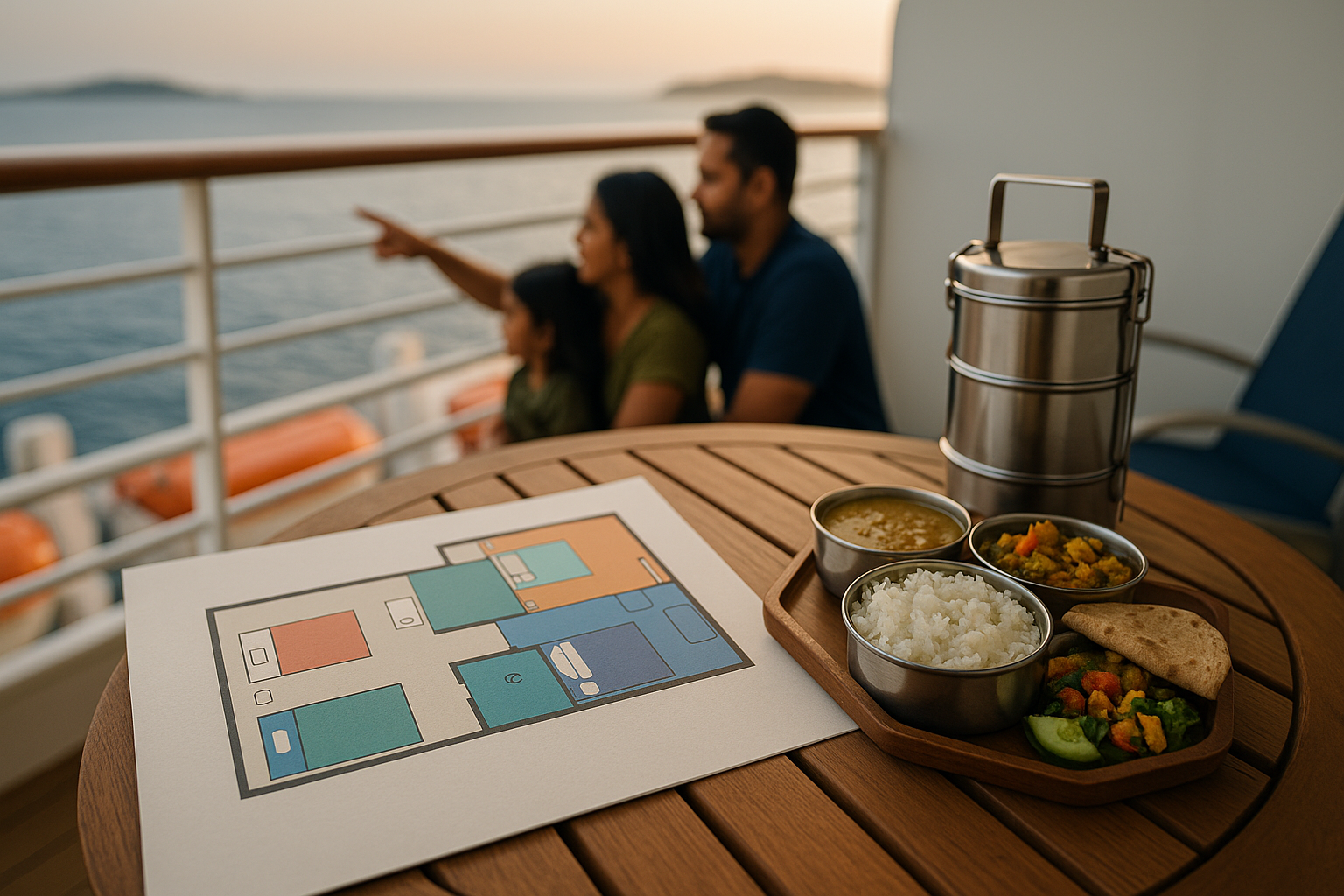
What are the main cruise cabin types?
Cruise cabins fall into four core types: Inside (Interior), Oceanview (Outside), Balcony (Verandah), and Suite.
Inside (Interior) rooms have no exterior window and are the most budget-friendly; Oceanview (Outside) cabins add a fixed window or porthole but no outdoor space; Balcony (Verandah) cabins include a private outdoor area accessed by sliding doors; Suite accommodations are larger and include extra rooms or perks. These four categories are the top-level taxonomy used by cruise lines, though each line may subdivide them into many subcategories based on location, layout, and amenities.
What are the typical sizes and storage differences between interior, oceanview, balcony and suite cabins?
Typical sizes: Inside ~130–185 sq ft, Oceanview ~150–220 sq ft, Balcony ~175–275+ sq ft (including balcony); suites vary widely but are significantly larger.
Inside cabins typically measure about 130–185 sq ft and prioritize compact layout and basic storage. Inside rooms often have a closet, a set of drawers, and limited open floor space.
Oceanview cabins typically measure about 150–220 sq ft and often use similar storage to Inside rooms but may feel roomier because of natural light; Oceanview rooms usually keep the same closet/dresser footprint as Inside.
Balcony cabins typically measure about 175–275+ sq ft including the balcony and commonly add a small seating area and extra surface space; Balcony cabins often have additional closet or drawer space and a small table and chairs on the verandah.
Suites vary widely by ship and line and can be significantly larger; Suite layouts may add a separate living area, larger closets, extra dressers, and expanded bathrooms, giving substantially more storage and separate zones for sleeping and relaxing.
How do core amenities differ across inside, oceanview, balcony and suite cabins?
Inside: typically a bed, compact bathroom, TV, climate control, and basic storage; Inside cabins may include a small desk or sofa but lack natural light.
Oceanview: typically the same core amenities as Inside plus a fixed window or porthole for natural light; Oceanview cabins may include slightly more floor space or alternative layouts.
Balcony: typically sliding glass doors, a private outdoor seating area (table and chairs), more usable living space, and often a small sitting area inside; Balcony cabins typically make fresh air and private views available.
Suite: typically separate living and sleeping areas, larger bathrooms (sometimes with tubs), expanded storage, upgraded toiletries and linens, and perks such as priority boarding or concierge access; Suite extras may include in-suite dining options, dedicated concierge, or access to exclusive lounges depending on the line.
Below are typical amenities for each cabin type.
Line‑specific cabin mixes and notable differences (quick examples)
Some lines — for example, Princess — typically have a high proportion of balcony cabins and relatively few suites; other lines often offer inside cabins with "virtual" balconies (Royal Caribbean, Disney) or maintain different suite counts. Princess — Princess ships often load decks with balconies but list fewer suites compared with big-ship rivals. Royal Caribbean and Disney — these lines have introduced virtual balconies or inside-view technology on some ships. Because mixes and subcategories vary by ship, check the ship’s deck plan and the line-specific guides (for example, The Points Guy’s Princess guide, CruiseShipTracking, or CruiseHabit) for exact cabin counts and subcategory details.
Which cabin type is the cheapest, and which offers the best value?
Inside (interior) cabins are usually the cheapest; suites are the most expensive; "best value" is a function of itinerary, time-in-cabin, and family size.
Price hierarchy on most ships presents Interior < Oceanview < Balcony < Suite. Travelers should treat that as the baseline and then weigh value: best value depends on how scenic the itinerary is, how many hours you will spend in the cabin, and whether you need extra space or bathrooms for a family. For short, port-heavy sailings an Interior often delivers the best overall value; for longer or scenic sailings a Balcony may be worth the premium; for large families, milestone trips, or when privacy and extra bathrooms matter, a Suite may justify its higher cost.
How much more does a balcony typically cost compared with an interior on a 7‑night cruise?
Typical 7‑night deltas for a balcony over an interior range from roughly $800 to $2,000 per cabin, depending on line and season. On a 7‑night cruise the balcony premium commonly falls in that $800–$2,000 band; actual prices may vary by cruise line, ship, deck location, and the time of year.
When do upgrades to a balcony or suite generally deliver clear value (trip length, itinerary, privacy)?
Upgrades deliver clear value on long cruises, scenic itineraries, for families needing extra space, or when privacy and balcony time matter.
- Trip length: Trip length should guide upgrade choices; longer sailings increase the value of extra space and a private balcony because you'll spend more time in the cabin.
- Scenic itinerary: Scenic itinerary should prompt a Balcony upgrade; routes like Alaska, fjords, or coastal Europe may make private outdoor viewing worth the cost.
- Privacy & time-in-cabin: Privacy and time-in-cabin should drive upgrades when you plan to relax in your room, work remotely, or enjoy sail‑away from your own space.
- Family size & layout: Family size should justify Suites or connecting cabins when extra beds, a second bathroom, or separate living areas reduce stress and add convenience.
- Motion sensitivity & comfort: Motion sensitivity may make midship interiors preferable for stability, but if fresh air and stepping outside reduce seasickness, a Balcony may be worth considering.
What do cabin subcategory codes (e.g., 1A, BA, IX) mean?
Subcategory codes combine type, location and special flags: numbers often map to deck/zone; letters to cabin type or layout; suffixes like "X" often mean "guarantee". These alphanumeric labels are the shorthand cruise lines use to signal where a stateroom sits on the deck plan, which layout or view it has, and any price or assignment modifiers. Guides such as CruiseBestie and CruiseHabit explain these conventions, but exact mappings can vary by line and ship, so always check the ship’s deck plan.
What do the numbers in cabin subcategory codes usually indicate?
Numbers in codes usually indicate deck level or zone—higher numbers often mean higher decks or specific ship zones, but systems vary by line. Numbers act as a quick location cue on a deck plan and help you infer motion and noise exposure (deck location affects seasickness and convenience). For example, a code beginning with 1 will usually point to a lower deck while one beginning with 6 will usually point to a higher deck; checking the ship’s deck plan confirms the exact deck.
What do the letters and suffixes (e.g., BA, IF, IX, X) usually mean?
Letters and suffixes identify layout or special flags: e.g., "BA" may mark a balcony subcategory, "IF" a specific balcony layout, "X" commonly marks guarantee bookings.
The following are common meanings, which may vary by cruise line.
- BA — "BA" may denote a balcony subcategory; BA indicates a balcony-type layout and may be used to price or distinguish a particular verandah size or view (for example, 4BA to show a balcony on deck 4).
- IF — "IF" may indicate a specific balcony layout; IF can identify a particular verandah footprint or positioning that some lines treat as a distinct subcategory.
- IX — "IX" repeats the code: "I" for an inside cabin and "X" as the guarantee flag; IX therefore could be an inside stateroom sold as a guarantee (you buy the category but the exact cabin is assigned later).
- X — "X" — "X" commonly marks a guarantee booking; a fare ending in X usually means the cruise line will assign the exact cabin within your purchased category a few weeks before sailing.
How do cabin subcategories (location and deck) affect price within the same cabin type?
Subcategories matter: midship and higher‑deck positions usually command premiums for stability, views and convenience; obstructions or venue proximity create discounts. Two “balcony” or “oceanview” cabins can therefore differ substantially in price and desirability depending on deck and location.
Cruise lines use subcategory codes to signal where a room sits on the ship, whether a view is full or obstructed, and how close the cabin is to elevators or public venues. Midship cabins often feel more stable and reduce seasickness, higher‑deck cabins can offer better sightlines and larger balconies, and cabins near elevators or on popular decks save walking time—so lines price those locations higher. Conversely, cabins with lifeboats or structural obstructions, those directly above pools or nightclubs, and “guarantee” bookings usually sell for less because they reduce comfort or certainty.
Why do midship and higher‑deck positions often command higher prices within the same cabin category?
Midship and higher‑deck positions often command a premium for greater stability (midship), better views (higher decks), and convenient access to amenities.
The main reasons are:
- Stability — Midship cabins feel less roll and sway, which improves comfort and reduces seasickness; Cruise Critic notes this is a common reason travelers pay more for midship locations.
- Views — Higher‑deck cabins often offer unobstructed sightlines and larger or more elevated balconies, making them more desirable and pricier.
- Convenience — Midship cabins are typically closer to elevator banks and central amenities, shortening walks across large ships and adding value; Eat Sleep Cruise highlights proximity to elevators and venues as a location premium.
- Perceived prestige — Cabins high on the ship or centered in popular neighborhoods can be marketed as superior, which lines price as a premium.
How do obstructed views, proximity to loud venues, and guarantee codes change price and desirability?
Obstructed views, cabins near loud venues, and guarantee bookings usually reduce price and desirability; cabins with unobstructed midship positions typically carry a premium.
An obstructed view (for example, a window partially blocked by lifeboats or structural elements) creates a clear discount because the primary benefit of an ocean‑view or balcony is diminished. Cabins above or adjacent to loud venues—nightclubs, pool decks, or buffet areas—usually sell at a discount because noise and foot traffic reduce nighttime and daytime comfort. Guarantee cabins (codes that commit you to a category but not a specific room) usually cost less and may be assigned a few weeks before sail; CruiseBestie and Eat Sleep Cruise note that guarantee spaces commonly end up in less desirable or obstructed locations, which is why they’re cheaper.
What cabin location (forward, midship, aft; high vs low deck) is best to avoid seasickness?
To minimise seasickness choose midship and lower-deck cabins; forward and high-deck cabins feel more motion and may increase seasickness risk.
Midship on lower decks sits closest to the ship’s roll axis and therefore minimises the amount of roll and sway passengers feel. Choosing a midship, lower-deck cabin gives the clearest engineering-based reduction in motion and is the simplest action for anyone prone to seasickness, unless ship-specific design differs.
Exactly which ship areas (forward, midship, aft; deck levels) minimise motion and seasickness?
Midship on lower decks minimises motion because it sits closest to the ship's roll axis and experiences less sway than forward/aft or top-deck locations.
Midship cabins on lower decks feel the least roll because they are near the ship’s centre of pitch and roll; midship repeat placement reduces both fore-aft and side-to-side motion compared with forward or aft positions. Lower decks also reduce the amplified motion felt near the top of the ship, so if you are susceptible to motion, book midship on a lower deck to minimise seasickness.
What are the tradeoffs between choosing a low/midship cabin for stability versus a high/forward/aft cabin for views or convenience?
Here are the main tradeoffs to weigh when choosing stability over views or convenience.
- Stability vs views: Stability vs views — low/midship lower-deck cabins maximise stability but sacrifice the panoramic forward/aft or upper-deck balcony views that high or bow/stern cabins provide.
- Stability vs noise: Stability vs noise — lower decks and midship cabins often reduce motion and may be quieter than cabins directly under the pool deck or nightclub, while forward/aft or high-deck cabins could be louder near public venues.
- Stability vs distance to amenities: Stability vs distance to amenities — choosing midship may place you farther from a specific venue (pool, specialty restaurant or elevators) on very large ships, so stability can mean more walking to entertainment or dining.
- Stability vs scenic convenience: Stability vs scenic convenience — forward and aft cabins offer dramatic sail-away and wake views and shorter walks to some outdoor spaces, but they may increase motion and therefore seasickness risk.
Which cabin types are best for families, solo travellers, and accessibility needs?
Families often prefer connecting cabins, family suites or two cabins; solo travellers can use studio/solo cabins to avoid single supplements; accessible travellers should book cabins with roll‑in showers and wider doors. These match common line offerings and solve the usual trade‑offs between space, privacy and cost. Use connecting cabins or family suites when you want separate sleeping areas; consider two cabins when extra bathrooms or independent bed arrangements make mornings easier. For accessibility, confirm ship‑specific accessible features with the line before you book.
What cabin layouts and features work best for families travelling with children?
Families benefit most from connecting cabins, family suites, and bunk configurations; two cabins beat one larger cabin when you need extra bathrooms or added privacy.
Here are practical family layouts and when each is best:
- Connecting cabins — two staterooms with an internal door that join; connecting cabins let parents supervise younger children while keeping separate sleeping spaces.
- Family suites — larger layouts with distinct sleeping and living areas that work best for multi‑generational groups and longer sailings.
- Bunk configurations and sofa beds — family cabins often include bunks to increase capacity without sacrificing floor space.
- Two cabins (adjacent or connecting) — choose two cabins when having an extra bathroom or separate adult/child sleeping areas matters more than a single large living room; two cabins can be more economical on some ships.
For more on onboard meals and how cruise lines accommodate Indian dining needs, see Cruises with Indian Cuisine: What to Expect Onboard for Indian Travelers.
Are solo cabins or single‑occupancy options available, and when do they make sense?
Some cruise lines offer studio or solo cabins that avoid the single supplement, and they make sense when solo travellers want privacy and lower per‑person costs. Availability of studio/solo cabins can vary by line and ship, so book early if you need one. Solo cabins should be chosen when you value a private, compact room and want to avoid paying a full double‑occupancy fare; otherwise an interior cabin or a guarantee fare may be a cheaper alternative depending on the itinerary.
What should travellers with reduced mobility look for in accessible cabins?
Accessible cabins should include roll‑in showers, grab rails, wider doors, and proximity to elevators; confirm specifics with the cruise line when booking.
Checklist: confirm these accessible features before you book.
- Roll‑in shower — accessible cabins should have a roll‑in or low‑threshold shower area.
- Grab rails — accessible cabins should include grab rails in the bathroom and near the toilet.
- Wider doors and maneuvering space — accessible cabins should have wider doorways and clear floor space for mobility devices.
- Lowered sinks/closets and reachable controls — accessible cabins should offer lowered fixtures and reachable storage/controls.
- Proximity to elevators and public areas — accessible cabins should be located near elevator banks or accessible routes to reduce wait and transfer distances.
Confirm accessible cabin specifications and any required equipment or assistance with the line when you book, and request written confirmation of the accessible features you need.
What is a guarantee cabin and how is it different from an assigned cabin?
A guarantee cabin sells you a category but not a specific cabin; the line assigns an exact room later, unlike an assigned cabin you select at booking. In practice, a guarantee cabin guarantees only the cabin type (inside, oceanview, balcony, suite) or subcategory, and the cruise line holds back specific cabin numbers until assignment. This lets lines sell discounted fares (often shown as codes ending in “X”) but removes your ability to pick location, deck, or proximity to elevators and venues at the time of booking; assignment timing is typically a few weeks before sailing and may vary by cruise line.
What exactly is a guarantee cabin and how does it work?
A guarantee cabin means you book a cabin category but accept that the cruise line assigns a specific cabin—assignment occurs weeks before sailing and the room may be any within the category. The cruise keeps inventory of numbered staterooms and uses guarantee inventory to move unsold specific rooms into flexible, lower‑priced buckets. When the ship’s manifest and allocation are finalised (typically a few weeks out), the line assigns you a numbered cabin based on availability, operational needs, and booking priority; that assigned cabin could be better, equivalent, or less desirable than a specific cabin you would have picked.
What are the pros and cons of choosing a guarantee cabin versus requesting an assigned cabin?
Choosing a guarantee cabin usually saves money but gives up control over the exact room, while requesting an assigned cabin preserves location control at a higher price. Below are the main pros and cons to compare.
- Pros: guarantee cabin — usually cheaper than an assigned cabin and can access discounted or last‑minute fares.
- Pros: guarantee cabin — can be flexible for travelers who prioritize price over cabin location and may result in a pleasantly better assignment by chance.
- Cons: guarantee cabin — you have no control over the exact cabin and you may end up with an obstructed view, near loud venues, or on a less‑desirable deck.
- Cons: guarantee cabin — may complicate requests for connecting rooms, specific bed configurations, or accessible cabins because exact numbers aren’t held at booking.
- Recommended: guarantee cabin — when location matters less (short itineraries, solo travelers, families focused on activities), when you want the lowest fare, or when you’re willing to accept the assignment risk to save.
When and how will the cruise line assign a guaranteed cabin, and can I request changes afterwards?
The cruise line typically assigns guaranteed cabins a few weeks before sailing, and you can request changes but selection is limited. Assignment windows may vary by line and sail date, but most carriers finalize numbered cabins during the final weeks as the manifest locks; some lines (or fare rules) may assign earlier or later. After assignment you can request a different cabin by contacting your travel agent or the cruise line, using online check‑in tools, or accepting upgrade offers, but any change depends on available inventory and may incur a fee. To reduce risk when choosing a guarantee cabin, you should book early, avoid guarantee fares if you need connecting or accessible rooms, ask your travel agent to note location preferences, monitor the cabin map when assignments are released, and be prepared to pay for an assigned cabin if exact placement matters.