A cruise is the travel product of a voyage on a passenger ship; this guide explains how onboard gratuities, service charges and tipping etiquette work for Indian travellers so they can budget and act appropriately. Daily automatic gratuities are per‑passenger, per‑day service charges added by most mainstream cruise lines to compensate cabin, dining and hotel service teams.
Typical daily rates on mainstream lines are roughly $16–$25 per person per day, with suites usually paying more and amounts varying by line and itinerary. Daily automatic gratuities are pooled and distributed to cabin stewards, main dining room waiters, assistant servers, housekeeping and the hotel service team. Separate service charges commonly appear on bars, specialty dining and spa/salon bills—typically around 15–20% (many lines use about 18%)—and if a service charge appears extra cash is usually not required, though discretionary for standout service.
Onboard gratuities do not cover shore services: tip shore‑excursion guides and local drivers separately (typically $5–$20+ per person) and tip dock porters about $1–$5 per bag in cash. Prepaying gratuities means paying the daily charges at booking or before sailing; prepaying gives budget certainty but reduces flexibility to reward exceptional service and may be non‑refundable. You can prepay or let gratuities post to your onboard account and settle by card, and Guest Services can review or adjust gratuities before disembarkation, though full removal is uncommon.
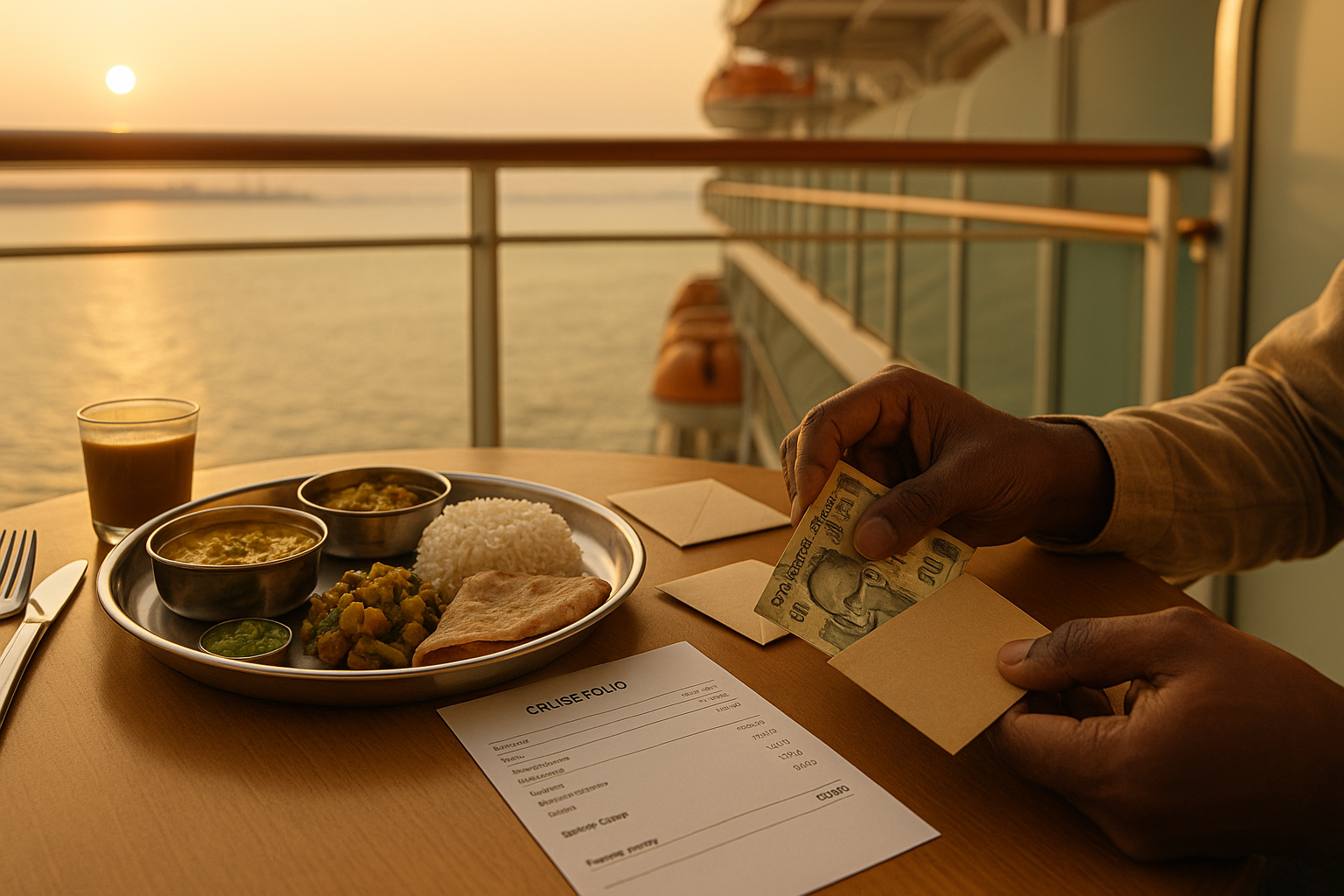
What are daily automatic gratuities on a cruise and what do they cover?
Daily automatic gratuities are per‑passenger, per‑day service charges added by most mainstream cruise lines to compensate cabin, dining and hotel service teams.
Typical daily rates on mainstream lines are roughly $16–$25 per person per day, and amounts may be higher for suites or vary by line and itinerary.
They are typically pooled and paid to several onboard staff, including:
- cabin stewards (stateroom attendants)
- main dining room waiters and head waitstaff
- assistant servers and dining-room support staff
- housekeeping and room‑service teams
- the hotel service team and other behind‑the‑scenes service staff
Typical per-person, per-day ranges and examples
Typical daily gratuities on mainstream lines are roughly $16–$25 per person per day; suites usually pay more and amounts vary by line and itinerary.
Representative examples (not exhaustive) follow and may change by region or booking channel:
- Carnival: ~$16 per person per day for standard cabins (suite premiums apply).
- Royal Caribbean: ~$18.50 per person per day for standard cabins; higher rates for suites.
- Norwegian: ~$20 per person per day for standard cabins; higher amounts for The Haven.
- Celebrity Cruises: ~$18 per person per day for standard cabins; higher for premium categories.
- Princess Cruises: ~$18 per person per day for standard cabins; suites are higher.
- Disney Cruise Line: ~$16 per person per day for standard cabins; higher for concierge and suites.
- Virgin Voyages: ~$20 per person per day if prepaid (higher if settled onboard).
- MSC Cruises: publishes region‑specific rates (examples include $16 or 12 euro for certain itineraries, with reduced or no charge for very young children on some sailings).
Which crew and onboard services the daily gratuity pays for
Daily gratuities are pooled and distributed to cabin stewards, dining staff, assistant servers, housekeeping and the hotel service team.
Typical recipients include:
- cabin stewards / stateroom attendants
- main dining room waiters and head waitstaff
- assistant servers and dining‑room support staff
- housekeeping and room‑service teams
- hotel service team and other service crew working behind the scenes
The gratuity pool is divided by the line’s payroll system and may be distributed differently by cruise line or ship.
Are children charged differently or exempt?
Children policies vary: many lines charge gratuities for children but some waive or reduce amounts for infants/toddlers on certain sailings.
Check your line's policy before sailing, because carriers such as MSC and others publish age‑based variations (examples include reduced rates for young children or no daily charge for infants under certain ages).
Who should I tip on a cruise ship?
Beyond auto‑gratuities, tip porters at embarkation, cabin stewards and dining staff for exceptional service, bartenders for regular attention, and spa therapists after services.
Below is who you should consider tipping in cash and when — short contexts and why:
- Porters at embarkation — Should consider $1–$5 per bag in cash because they typically lack card facilities and rely on small bills; give more for many or heavy bags.
- Cabin steward — Should consider an extra handout (often on the last night) for attentive, personalized service or special requests beyond routine cleaning.
- Waiter / dining staff — Should consider extra for above‑and‑beyond service in specialty dining, private requests, or consistently excellent service.
- Bartender — May receive $1–$2 per drink from guests you frequent, or small cash handouts for steady, prompt bar service.
- Spa therapist / technician — Should consider cash after treatments even if a service charge appears; extra is customary for exceptional or private appointments.
Onboard staff who may still expect separate cash tips (cabin steward, waiter, bartender, spa therapist)
Extra cash is customary for exceptional or personalized service: larger steward requests, frequent bar service, and spa technicians after appointments.
Below are typical onboard situations where an additional cash tip may be customary and why:
- Cabin steward: give an extra on the last night for consistently attentive service, special turndown touches, or handling special requests (laundry, extra turn‑down, arranging items). You should use small bills and a tip envelope if available.
- Waiter / dining staff: consider extra for specialty dining, private-party service, or if your table server remembers preferences and goes beyond normal duties; cash is convenient for direct thank‑you tips.
- Bartender: you may tip $1–$2 per drink to bartenders you frequent or give small handouts for prompt, friendly service; many guests still leave cash even with beverage service charges.
- Spa therapist / technician: tip immediately after the appointment for massages, facials, or salon services — spa bills sometimes add service charges, but a personal cash tip for great care is customary.
Embarkation and terminal staff: porters and luggage helpers
Tip porters in cash—typically $1–$5 per bag—because they lack card facilities and rely on small bills.
Recommended per‑bag ranges and practical notes:
- Typical range: $1–$5 per bag, with $2–$5 commonly cited for many ports; regional and port variation may apply, so use “typically” when planning.
- Give cash only and have small bills ready; don’t expect porters to accept cards or digital payments.
- Increase the amount for extra help, heavy bags, or when porters carry multiple pieces; a clear, personal handover speeds the process and ensures the tip reaches the helper.
When and how to give extra cash directly (tip envelopes, personal handover)
Give extra tips in discrete envelopes or by hand—usually on the last night for stewards or immediately after a service for spa/bar staff.
Practical handover and etiquette guidance:
- Timing: usually hand cabin steward tips on the last evening of the cruise; tip room‑service, spa and bar staff immediately after the service while the interaction is fresh.
- Method: use discrete tip envelopes (many ships supply them at Guest Services) or hand cash directly with a brief “thank you.” Avoid large public displays.
- Bills and denominations: bring plenty of small bills (ones, fives, tens) so you can hand exact amounts; don’t wait until disembarkation morning when crew are hard to locate.
What purchases on a cruise typically carry separate service charges — drinks, specialty dining, spa — and how much are they?
Bars, specialty dining and spa/salon services commonly include automatic service charges, typically around 15–20%; extra cash is optional for exceptional service.
Cruise lines commonly add a separate gratuity to items charged a la carte so the cost of a drink, a specialty-restaurant meal, or a spa treatment already includes the tip. This helps standardize pay for the crew but can vary by line, itinerary, and currency, so always check your onboard receipt.
The common purchase categories and their typical automatic service‑charge ranges are:
- Bars and beverage purchases (including beverage packages): typically 15–20%; many mainstream lines commonly add about 18%. Check the beverage bill for the exact percent, which can vary by line and port currency.
- Specialty dining (a la carte restaurants and chef‑tables): often in the 15–20% band; some lines treat specialty-restaurant checks like bar bills and fold a gratuity into the charge.
- Spa and salon services: frequently around 20% (commonly listed as a service charge on spa/salon bills); spa receipts often show a separate service charge line.
Bars, beverage purchases and beverage packages (typical 15–20% range)
Bars and beverage purchases commonly carry an automatic service charge of about 15–20%.
Beverage bills and beverage packages often have an auto‑gratuity added (many lines use ~18%), but the exact percent can vary by cruise line, ship, and region—so confirm the rate on your receipt before tipping extra.
- Typical: 15–20% auto‑gratuity on single drinks, specialty coffees, and beverage‑package charges.
- Variation: some lines standardize at 18% on drink bills; other itineraries or local currencies may show different amounts.
Specialty dining and spa/salon charges (typical 15–20%+)
Specialty dining and spa/salon bills often include a service charge in the 15–20% range, and spa bills frequently show a 20% service charge.
Specialty dining commonly carries an automatic gratuity similar to beverage charges, and spa/salon receipts frequently list a 20% service charge to cover therapist/stylist wages and overhead; additional cash is optional for exceptional, personalized service.
If a service charge appears on my bill, should I still tip in cash?
If a service charge appears on your bill, extra cash is usually not required.
Automatic service charges are intended to cover the tip for that service; additional cash tips are discretionary and appropriate only for standout service or personal attention. To avoid double‑tipping, review the receipt and, if unsure, ask guest services how that cruise line allocates onboard service charges.
Who and what is NOT covered by onboard gratuities — shore excursions, local guides and dock porters?
Onboard gratuities do not cover shore services: tip shore excursions, local guides, drivers and dock porters separately—typical ranges are $5–$20+ for guides and $1–$5 per bag for porters.
Cruise lines’ daily or auto-gratuities apply to ship staff only; any services you receive ashore (excursions, taxis, licensed guides, local drivers, or baggage handlers at the dock) are excluded and usually paid in cash at the time of service. You should plan cash for port days, favour small bills, and check whether USD is commonly accepted at the port you visit.
Shore excursion guides and local drivers — suggested ranges
Tip shore excursion guides and local drivers separately — typically $5–$20+ per person depending on service and group size; consider pooling for staff.
When the excursion is cruise-sponsored and you’re in a large group, tip toward the lower part of the range; for private or full‑day guided tours you should tip toward the higher end. You may hand the tip to the lead guide or place it in a group envelope; for larger tours or boats, pooling and splitting among driver, guide and supporting staff is often appropriate.
Suggested guideline for tipping guides and drivers:
- Cruise-line or large-group excursions: $5–$10 per person, given at the end of the tour.
- Small-group or private full‑day excursions: $10–$20+ per person, given directly to the guide/driver.
- If multiple staff assist (boat crew, assistant guides), consider pooling and asking the lead to distribute or split the tip among staff.
Porters at the dock and luggage helpers — per-bag guidance
Tip dock porters and luggage helpers per bag — typically $1–$5 per bag in cash; carry small bills (local currency or USD) for quick payments.
Porters rarely accept cards, so you should have small denominations ready. Increase the amount for very heavy bags, many pieces, or if they carry bags a long distance from tender boats or shuttle areas.
Practical per-bag guidance:
- Standard bag (normal weight): $1–$2 per bag.
- Heavy or oversized bag, multiple bags, or extra service: $3–$5 per bag.
- Have small bills in local currency or USD and tip immediately when the porter takes or delivers your luggage.
What does prepaying gratuities mean and should I prepay before my cruise?
Prepaying gratuities means paying the daily service charges at booking or before sailing; it provides budget certainty but reduces flexibility to reward exceptional service.
Prepay is an option offered by most mainstream lines so you can lock the recommended per‑person, per‑day gratuity into your fare; alternatively you can choose to pay onboard, where the line posts the daily charge to your onboard account and you settle it at the end of the cruise. Prepay gives predictable costs and avoids surprise charges on your final bill, while pay onboard keeps you able to increase, decrease, or add cash tips based on the service you receive. Before you decide, check the cruise line’s refund/change rules and whether gratuities are already included in any promotion.
Below are quick pros and cons to help you decide.
- Pros: budget certainty; convenience at embarkation; sometimes included in promotions or package deals.
- Cons: less flexibility to reward exceptional service; prepaid amounts might be non‑refundable or restricted — check line policy; you still may need cash for porters and local tips.
Pros and cons of prepaying gratuities
Pros: budget certainty and convenience. Cons: less flexibility to reward exceptional service and possible non‑refundability—check line policy.
Prepaying prevents daily charges from appearing as surprises on your onboard account and saves you from calculating or handing out multiple cash tips. It also simplifies billing if you use third‑party payment methods or want the cruise fare to cover all standard service charges. On the downside, prepay means you pay the same regardless of individual service experiences and some lines or promotions may treat prepaid gratuities as final; always confirm refund and adjustment rules with the cruise line or your travel agent.
- Pros:
- Budget certainty: you know the gratuity cost before sailing.
- Convenience: no daily postings to monitor; one payment handled at booking.
- Promotion compatibility: some offers include gratuities, simplifying comparisons.
- Cons:
- Less flexibility: you can’t easily redistribute or withhold tips after service.
- Possible non‑refundability: refunds or changes may be limited—check policy.
- You may still want to carry cash for porters, excursion guides, or exceptional personal service.
How to prepay, how it's charged to your account, and digital/card tipping options
You can prepay at booking or accept daily onboard charges that post to your onboard account; additional tips can be paid by card (charged to the onboard account) or given in cash.
If you choose to prepay, you typically do it when you book through the cruise line website, your travel agent, or by calling reservations; payment is processed with the card on file and the gratuity is marked as paid on your reservation. If you opt to pay onboard, the cruise posts the daily gratuity to your onboard account automatically and you settle the accumulated balance with the credit card you registered or at guest services before disembarkation. Guest services can handle requests to increase or decrease gratuities during the cruise, but any final adjustments generally must be made before you leave the ship.
Use these common ways to prepay or tip onboard:
- Prepay at booking or via the cruise line’s “manage my booking” tools using your credit/debit card.
- Pay onboard: daily gratuities post to your onboard account and are settled by the card on file at the end of the cruise.
- Card/digital tipping: many lines let you add extra tips to the onboard account or use card readers for direct tips to spa staff, bartenders, or specialty dining.
- Cash tips: carry small bills for luggage porters, excursion guides, and crew members you prefer to tip directly.
You should check the line’s specific policy before you prepay and should carry some cash even if you plan to use card tipping, and visit Guest Services onboard if you need changes or adjustments.
How do gratuity amounts vary by cruise line and by cabin type (standard vs suite)?
Gratuity amounts vary: mainstream lines charge daily auto‑gratuities (examples $16–$25) with suites paying a premium, while many luxury/all‑inclusive lines include gratuities in the fare. This affects budgeting and whether you need extra cash for spa or shore tips.
Mainstream big‑ship lines typically add a per‑person, per‑night service charge that is split among dining, housekeeping and hotel teams; suite guests commonly pay a slightly higher daily rate. Rates can vary by itinerary and booking country, so always check your booking details.
Example daily gratuity rates for major lines (representative examples)
Representative examples show many mainstream lines charging about $16–$25 per person per day, with suites at higher daily rates — check your booking details.
The following representative examples illustrate common auto‑gratuity models (not exhaustive; rates differ by itinerary and booking country):
- Carnival — $16.00 per person per day for standard cabins; $18.00 for suites (representative example).
- Royal Caribbean — $18.50 per person per day for standard cabins; $21.00 for suites (representative example).
- MSC Cruises — about $16.00 per person per day on many Caribbean/Alaska sailings; regional Euro rates (for example 12€) apply on some European itineraries; Yacht Club/Yacht Club‑level fares carry a higher daily amount (representative examples).
- Norwegian — $20.00 per person per day for standard cabins; $25.00 for The Haven/suite areas (representative example).
- Celebrity — $18.00 per person per day for standard cabins; higher rates for Concierge/AquaClass and The Retreat (illustrative: $23.00 for The Retreat).
- Princess — $18.00 per person per day for standard cabins; higher daily rates for suites (representative example).
- Disney — $16.00 per person per day for standard cabins; higher charges for Concierge rooms and suites (illustrative example: $27.25).
- Virgin Voyages — $20.00 per person per day if prepaid, $22.00 if settled onboard (representative example).
Check your cruise documents because lines such as MSC and others may publish different amounts by region, and some lines updated rates on specific effective dates.
All‑inclusive / luxury lines where gratuities are included vs mainstream auto-gratuities
Luxury/all‑inclusive lines typically fold gratuities into the advertised fare, while mainstream lines use daily auto‑gratuities charged to your onboard account. Regent Seven Seas and Silversea are examples of lines that include tips in their all‑inclusive fares, though specific services may vary.
Even on inclusive lines, guests might still tip for optional or third‑party services: spa treatments, salon services, specialty shore‑based guides, or exceptional personal attention at times may be charged separately or receive direct cash tips. Always verify the line’s published inclusions and bring small cash for spa, specialty services, or shore‑excursion guide tips.
How should Indian travellers handle cash, small bills and currency for tipping on and off the ship?
Indian travellers should carry small-denomination USD and local currency for port tips; Indian rupees are rarely useful ashore—see /logistics/currency/ for conversions.
Carry a mix: USD for places that accept it (for example the Bahamas and Caribbean), local notes where required, and only a small amount of INR for emergency use or returning to India. Check your port’s currency acceptance before you disembark.
Use this quick Do/Don't list for currency and small bills before you sail.
- Do: bring small bills (ones, fives, tens) in USD and exchange a small amount into each port’s local currency as needed.
- Do: keep a separate tip envelope or pouch for porters, shore‑excursion guides, and cabin stewards.
- Do: convert or withdraw modest sums at port ATMs or local exchange counters if the port prefers local currency.
- Don’t: rely on Indian rupees ashore—INR is rarely useful outside India (though not universally useless for very specific cases).
- Don’t: bring only large notes or flash cash; small, crisp bills prevent awkward change issues and are appreciated by crew and port staff.
Should I tip in Indian rupees, US dollars or local currency at ports?
You should use USD where widely accepted (Caribbean/Bahamas); prefer local currency at most ports—INR is rarely useful ashore; see /logistics/currency/ for conversion help.
U.S. dollars are fine in many Caribbean/Bahamas ports, but many destinations expect local notes for porters, taxi drivers and shore‑excursion staff. Check your port’s currency acceptance before you go ashore and plan to convert small amounts rather than carrying large sums of foreign cash.
What small bills and denominations to carry (singles, fives, tens) and an example tipping stash
Carry small-denomination USD or local notes—ones, fives and tens—and a small tip stash for porters and excursions.
- Bring a stack of one‑dollar (or one‑unit local) bills for luggage porters and quick tips.
- Add several $5 (or equivalent) bills for shore‑excursion drivers and small groups.
- Keep a few $10 (or local tens) for larger gratuities or restaurant servers when needed.
- Example tip stash (label as example): a handful of singles, a few fives and a couple of tens tucked into an envelope for disembarkation day and ports.
Indian traveller etiquette: discreet tipping and cultural notes
Tip discreetly, hand tips personally or in an envelope, and use modest amounts; avoid public displays of cash.
Indian etiquette favors modest, personal gestures: hand the tip discreetly with a thank‑you, or leave it in an envelope marked for housekeeping. Avoid openly counting or flaunting money, keep tips modest relative to local norms, and secure your cash in a money belt or ship safe when not in use.
Onboard Indian cuisine and dining expectations
For more on dining options and how Indian meals are handled on cruises, see Cruises with Indian Cuisine: What to Expect Onboard for Indian Travelers.
Can I have automatic gratuities removed or adjusted if I’m unhappy with service?
Yes — most lines allow you to request adjustment or removal via Guest Services before disembarkation, though full removal is uncommon and frowned upon.
Automatic gratuities are applied to your onboard account but Guest Services handles requests; you should raise problems as they occur because adjustments must be requested before disembarking and refunds are not guaranteed.
Please follow these steps to request an adjustment and understand likely outcomes:
- Note the issue clearly (date, time, location, crew involved) and gather any receipts or photos that support your complaint.
- Contact Guest Services promptly — visit the Guest Services desk or call from your cabin and state that you want an adjustment to your gratuities.
- Explain the problem calmly and ask for a formal review; Guest Services may consult dining, housekeeping, or your cabin steward.
- Expect Guest Services to investigate; outcomes may include no change, a partial adjustment, or (rarely) a full removal of the charge.
- If an adjustment is made, the line may reallocate charges rather than issue a cash refund; a refund is not guaranteed.
- If you do remove gratuities, consider leaving cash directly to individual crew who provided good service.
- Make the formal request and any follow-up before disembarking — Guest Services cannot process adjustments after you leave the ship.
How to request an adjustment or removal (guest services process)
Contact Guest Services as soon as issues arise and request adjustment before disembarkation; outcomes range from investigation to partial or full change.
- Visit the Guest Services desk in person or call from your cabin to report the issue.
- Provide your cabin number, sail date, specifics of the incident, and any supporting receipts or photos.
- Ask for a written note or reference number for your complaint and an estimated timeline for resolution.
- Allow Guest Services time to investigate; they may speak with the crew involved to verify details.
- Accept that the result may be no change, a partial credit, or in rare cases full removal; refunds are not automatic.
- If an adjustment is agreed, confirm how it will appear on your account and tip individual crew directly if you still wish to reward good service.
- Complete all requests and confirmations before disembarking — Guest Services generally will not handle gratuity changes after you leave.
Will removing gratuities affect service or crew relations?
Removing gratuities can strain crew relations and is generally frowned upon; you should raise issues early so staff can address them.
Automatic gratuities are typically pooled to cover many teams (stateroom attendants, dining, hotel services), so blanket removal may penalize staff who were not involved. That can create awkwardness and hurt morale, which is why many sources advise against using removal as a first response. For best results, report problems promptly to Guest Services and seek on-the-spot resolution; if you still choose removal, consider tipping affected individuals directly to avoid harming crew who provided good service.