A cruise's onboard payment system is a cashless, ship‑managed ledger tied to your cruise card or wearable medallion that records purchases, gratuities and deposits, is set up at check‑in, updated as charges post, and settled at disembarkation.
At embarkation you register a payment method (credit/debit card or cash deposit), consent to any pre‑authorisation hold and receive your cruise card as the account key; the cruise line may place a temporary pre‑authorisation whose size and duration vary by line. The cruise card functions as your room key, ID and payment token; if it’s lost guest services can deactivate it, issue a replacement and help investigate unfamiliar charges.
Charges post to the onboard account via your cruise card and you can view itemised statements on the in‑cabin TV, the ship app or at guest services, often updated daily. Accepted methods typically include a cruise card linked to credit/debit, a cash deposit, onboard ATMs and prepaid packages. Most lines bill in a line‑specified currency (commonly USD or EUR) and your card issuer may apply foreign‑transaction/FX fees. Most lines also add automatic gratuities (typically US$15–$20 per person per day) to accounts; amounts and adjustability vary and you can still give additional cash tips.
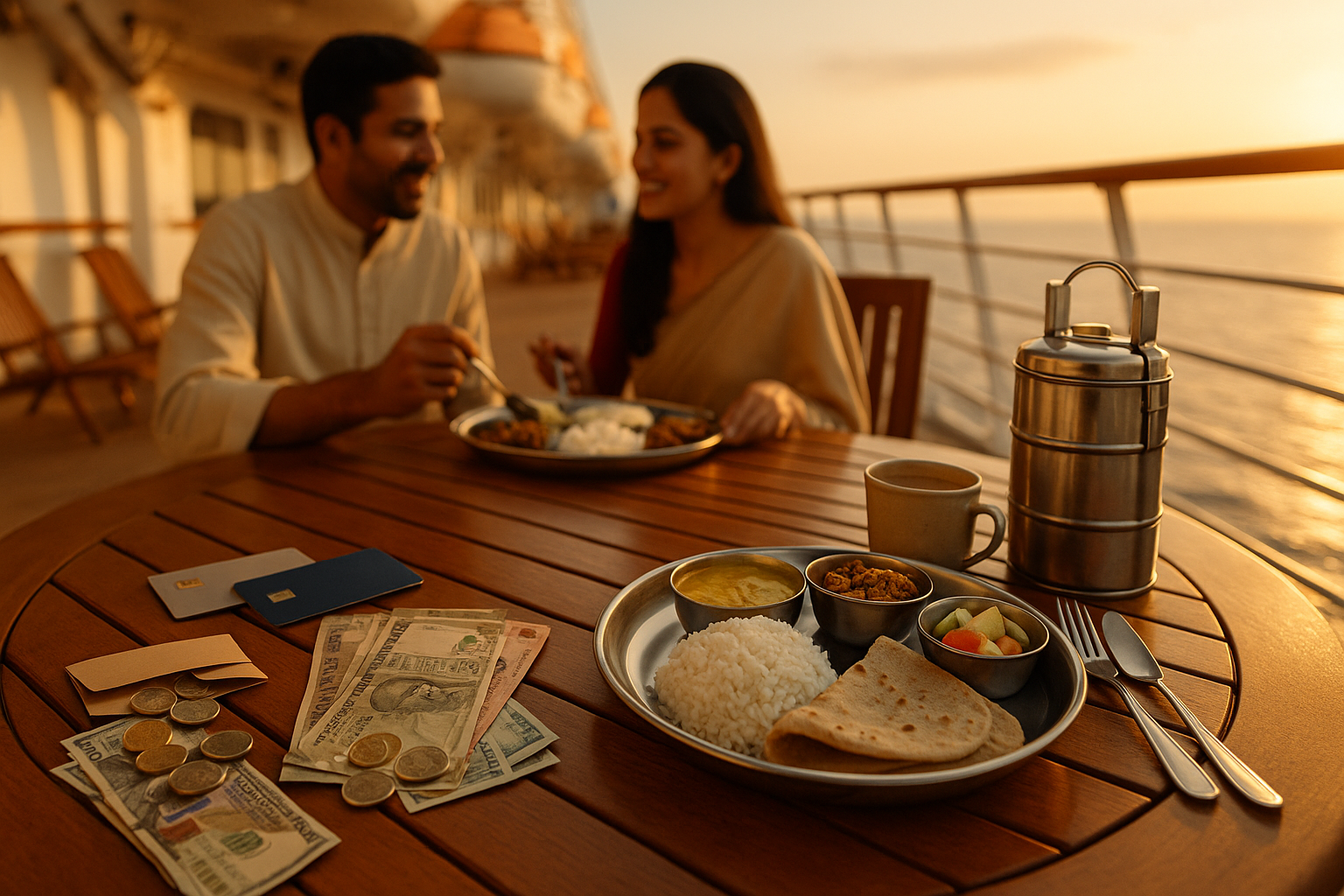
Indian travellers should notify card issuers before travel, prioritise an international Visa or Mastercard with a backup card, carry small USD (not INR) for tips and ports, and prefer credit over debit where possible because pre‑authorisations can hold funds.
What is an onboard account and how does it work?
An onboard account is a cashless, ship‑managed ledger tied to your cruise card that records purchases, gratuities and deposits; it’s set up at check‑in, updated as charges post, and settled at disembarkation.
An onboard account functions like a single tab for everything you buy or book on board. You use your cruise card (or wearable like a medallion on some lines) as the account key, so outlets, bars, the spa and shore‑excursions post charges to that ledger. Policies vary by cruise line, so the exact currency, hold procedures and refund timing might differ.
Use this three‑step checklist to see the typical flow of an onboard account:
- Setup at check‑in: register a payment method or leave a cash deposit and receive your cruise card.
- Posting: purchases are charged to the onboard account via your cruise card during the cruise.
- Settlement: the account is paid off and any refunds processed at disembarkation.
How do I set up my onboard account at embarkation?
At embarkation you register a payment (credit/debit card or cash deposit), consent to any pre‑authorisation hold, and receive your cruise card as the account key.
At check‑in you’ll be asked to link a credit or debit card or to make a cash deposit with guest services; some passengers register one card for the whole stateroom while others register separate cards per person. The cruise line may place a pre‑authorisation hold on a linked card (a temporary hold to cover incidentals) rather than an immediate charge — the size and duration of that hold can vary by line. You should have photo ID and the card you plan to register ready at check‑in, and you may be able to provide card details during online check‑in on some lines.
How are purchases posted and how can I review them while onboard?
Charges post to the onboard account via your cruise card; you can view itemised statements on the in‑cabin TV, the ship app, or at guest services, often updated daily.
Every purchase you make on board is recorded to your onboard account when the merchant posts the charge; that charge is linked to the cruise card or account number the ship issued you. You can monitor an itemised statement on the stateroom TV, in the cruise line’s ship app, or by asking guest services for a printout; most ships update statements regularly (often daily), but timing can vary. You should review your itemised statement during the cruise and raise any discrepancies with guest services before the final day so issues can be resolved before settlement.
What payment methods are accepted on cruise ships?
Cruise ships primarily accept charges via your cruise card linked to a credit or debit card or a cash deposit; some ships also offer onboard ATMs, prepaid packages and limited cash services.
The main accepted payment methods are:
- Cruise card linked to a credit/debit card — convenient for most purchases; posts to your onboard account.
- Cash deposit at guest services — lets you pre‑fund your onboard account; refunds may require a visit to guest services.
- Onboard ATM — provides cash or foreign currency but availability varies and fees can be high.
- Prepaid packages / onboard credit — covers specified items (drinks, dining, excursions) and simplifies budgeting.
You should check your specific ship or cruise line for exact accepted cards, onboard currency and any holds or foreign‑transaction rules.
Cash vs card — when cash is accepted and how onboard ATMs work
Ships are typically cashless—cards linked to your onboard account are preferred; onboard ATMs may be available, and limited cash can sometimes be obtained at guest services or the casino.
Most onboard transactions use your cruise card (cashless system), while cash is accepted in limited ways: you can deposit cash at guest services to fund your account, or use an onboard ATM where fitted. Onboard ATMs are common on large ships but may not be present on every vessel; they often charge steep fees, sometimes upward of $10 per withdrawal, plus your bank may apply its own fees.
Emergency cash options include asking guest services to convert a charge to cash (convenient but not guaranteed) or using the casino cashier to cash out chips or preload funds onto your keycard (works only on ships with casinos and can cost you through play losses). You should withdraw needed local or U.S. cash before boarding if possible to avoid onboard ATM fees and availability issues.
Prepaid packages and onboard credit: what they cover and when to prepay
Prepaid options typically include drink packages, specialty‑dining credits and shore‑excursion or onboard credit and they cover specified purchases; refund and transfer terms vary by cruise line.
Prepaid packages (drink packages, beverage or dining bundles, spa credits, excursion credits or prepaid gratuities) usually cover only the items named in the package and can simplify budgeting and speed service. Prebooking makes sense if you know you will use the service frequently (for example, heavy drinkers buying a drink package) or when a line offers a pre‑cruise discount. Refunds, transfers between guests, and cancellations vary by cruise line and product, so you should read the package terms and the cruise line’s T&Cs before purchasing.
What is a cruise card (shipboard spending card) and how is it used?
A cruise card (or medallion) is the shipboard spending card that functions as your room key, ID and payment token for posting charges to your onboard account.
The cruise card is issued at embarkation (or your line may provide a wearable medallion, as Princess does) and links every onboard purchase to a single onboard account. Technology and exact features can vary by cruise line, so the form factor (plastic card vs. wearable) may differ.
It serves several roles aboard the ship:
- ID for security and muster/embarkation.
- Room key to open your stateroom.
- Payment token that posts charges to your onboard account.
- Proof of entitlement for dining reservations, excursions, and disembarkation.
Operationally, ships operate largely cashless: you either link a credit/debit card or leave a cash deposit at check‑in to fund the onboard account, then use the cruise card/medallion to make purchases. You can monitor charges via the ship’s app, stateroom TV, or guest services; final settlement is processed against the linked payment at the end of the cruise.
How is the cruise card linked to my payment method and what if it’s lost or stolen?
You link a card or deposit to your cruise card at check‑in; if it’s lost charges still post to the account and guest services can replace the card and resolve disputes.
Linking typically happens during online check‑in or at the gangway when you provide a credit/debit card or a cash deposit to open the onboard account. If the cruise card is lost or stolen, charges continue to post to the linked onboard account; guest services can deactivate the lost card, issue a replacement card (or medallion), and help investigate or dispute unfamiliar charges. You should notify guest services immediately and review your running bill before disembarkation to resolve issues.
Quick steps if your card is lost or stolen:
- Notify guest services immediately and request the card be deactivated.
- Request a replacement card and confirm any recent charges on your onboard account.
- Ask guest services how to file a dispute and how final billing will be handled.
- Prefer linking a credit card rather than a debit card to avoid long holds on your bank funds.
Shared cards, multiple cards per cabin and split billing
Cabins can register one primary card or individual cards per person; many lines support split billing choices at embarkation or guest services to track individual spending.
You can register one card for the whole stateroom or register separate cards for each guest depending on the cruise line’s options. Some lines allow charges to be assigned to individual profiles, let you split a single bill at the point of sale, or change billing arrangements at the guest services desk — practices can vary by line.
Practical tips for group billing control:
- Decide before boarding whether to register one primary card or separate cards for each guest.
- Use separate cards if you want individual statements and easier tracking.
- Ask guest services about split‑bill options or how to reassign charges if plans change.
- For children or teens, consider a cash deposit or separate card to limit spending.
What currency is used onboard and how are exchange rates handled?
Most cruise lines bill onboard accounts in a line‑specified currency (commonly USD or EUR); your final card statement reflects the currency conversion and issuer fees may apply.
Cruise ships operate a cashless system where charges post to an onboard account in the cruise line’s chosen billing currency — the "line‑specified currency." That choice is set by company policy and often by itinerary or region; it determines the currency shown on menus, shops and your onboard folio. When the ship posts a charge in that currency, your card issuer converts it to your card’s billing currency for the final statement and might apply a foreign‑transaction (FX) fee or conversion spread.
Here are representative examples of line‑specified billing currencies (not exhaustive):
- Azamara — US dollars (USD)
- Carnival Cruise Line — US dollars (USD)
- Celebrity Cruises — US dollars (USD)
- Costa Cruises — euros onboard for non‑Caribbean itineraries; US dollars for Caribbean itineraries
- Cunard — US dollars (USD); Cunard can convert charges into UK sterling with a 3% conversion charge
- Fred. Olsen — UK sterling
How do cruise lines decide which currency to use and how can I check my line’s policy?
Cruise lines set a billing currency by company policy and itinerary; you should check the line's official currency/FAQ page or your booking agent for the exact rule.
Lines choose a line‑specified currency based on their headquarters, primary markets and the regions they serve. You should verify the currency before you sail by checking the cruise line’s official website or FAQ (many lines publish a currency guide), reviewing your booking confirmation, or asking your travel agent. PortFunFinder and Cruise Nation recommend confirming currency availability and the line’s policy so you aren’t surprised at embarkation. Regional exceptions (for example, Costa’s different rules for Caribbean vs. European sailings) may apply.
Exchange rates, foreign‑transaction fees and dynamic currency conversion to watch for
Expect card issuer FX fees, onboard exchange margins and ATM charges; avoid dynamic currency conversion (DCC) and ask guest services about buyback/refund options.
Expect these fee types when using cards or onboard exchange services:
- Card issuer FX fees — your bank or card company may charge a foreign‑transaction fee or use a conversion spread when they convert the line‑specified currency to your billing currency.
- Onboard exchange margins — the ship’s exchange service can apply its own markup on rates when selling or buying cash.
- Onboard ATM fees — ship ATMs often charge high per‑withdrawal fees and poor rates.
- Dynamic currency conversion (DCC) — the merchant offers to charge you in your home currency at the point of sale; this typically uses a worse rate and you should avoid DCC.
If a terminal offers DCC, decline it and request the charge in the ship’s line‑specified currency so your card issuer does the conversion (or use a no‑foreign‑transaction‑fee card). Ships may offer buyback of unused foreign currency; you should ask guest services about buyback terms, the rate they’ll use and any minimums or timing requirements. If you need cash onboard, ask whether the front desk can provide it as a posted charge (which may post as a card purchase rather than a cash advance) to avoid unexpected banking fees.
Gratuities and tipping policies
Most lines add automatic gratuities (typically $15–$20 per person per day) to your onboard account; these post like other charges and you can usually adjust them or give extra cash personally.
Automatic gratuities are precharged service fees shared among crew and they appear on your daily onboard statement and final bill just like drinks or spa charges. Amounts and whether you can change them can vary by cruise line and cabin category, so you should check the line’s policy and review your final bill before disembarkation.
Here’s how automatic gratuities typically work and what options you have:
- Automatic gratuity: automatic gratuities are precharged daily service fees (typical $15–$20 per person per day) that cover general service.
- How it appears: they post to your onboard account and show on your in‑cabin statement and the final bill.
- Adjustment options: many lines allow removal or adjustment through Guest Services, the ship’s app, or when you review the final bill, but policies can differ by line.
- Cash tipping: you can still tip crew directly in cash; Guest Services can often accept cash deposits to credit your onboard account if you prefer.
What are automatic gratuities, can I modify them and can I pay tips in cash instead?
Automatic gratuities are precharged daily service fees (typically $15–$20 per person per day); many lines permit adjustments through Guest Services or on your final bill, and you can still give additional cash tips.
These gratuities cover routine onboard service and are commonly shared among dining and housekeeping staff. Drinks, specialty dining and some services may carry separate automatic service charges that post to your account. If you want to change an automatic gratuity, you should ask Guest Services, use the ship’s app if available, or dispute/adjust the line items when you receive your final bill—some lines require changes before final settlement. Cash tips remain acceptable: you may hand cash directly to staff for exceptional service, or ask Guest Services to accept cash and credit it to your onboard account, though the availability of these options can vary by ship.
Tipping etiquette: when to give extra cash (special service, shore staff, guides)
Extra cash is customary for exceptional service—room stewards, excursion guides and porters—and Indian travellers should carry small USD or local currency ashore for port‑level tipping.
Automatic gratuities cover everyday onboard service, but small cash tips are often given for above‑and‑beyond attention from a room steward, for helpful or personalised shore‑excursion guides, for taxi drivers and for porters handling luggage. For Indian travellers, carry a modest supply of widely accepted small‑denomination US dollars or pick up local currency at the port rather than relying on INR onboard; you should have small notes for tipping in ports and at informal vendor stalls.
Managing, tracking and settling your onboard account
Monitor your onboard account via the ship app, in‑cabin TV or guest services and settle it at disembarkation using your linked card or cash.
Best ways to track spending during the cruise (app, TV, guest services)
Track spending on the ship app, in‑cabin TV or at guest services; statements typically update daily and you should review charges promptly and ask guest services about any discrepancies.
Use the tools below to monitor your running tab and set limits where offered:
- Use the ship app for near‑real‑time monitoring and push alerts where the app supports them; you should check the app at least once a day.
- Check the in‑cabin TV for the daily statement the ship typically delivers to staterooms; review line‑item charges each evening.
- Visit or call guest services to request an itemised receipt, to set spending limits (for children or a cabin account) and to enable any account alerts the line provides.
- Keep a copy of receipts for specialty restaurants, spa or retail purchases and immediately compare them with the app/TV statement.
- If you see an unexpected charge, you should raise it with guest services before the final day so it can be investigated and corrected promptly.
- For occasional cash needs, use the onboard ATM, front desk cash service, or casino cashier options; monitor cash withdrawals as they may carry fees.
How to settle your account at disembarkation and what to expect about refunds/holds
At disembarkation you receive a final statement and the linked card or cash is charged; pre‑authorisation holds may last days to weeks and leftover cash deposits are refunded per the line's process.
Follow these steps to settle and obtain refunds smoothly:
- Review the final statement delivered to your stateroom before disembarkation and verify all charges are correct.
- Visit guest services if you want to dispute any line items — you should do this before the final settlement so corrections post to the final bill.
- Settle the account at checkout with the payment method you registered (the linked credit/debit card) or, where accepted, pay the balance in cash at guest services.
- Request and keep a receipt for the final settlement and any corrected charges for your records.
- Ask guest services how any pre‑authorisation holds were applied and when they expect the holds to release; holds can take days to weeks to drop from your bank or card issuer.
- If you made a cash deposit at embarkation, request the refund procedure at guest services — refunds are processed per the cruise line’s policy and may be returned to your card or issued as cash or a check, which can take time to complete.
- If a hold or refund takes longer than expected, you should contact guest services and your card issuer; the cruise line can confirm their processing date while your bank confirms the release.
Planning for Indian travellers: pre‑cruise checklist and card issues
Indian travellers should notify card issuers, carry some USD, use a primary Visa/MasterCard plus a backup (preferably a no‑FX‑fee card), and favour credit over debit because pre‑authorisations can hold funds.
Most cruise lines operate cashless onboard accounts and may post charges in US dollars; predeparture planning prevents declined cards, unexpected FX fees, and holds that tie up INR bank balances. Notify your bank early, bring small USD notes for tips and ports, and carry at least one backup Visa/MasterCard to avoid acceptance problems.
Pre‑cruise checklist: notify issuers, what cash to carry (USD vs INR), and backup cards
You should notify your bank and card issuers, carry a small amount of USD rather than INR for tips and port purchases, and bring a spare Visa/MasterCard plus a no‑foreign‑transaction‑fee card where possible.
Plan these simple steps before you leave to reduce friction at embarkation and in ports of call. Notify issuers via your bank’s app or phone line with travel dates and destinations so transactions aren’t flagged. USD is the recommended carry currency for most international cruise lines and shore vendors; do not assume INR will be accepted onboard. Bring a spare Visa or MasterCard because AmEx/Discover may be less widely accepted.
Use this short pre‑cruise checklist:
- You should notify your bank and card issuers of travel dates and countries so international transactions are not blocked.
- You should carry a small amount of USD for tips, taxis, and small vendors ashore rather than relying on INR.
- You should bring a primary Visa/MasterCard and at least one spare Visa/MasterCard in a separate bag.
- You should consider a no‑FX‑fee or travel card to avoid 2–3% foreign transaction fees when charged in USD.
- You should preload cash only if needed; avoid airport cambio booths with high fees and prefer bank/ATM or preordered USD.
Pre‑authorisations, holds and differences between debit and credit cards
Pre‑authorisations (holds) are placed against the linked card for an estimated amount and may hold funds for days to weeks; credit cards avoid immediate depletion of your bank balance and are therefore safer than debit cards for pre‑auths.
Cruise lines and hotels commonly place an estimated hold on the card you register to cover incidentals; these holds may last up to 4 weeks after sailing depending on the bank or processor. A hold on a debit card reduces your available INR balance immediately, which can cause ATM declines or overdrafts ashore. A hold on a credit card reduces available credit but does not remove cash from your bank account, so it usually causes less day‑to‑day disruption.
If you must use a debit card, mitigate risk by notifying the issuer in advance, keeping a healthy cash buffer in your account, and bringing an alternate card. You should register a credit card where possible or deposit cash with guest services to fund your onboard account instead of linking a debit card. If you run into issues while onboard, guest services or the front desk may be able to provide cash charged as a card transaction (avoiding a cash advance), and you should monitor transactions during and after the cruise to catch lingering holds.
Can a cruise ship accept Indian rupees (INR) and what are the practical alternatives?
Cruise ships almost never accept INR onboard; instead Indian travellers should link an international Visa/Mastercard, carry some USD or the local port currency, pre‑exchange before boarding, and use local ATMs ashore for cash top‑ups.
Prioritise these alternatives for onboard and ashore spending:
-
Link an international Visa/Mastercard to your onboard account.
- Pros: works with the ship’s cashless system, accepted at bars, restaurants, shops and excursions; convenient for settling the final bill.
- Cons: your issuer may charge foreign‑transaction or cash‑advance fees and may place fraud holds if not notified.
-
Carry some USD (or another widely accepted currency).
- Pros: many cruise lines and onboard prices are quoted in US dollars and USD is widely accepted ashore in the Caribbean and tourist ports.
- Cons: carrying cash has theft risk and airport/exchange counters may give weaker rates than banks.
-
Pre‑exchange a small amount of local port currency before boarding.
- Pros: avoids last‑minute onboard exchange hassles and gives exact change for taxis, markets and small vendors.
- Cons: exchange fees and buy‑back policies may apply; check rates and limits beforehand.
-
Use local ATMs ashore for cash top‑ups.
- Pros: often the best exchange rate compared with currency booths or onboard exchangers.
- Cons: ATM fees and foreign bank charges may apply; you should choose ATMs attached to banks and avoid dynamic currency conversion.
If INR isn't accepted, what should Indian travellers carry or arrange instead?
Prioritise linking an international Visa/Mastercard.
Link a card to your onboard account at check‑in; a linked Visa or Mastercard is the easiest way to pay on most ships and in most port services. You should notify your bank before travel and check foreign‑transaction fees.
Prioritise these options in order:
-
Link an international Visa/Mastercard (priority #1).
- Pros: seamless on‑board charges, wide acceptance, no need to carry large cash.
- Cons: may incur foreign‑transaction fees; issuer holds may occur if not pre‑notified.
-
Carry USD or another widely accepted currency (priority #2).
- Pros: accepted onboard and useful in many ports; avoids small‑vendor refusal of cards.
- Cons: exchange rates at airports may be poor; cash loss/theft risk.
-
Pre‑exchange a small amount before boarding (priority #3).
- Pros: immediate access to local cash on arrival in port; avoids high onboard exchange margins.
- Cons: check buyback and commission; don’t over‑exchange.
-
Use local ATMs ashore for additional cash (priority #4).
- Pros: typically better rates than exchange booths; recommended for larger withdrawals.
- Cons: ATM and bank fees may apply and availability varies by port.
If you need cash onboard in a pinch, many ships offer onboard ATMs, guest‑services cash advances or casino cashouts, but these options may carry higher fees or unfavourable rates, so you should treat them as backups.
For more on dining options and how to find Indian food onboard, see Cruises with Indian Cuisine: What to Expect Onboard for Indian Travelers.