This page defines travel documentation requirements for Indian passport holders for the primary central entity "Cruise" — specifically cruise travel and cruise ship itineraries — and specifies which passports, visas, boarding documents, health records, and identity credentials are required or recommended for smooth embarkation, port entry, and disembarkation. The guide follows a linear flow so travellers can follow: what to bring → how to present documents at check‑in → which entries require port‑specific visas → India‑specific digital arrival and OCI considerations.
Carry a valid passport with at least six months’ validity and the blank pages required for immigration stamping. Travellers should obtain visas or e‑Visas for each port of call and carry printed originals or approvals. Keep cruise booking confirmation and boarding pass as both printed and mobile copies, and carry proof of travel insurance with a policy summary and emergency contact number. Families should carry a minor’s original birth certificate and a notarized parental/guardian consent form when the child travels without both legal guardians.
A passport is required for international itineraries; closed‑loop (same‑port roundtrip) sailings may accept a government photo ID plus an original birth certificate. Each port of call is treated as a separate entry, so verify and secure the correct visas per stop. For India, submit the e‑arrival (disembarkation) form up to 72 hours before arrival via indianvisaonline.gov.in, the Bureau of Immigration portal, or the Su‑Swagatam app; remember India e‑Visas may be limited to designated seaports. OCI cardholders generally do not need a visa but must carry their OCI card and a valid passport.
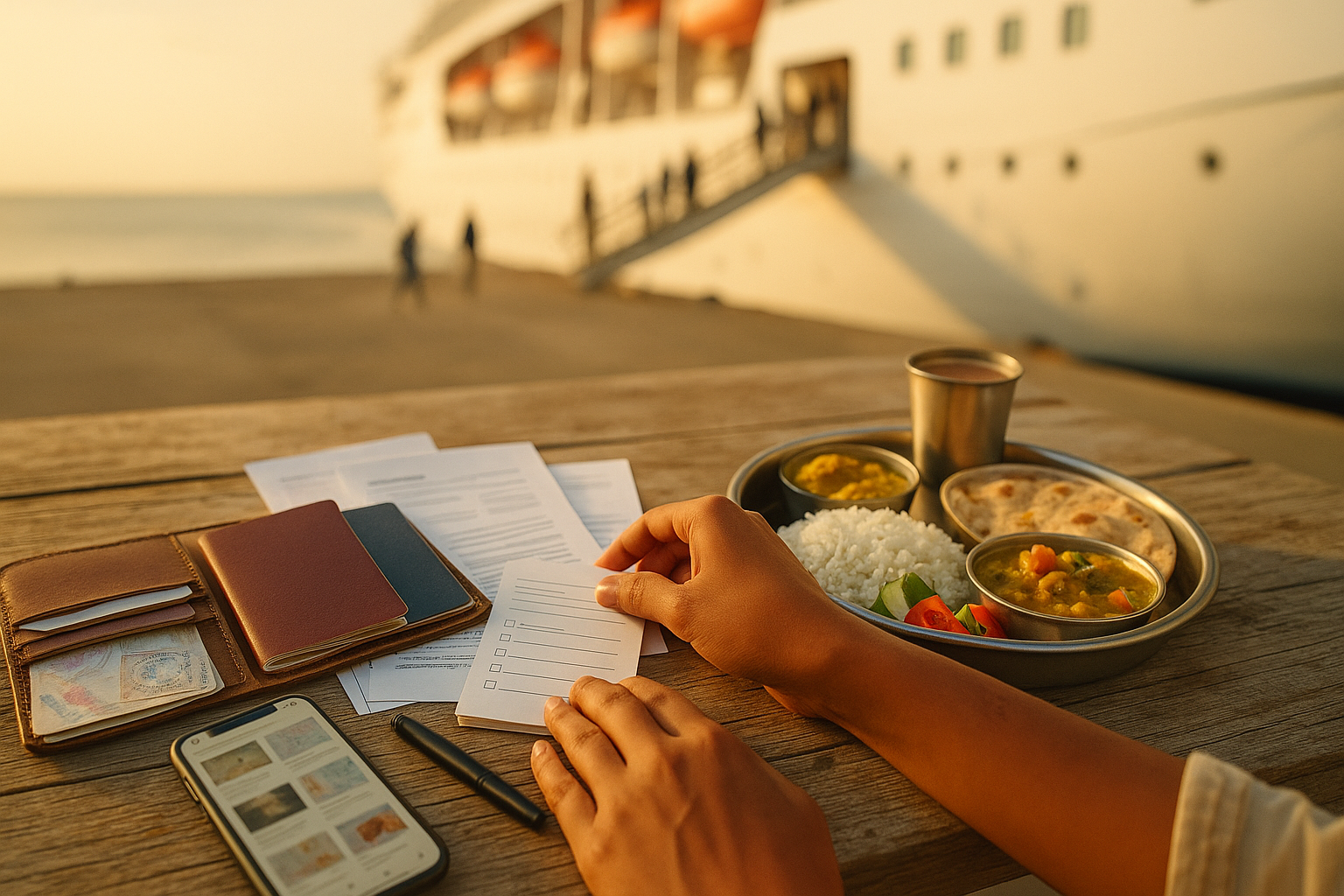
What travel documents do Indian cruise passengers need before boarding?
Carry a valid passport (≥6 months), required visas for ports of call, cruise booking/boarding pass, travel insurance, vaccination records, and notarized minor consent where applicable.
For travel documents, start with originals and carry printed plus digital backups.
- Passport with required validity and blank pages (original).
- Visas or e‑Visas for each port of call (original/printed e‑Visa).
- Cruise booking confirmation and boarding pass (printed and mobile copy).
- Travel insurance proof (policy summary and emergency number).
- Vaccination certificate(s) where required (e.g., yellow fever).
- Notarized minor consent form when children travel without both parents.
- A folder or travel wallet for originals and accessible digital backups (phone/cloud).
What passport validity and blank‑page rules should Indian cruise travellers follow?
Passports should be valid for at least six months beyond your travel/end date and contain the blank pages required for immigration stamping.
Passport validity is a common requirement for many cruise destinations and operators such as Royal Caribbean and cruise.travel.in advise six‑month validity; many countries also expect two blank pages for entry/exit stamps. Travellers should renew passports before booking if validity or blank pages are lacking.
Which additional documents (insurance, vaccination records, and booking confirmation) should I carry?
Carry proof of travel insurance, vaccination certificates (if required), and your printed cruise booking confirmation and emergency contacts.
- Travel insurance proof: policy summary with emergency contact and coverage dates (should be with you).
- Vaccination certificate(s): yellow fever or other destination‑specific vaccines (may be required at some ports).
- Cruise booking confirmation: printed PDF with reservation number and cruise line contact.
- Medication list and prescriptions: short list for customs/medical needs.
- Emergency contact and cruise line local phone number: printed and in your phone.
If you need to arrange or confirm meal options while booking, see Book Cruises with Indian Cuisine Included: Indian, Vegetarian, and Jain Menu Options.
Which documents do travellers commonly forget?
Commonly forgotten items include travel insurance printouts, vaccination cards, visa/e‑Visa printouts, boarding passes, and notarized minor consent forms.
Commonly forgotten documents cause most embarkation delays; travellers should pre‑departure check a simple documents checklist, print all e‑Visas/insurance summaries, and store digital copies in the cloud and on their phone.
How should I organise and present my travel documents at check‑in to avoid delays?
Organise documents in a single folder with your passport on top, printed boarding pass, visas, insurance and booking confirmation immediately accessible, and keep digital backups.
For presentation at check‑in, complete online check‑in where offered and print your boarding pass; present originals in this order: passport, visa/e‑Visa printout, boarding pass, insurance summary, and any notarized minor consent. Travellers should keep digital copies in an accessible folder on their phone and leave photocopies in luggage as a backup.
Which identification documents do cruise lines accept for embarkation from Indian ports?
A passport is best; most international itineraries require a passport, while some closed‑loop (same‑port roundtrip) sailings may accept a government photo ID plus a birth certificate.
Below is a short list contrasting international versus closed‑loop acceptable IDs.
- International itineraries: passport required for embarkation and for entry to ports of call.
- Closed‑loop (same‑port roundtrip) sailings: some lines may accept a government photo ID plus an original birth certificate instead of a passport.
- One‑way or cruises that disembark in a different country: passport is mandatory.
- Names must match across all travel documents; you should resolve any name differences before travel.
Accepted ID types and alternatives (passport, government ID, birth certificate for closed‑loop sailings)
International itineraries require passports; closed‑loop roundtrips may accept a government photo ID plus a birth certificate—names should match across documents.
- International cruises: valid passport is required and is the preferred document (Royal Caribbean and NCL advise passports as best).
- Closed‑loop (same‑port return) sailings: government‑issued photo ID plus an original birth certificate is commonly accepted by many lines as an alternative to a passport.
- One‑way or multi‑country disembarkation: passport is required; closed‑loop exceptions do not apply.
- Name consistency: cruise lines state names must match exactly across ticketing, ID, and travel documents; you should provide legal name change documentation if needed.
Can I use alternative identification for sailings that start and end in the same Indian port?
Yes: for closed‑loop (same‑port return) sailings some cruise lines may accept a birth certificate plus a government photo ID, but passports remain mandatory for one‑way sailings or any itinerary that requires international disembarkation.
Acceptance for Indian departures may vary by cruise line and port authority and might depend on the ship’s itinerary and immigration rules at ports of call. You should confirm with your cruise line before travel, because some carriers or terminals may still require passports even for closed‑loop sailings originating in India.
What boarding pass and check‑in ID requirements should I expect at Indian ports?
You should expect to present your boarding pass (mobile or printed) plus government ID at terminal check‑in, and you should complete online check‑in where available to speed embarkation.
Most cruise lines offer online check‑in and mobile boarding passes via their websites or apps, but some terminals may ask for a printed boarding pass—keep both options ready. Bring the same ID you used during online check‑in (passport or accepted government ID) and keep all original documents on your person at the pier to present to port staff and the ship gangway.
What additional documents should families travelling with minors carry for embarkation?
Families should carry minors' birth certificates, notarized parental consent if the child travels without both legal guardians, and ID proving the adult–child relationship.
- Minor’s original birth certificate (required to verify parentage and age).
- Notarized parental/guardian consent form if the minor travels with one parent, a single parent, or a non‑guardian adult — the form should state travel dates and destinations.
- Copies of parents’/guardians’ IDs and the accompanying adult’s photo ID.
- Legal guardianship or custody documents when applicable.
- Passports for minors when the cruise visits foreign ports; requirements may vary by cruise line and port, so you should verify specific rules with your carrier.
Which visas and e‑Visa options apply to cruise passengers for each port of call?
Visa needs are port‑specific: treat each port as a separate entry and verify whether an e‑Visa, transit visa, or standard visa is required for each stop. Port‑by‑port rules apply to your itinerary, so you must check entry requirements for every port of call on the route.
Do I need a visa for every country on my cruise route?
Usually yes—each port of call is a separate entry; visa needs depend on nationality and whether you disembark or re‑enter a country. Each port of call is treated like an international border, so immigration rules apply per stop and your nationality, embarkation/disembarkation pattern, and the port’s visa policy determine the actual requirement. Exceptions could apply (for example, some short tender-only stops or visa‑exempt nationalities), so you should confirm for each port rather than assume a single visa covers the whole cruise.
How do I check and apply for port‑specific visas and e‑Visas for my itinerary?
Get a port‑wise itinerary and then follow this checklist:
- Obtain a port‑wise itinerary from your cruise booking or boarding documents; use that itinerary as the basis for visa checks.
- You should check the embassy or official visa website for each country on the itinerary to confirm visa type (e‑Visa, transit visa, standard visa), entry ports allowed, and document requirements.
- You should consult your cruise line’s travel‑documents page (for example, Norwegian Cruise Line, Royal Caribbean, MSC or NCL visa support) because cruise lines often summarise common requirements and advise passenger responsibility.
- You may use a paid visa service or travel agent if you have multiple or complex visas; these services can apply on your behalf.
- You should apply online for e‑Visas through the country’s official portal where available, or submit applications to the relevant consulate for standard visas, and carry printed copies of all approvals aboard.
How long do common cruise‑related visas take to process and when must I apply?
Processing varies: some e‑Visas can issue in 2–7 business days, while consular (standard) visas may take weeks; you should apply as early as possible and allow overlap for multiple visas. Processing for India’s cruise e‑Visa is commonly reported as 2–7 business days, but other e‑Visas may vary and consular visas could require substantially longer lead times; you should check each embassy’s stated processing window. For itineraries with multiple ports, you should start the slowest (consular) visas first and submit e‑Visa applications closer to departure, and you may apply concurrently if timelines overlap.
Passport vs Visas: Which matters more for smooth cruise entry?
Both matter, but passport validity is the non‑negotiable first priority—renew first, then secure required visas specific to ports of call.
Follow these decision rules before you travel:
- renew first, then apply for visas.
- check visa requirements and deadlines for each port after renewal.
- consider concurrent actions only with contingencies.
Passport validity is a hard cutoff that often prevents boarding or entry; visas are required for specific ports and are the traveller’s responsibility. Royal Caribbean and Norwegian Cruise Line emphasise that an invalid passport blocks travel, and cruise.travel.in advises renewing before applying for visas. You should prioritise passport renewal because visas normally tie to passport number and expiry; missing or incorrect visas cause denial at the port, while an expired passport typically stops you earlier in the process. Renew first, then apply to minimise failure modes.
If my passport is near expiry, should I renew before applying for visas?
Yes—you should renew first, because many visas require the passport to be valid for six months beyond travel and visas tie to passport details. Renew first. Renewing avoids submitting visa applications with an old passport number and expiry that could invalidate the application or require reissuance. Consulate rules may vary, so you should check each destination’s requirements, but the practical rule is renew first to keep visa processing clean.
When visa processing times conflict with passport renewal timelines, what’s the best approach?
You should renew then apply; if time is tight, consult the consulate or cruise line about updating pending applications or reissuing visas. Renew then apply remains the recommended sequence, but you may prepare visa paperwork and supporting documents while the renewal is in progress. If a visa is already pending when your passport changes, you may need to request an amendment or reapplication—NCL advises confirming consulate policies and natvisatravel notes reapplication or correction steps could be required—so contact the consulate and the cruise line early to confirm contingency options.
How does India's digital e‑arrival (disembarkation) form and e‑Visa rules affect cruise passengers?
Cruise passengers should submit India’s e‑arrival form up to 72 hours before disembarkation; e‑Visas may be limited to designated seaports—verify port eligibility and OCI status rules before travel.
In short, key points for cruise passengers are:
- Where to submit: indianvisaonline.gov.in, the Bureau of Immigration portal, or the Su‑Swagatam mobile app.
- Timing: you should submit the e‑arrival form up to 72 hours prior to disembarkation for fastest processing.
- Port eligibility: e‑Visas can be restricted to designated seaports; confirm your specific port is permitted.
- OCI interaction: OCI cardholders generally do not need a visa but must carry their OCI and passport.
- Missed submission: paper disembarkation forms will be accepted during the transition period (paper acceptance continues for six months), but expect extra port processing.
Where and when must cruise passengers submit India's e‑arrival (disembarkation) form?
Submit India’s e‑arrival form via indianvisaonline.gov.in, the Bureau of Immigration portal, or the Su‑Swagatam mobile app, and you should submit it up to 72 hours before disembarkation.
Please use one of the official digital channels listed above for the fastest processing; the Government of India recommends the digital option. If you cannot use the digital route, paper disembarkation forms remain temporarily accepted (the government notes a transition period), but you should expect slower processing than digital submissions.
Will an India e‑Visa allow disembarkation at any Indian seaport (are e‑Visas limited to designated seaports)?
India e‑Visas for cruise passengers are limited to designated seaports.
Known example ports that are commonly listed for e‑Visa cruise entry include Chennai, Cochin, Mormugao, Mumbai, and New Mangalore. Travellers should verify that the specific Indian port of disembarkation is eligible for entry on an e‑Visa by checking the official Indian e‑Visa/immigration information or confirming with the ship operator before travel.
Do OCI cardholders need a visa to enter India when arriving by cruise?
No — OCI cardholders do not need a visa for most entries to India, including when arriving by cruise.
OCI holders must carry their OCI card and a valid passport and should confirm any port‑specific procedures with official OCI/Bureau of Immigration guidance before sailing, as port processes could require additional verification.
What happens if I miss the e‑arrival submission window before my cruise disembarks in India?
If you miss the e‑arrival submission window, paper disembarkation forms will be accepted during the transition period, but you should expect extra processing at the port.
Fallback steps include completing a paper disembarkation form on arrival and presenting your passport, e‑Visa or OCI documentation to Bureau of Immigration staff. Missing the digital window can cause additional checks and delays, so you should complete the paper form immediately, keep documents ready, and follow BOI staff instructions at the port.