A cruise is the travel product represented by cruise travel and cruise ship travel, and this page explains the methods and expectations for requesting and receiving special dietary meals on cruise ships. Cruise lines typically accommodate allergies, medical diets, and lifestyle or religious diets, but availability and limits vary by line and ship; travelers should check line‑specific policies and notify the cruise early so the ship can plan supplies and preparation.
Diet‑specific realities matter: many ships offer gluten‑free entrées and alternatives though gluten‑free breads and pasta may be limited depending on provisioning, and kitchens can prepare nut‑free meals but cross‑contact risk can remain in shared galleys. Prepackaged certified kosher meals are generally more reliable and commonly require long lead times (for example, Royal Caribbean advises 45–90 days’ notice). The Disney Adventure carries Jain meals and Disney asks for at least 35 days’ notice for some cultural/lifestyle requests.
Before you sail, use My Reservations/Cruise Planner, the cruise line’s special‑needs email/phone, or your travel agent to submit requests and, for complex or medically necessary diets, contact the special‑needs department and request a chef review. Confirm your request at booking, again 24–72 hours pre‑embarkation, and on embarkation day with the dining team; keep written records. Onboard, the Main Dining Room (MDR) is usually safer than the buffet because dedicated staff, chef consultation, and pre‑order capability reduce cross‑contact risk, but ships often do not have separate allergy kitchens and onboard measures are risk‑reduction rather than an absolute guarantee.
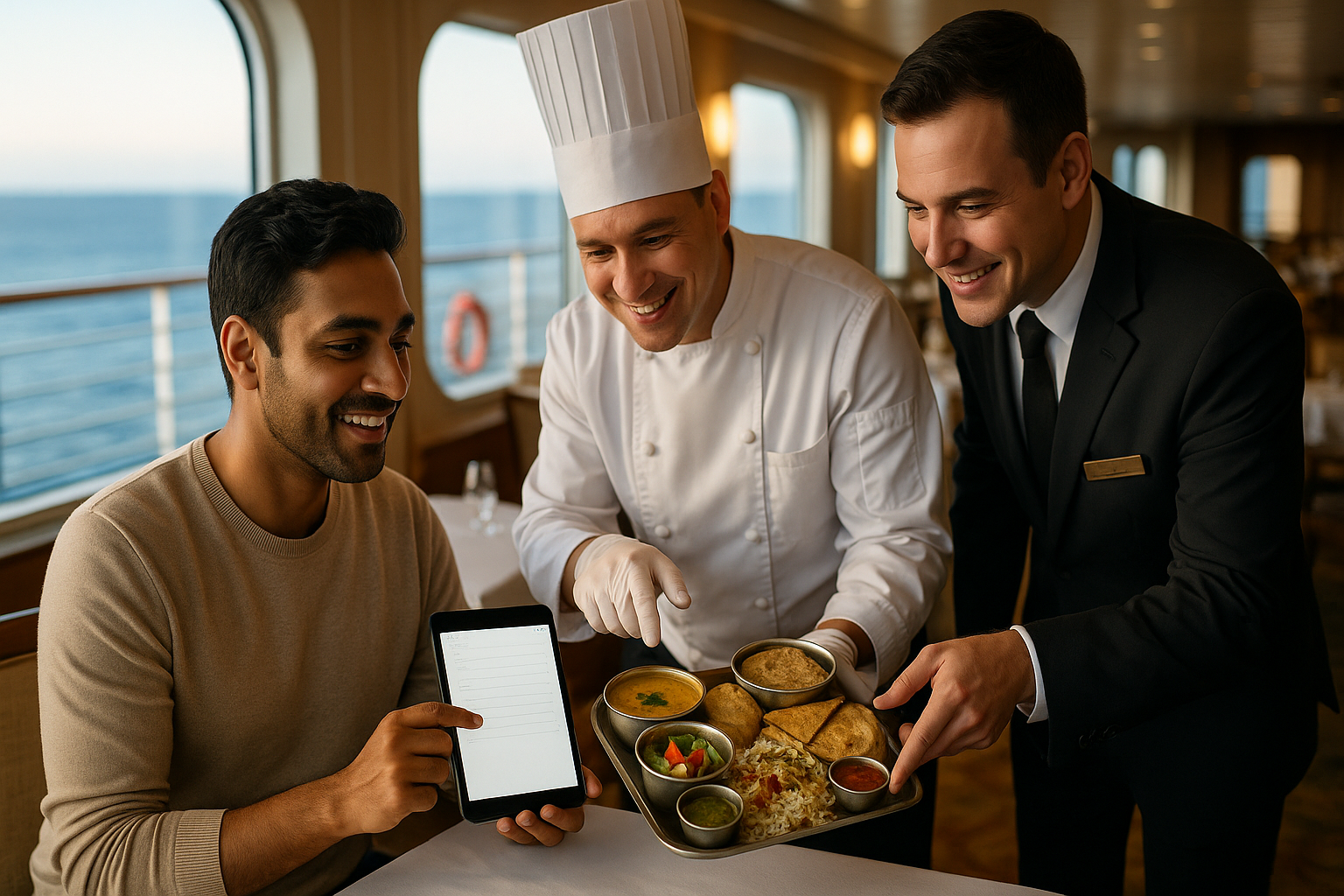
What options are available for dietary restrictions on cruises?
Cruise lines typically offer accommodations for allergies, medical diets, and lifestyle or religious diets but availability and limits vary by line/ship.
Cruise dining teams accommodate a broad range of needs—from allergy‑friendly and gluten‑free to vegetarian, vegan, diabetic, low‑sodium and kosher—but specific menus, ingredients and preparation methods may be limited and may depend on ship provisioning and itinerary. Travelers should check line‑specific policies and notify the cruise early so lines can plan supplies and preparation.
What common allergies and medical diets do cruise lines typically accommodate?
Most lines accommodate common allergies and medical diets—gluten‑free, nut‑free, dairy‑free, diabetic, low‑sodium—though preparation methods and supplies vary by ship.
Below are common accommodation categories and typical limits you should expect:
- Gluten‑free — Many ships offer gluten‑free entrées and alternatives; gluten‑free breads/pasta may be limited and depend on ship provisioning.
- Nut‑free — Kitchens may prepare nut‑free meals, but cross‑contact risk can remain in shared galley spaces.
- Dairy‑free / lactose‑free — Lactose‑free milk and dairy‑free dessert options may be available but selection varies.
- Diabetic / low‑sugar — Low‑sugar or diabetic‑friendly dishes are commonly offered, though precise carbohydrate control may be limited.
- Low‑sodium / heart‑healthy — Low‑sodium options are typically possible on request, with salt‑free preparation on occasion.
- Renal‑friendly / other medical diets — Some ships can adapt meals for renal or very specific medical needs, but these requests may be more constrained and depend on advance provisioning.
Do accommodation levels vary by cruise line or ship?
Accommodation levels vary by cruise line, ship, and itinerary, so you should confirm policies with the carrier before booking.
Some operators and individual ships have deeper plant‑based menus or specialty provisioning (for example, lines widely advertise gluten‑free and vegetarian offerings, and some premium lines emphasize extensive vegan options), while others offer a narrower range. Major lines like Royal Caribbean and Carnival state they accommodate gluten‑free, vegetarian, kosher, low‑sodium and similar needs, but specifics (menu depth, prepackaged kosher availability, advance‑notice requirements) may differ and may require advance notice. You should check the cruise line’s dietary policy and notify them well before sailing so the ship can accommodate your needs.
Which types of special diets can cruise lines commonly accommodate (e.g., vegetarian, vegan, Jain, kosher, halal)?
Cruise lines commonly accommodate vegetarian, vegan, Jain, kosher and halal diets, but each type has different provisioning, lead times and reliability.
Lines typically handle plant‑based, religious and medical diets through main dining rooms (MDR), buffets and specialty venues; some meals arrive prepackaged while others are prepared onboard, so availability may depend on the ship, itinerary and advance notice. Below are practical expectations and typical limits for the major diet types.
Vegetarian and vegan — what to expect onboard?
Vegetarian and vegan options are commonly available; specialty venues and buffets may have limited plant‑based items, so preordering and speaking with the dining team helps.
- Common offerings and where to find them — Expect salads, vegetable mains, stir‑fries, plant‑based burgers and dairy‑free desserts in the Main Dining Room (MDR) and at buffet/Windjammer stations; some specialty restaurants offer a small vegan entrée.
- Limits in specialty venues — Specialty restaurants and quick‑service outlets may have fewer vegan choices and may not carry vegan substitutes at every sitting; options may be limited without advance notice.
- How to request expanded options — Tell the cruise line at booking or via the Cruise Planner/special requests, confirm with the head waiter on embarkation day, and preorder meals or desserts when possible to increase variety and consistency.
Jain and Indian cuisine availability — when is it offered?
Jain and Indian meals are available on some ships (for example, the Disney Adventure) and require advance notice; availability depends on ship and itinerary.
Disney documents that Jain meals are exclusively offered on the Disney Adventure and requests for Jain/halal/kosher meals must be submitted in advance (Disney asks for at least 35 days for some cultural/lifestyle requests). Because supply and crew training vary by ship and route, you should check the specific ship’s special‑diet policy and submit the request early through the cruise line’s special requests or Special Services form.
Kosher and halal — prepackaged vs onboard-prepared: what’s more reliable?
Prepackaged certified kosher meals are generally more reliable; onboard-prepared halal and vegetarian options are more flexible but depend on supplies and ship procedures.
The following compares reliability, lead times and typical limits:
- Kosher — Expectation: Many lines offer prepackaged kosher meals that are sealed and labeled; Reliability/limits: these prepackaged meals often require long lead times (Royal Caribbean advises 45–90 days' notice) and are more consistent because they arrive sealed from certified suppliers.
- Halal — Expectation: Halal meals may be arranged and prepared onboard or provided using halal‑certified meats on select ships; Reliability/limits: fresh halal meat and full halal catering may not be available on every ship—availability often depends on itinerary and advance notice (some ships, like certain Disney sailings, accept halal-certified meat requests with advance notice), so onboard preparation may vary by sailing.
Overall, prepackaged kosher provides higher assurance if you need certified supply chains and seals; halal and other religiously compliant meals can often be accommodated onboard but may require specific advance requests and are subject to supply and procedural limits.
What methods can I use to request special dietary meals before a cruise?
Use online reservation tools (My Reservations/Cruise Planner), the cruise line’s special‑needs email/phone, a travel agent, or by phone — and reconfirm before embarkation.
Cruise lines commonly let you add dietary requests in your booking account or pre‑cruise planning tools; Royal Caribbean, for example, allows requests via the booking page (“update personal information”) or by emailing special_needs@rccl.com. Use the cruise line tools first for routine needs, email/phone for documented or urgent questions, and involve a travel agent when your request is detailed or complex.
Follow these steps to submit your request before sailing:
- Choose the right channel for your need (see channels below).
- Include the required information (see next section for the exact fields).
- Follow up and reconfirm at key moments (booking confirmation, 24–72 hours pre‑embarkation, and again on embarkation day).
Which channels can I use (online form, Cruise Planner, email, travel agent, phone)?
Use online reservation tools (My Reservations/Cruise Planner) first; use the cruise line special‑needs email/phone or a travel agent for more complex or medical cases.
Common channels and when to use each:
- My Reservations / Cruise Planner: first place to add routine dietary notes and “Special Requests” on your booking; Disney and Royal Caribbean both accept requests this way.
- Cruise line booking or customer‑care phone: use for confirmations, urgent clarifications, or when the website doesn’t have the right form.
- special_needs email (e.g., special_needs@rccl.com): use for documented medical requests or when you must include attachments and detailed explanations.
- Navigator app or onboard tools (for lines that support it): use to remind the ship’s dining team once you’re assigned a sailing.
- Travel agent: you should use an experienced travel agent when your requirements are complex, need coordination (kosher/halal logistics), or you want a single point of contact to follow up.
What exact information should I include when submitting a dietary request?
Include full name, reservation number, ship name, sail date, a clear description of the restriction, whether it is medical or a preference, the severity, and any supporting documentation.
Include full name and reservation number so staff can locate your booking; include ship name and sail date to ensure the request goes to the correct sailing. Include a precise description (ingredients to avoid, preferred substitutions), state whether the need is medical versus a lifestyle preference and describe severity (e.g., anaphylaxis risk). You should include medical documentation when the diet is medically necessary or when the line requests proof.
Which channel should I choose for complex or medically necessary diets?
For complex or medical diets you should contact the cruise line’s special‑needs department by email or phone and involve your travel agent, and request a chef review or that your reservation be flagged.
For complex allergies, kosher/halal logistics, or medical diets, email the designated special‑needs address (Royal Caribbean’s special_needs@rccl.com is one example) or call the cruise line so you can attach documentation and get a formal record. You should ask the line or your travel agent to flag the reservation for a chef/dining‑team review and request written confirmation that the requirement is noted. Cruise Critic and line guidance also recommend meeting the head waiter or chef onboard to review preparation and cross‑contamination procedures.
Should I confirm my dietary request after booking and how often?
Yes — confirm at booking, again 24–72 hours pre-embarkation, and on embarkation day with the dining team; keep written records.
Follow these steps to reconfirm your request:
- Confirm when you first add the request in My Reservations/Cruise Planner and save any automated confirmation emails or screenshots.
- Reconfirm 24–72 hours before embarkation by checking Cruise Planner, sending the special‑needs email, or calling customer service.
- Reconfirm on embarkation day by attending the onboard dining session, meeting the head waiter or dining team, and asking for the chef to review if needed.
- Keep written records of every confirmation (emails, screenshots, agent notes) so you can show the dining team if there’s any confusion.
What advance notice is required for kosher, halal, Jain, vegetarian, or vegan meals?
Lead times vary: simple allergy requests may need 3 days, while cultural or prepackaged meals commonly require weeks—typical windows range from 3 days up to 90 days; Kosher‑for‑Passover often requires 10 weeks or 90 days, depending on the line.
Different cruise lines and itineraries handle requests differently, so you should confirm deadlines when booking. Simple allergy or substitute items are often handled close to embarkation, whereas religious, cultural, or sealed/prepackaged meals require procurement, which drives longer lead times and possible itinerary‑specific rules.
Kosher and Kosher‑for‑Passover lead times
Kosher meals commonly require at least 45 days' notice (sometimes 90 days for certain itineraries); Kosher‑for‑Passover often requires 10 weeks or 90 days, depending on the cruise line.
Kosher provisioning usually involves prepackaged, certified items and supplier coordination, so many operators set firm cutoffs. Royal Caribbean asks to be notified at least 45 days prior (and 90 days for European/South American itineraries) and states Kosher‑for‑Passover requests must be received 90 days in advance. Disney Cruise Line lists Kosher‑for‑Passover requests at 10 weeks' notice. Practices vary by line and itinerary, so confirm the exact requirement with your carrier or travel advisor.
The following are typical lead times seen on major lines:
- Royal Caribbean: Kosher — notify at least 45 days (90 days for some itineraries); Kosher‑for‑Passover — 90 days.
- Disney Cruise Line: Kosher‑for‑Passover — 10 weeks.
- General industry guidance (varies by line): specialized kosher provisioning can require weeks to months.
Typical lead times for vegetarian, vegan, Jain and other diets
Typical windows range from 3 days for simple allergy forms to about 35 days for cultural requests, and many lines ask 45–90 days for complex or prepackaged provisions.
Vegetarian meals are commonly available on standard menus and often do not require a special request on many lines, but you should still confirm at booking. Vegan options are increasingly common and may be arranged with short notice on some ships, though variety and availability vary by operator. Jain and halal are usually treated as special cultural requests that need more lead time—Disney lists 35 days for Special Requests such as Jain or halal; Cruise Critic and other line guidance note many special provisions may require 45–90 days. For allergy‑style adjustments (peanut/tree‑nut/gluten avoidance), some lines accept as little as 3 days when submitted through their Special Services form.
Typical lead times by diet (examples of line practices):
- Allergy/Simple substitutions: 3 days (Disney Special Services for allergies).
- Jain / Halal / similar cultural requests: ~35 days in some programs (Disney lists 35 days for Special Requests).
- Vegetarian: Often available without special notice on menus (Royal Caribbean notes vegetarian meals are on all menus).
- Vegan: Available on request; confirm timing and menu variety with the line.
- Complex or prepackaged dietary provisions (including some kosher/halal packages): 45–90 days (industry guidance and Cruise Critic summary).
You should always verify the cruise line’s specific deadline at booking and repeat the request once aboard to ensure the dining team has it on file.
What is the onboard dining process and safety protocol for special‑meal requests?
Once aboard, guests meet the dining team, pre‑order or consult the chef, and ships follow ingredient checks and separation steps to reduce cross‑contact—though separate allergy kitchens are rare.
Cruise lines expect you to confirm requests on embarkation day: you should attend any Onboard Dining Session and introduce yourself to your dining team. The Main Dining Room (MDR) is usually the best place to start because it offers a consistent team, more kitchen resources, and direct chef access for custom preparation. Chefs and restaurant managers review your reservation notes, verify ingredients, and plan next‑day preparations to reduce risk of cross‑contact.
How does the Main Dining Room (MDR) handle special meal requests?
In the Main Dining Room (MDR) you meet the head waiter, pre‑order or consult the chef (often 24 hours ahead), and dedicated staff coordinate custom meals.
The MDR is preferred because it builds a consistent relationship between you and the dining team and gives chefs time to source or prepare alternatives. The MDR workflow typically follows these steps:
- Meet the host or head waiter at the MDR host stand on embarkation day and confirm your dietary needs; you should introduce yourself to the head waiter.
- The assigned waiter flags your reservation to the chef and kitchen team so the chef can review ingredients and plan preparation.
- You pre‑order dishes (often 24 hours before service) so the chef can prepare substitutions or batch items separately.
- Dedicated waiters and chefs coordinate service each night so the same staff handle your meals when possible, reducing errors and improving consistency.
What safety measures do cruise lines use to prevent cross‑contamination?
Cruise safety measures include ingredient verification, separate preparation steps when possible, labeled/prepackaged items, and chef briefings—separate allergy kitchens are rare.
The following are typical protocols used onboard to reduce cross‑contact:
- Ingredient verification: chefs check supplier labels and ingredient lists to confirm allergens or forbidden items.
- Separate prep steps: kitchens may prepare allergy‑safe items on different surfaces, use separate utensils, or stagger preparation times when feasible.
- Labeled and prepackaged items: some dietary meals (for example, kosher or certain allergy meals) are supplied prepackaged and clearly labeled.
- Chef briefings and communication: kitchen and dining staff receive notes or briefings each service about guests with special needs to ensure everyone understands restrictions. Limitations: ships often do not have a separate allergy kitchen and cannot guarantee an item is completely free of cross‑contact; you should treat onboard measures as risk‑reduction rather than an absolute guarantee.
What should I do if a meal is prepared incorrectly onboard?
If a meal is incorrect, notify your waiter, head waiter, or chef immediately, request a replacement, use emergency medication if allergic, and document and report the incident.
Follow these steps right away:
- Notify your waiter and ask for the head waiter or chef to review the dish; insist the incorrect plate not be served to you.
- Request a replacement or an alternate dish that the chef confirms is safe.
- If you are experiencing an allergic reaction, use your emergency medication (for example, an epinephrine auto‑injector) and seek ship medical attention immediately.
- Preserve evidence and document the incident: take a photo, note the time, the staff involved, and what was said.
- Report the issue through ship channels: inform the dining manager and Guest Services and request that the incident be logged; you should escalate to ship medical and Guest Services if the response is insufficient or if you suffered a reaction.
Allergy and venue safety — which dining venue is safer: Main Dining Room or buffet?
The Main Dining Room (MDR) is usually safer than the buffet because dedicated staff and chef access reduce cross‑contact risks; buffets carry higher cross‑contact exposure.
Compare at a glance:
- Main Dining Room (MDR): Dedicated waiter/head waiter and chef consultation, plus the ability to pre‑order and confirm ingredients, reduces cross‑contact and improves allergy management.
- buffet: Self‑service stations and shared utensils increase cross‑contact risk; you may need supervisor assistance or freshly prepared items to lower exposure.
Why the Main Dining Room (MDR) is usually safer than the buffet
MDR is usually safer because dedicated staff, chef consultation, and pre‑order capability reduce cross‑contact risk compared with buffet self‑service.
In the MDR your waiter or head waiter becomes the point person for your allergy and chefs can prepare or confirm dishes away from busy shared stations. Pre‑ordering lets the kitchen plan for safe ingredients and dedicated preparation, which strengthens allergy protocols. For these reasons you should choose the MDR when practical for the simplest, most controlled dining experience.
When is it acceptable to use the buffet and what precautions should I take?
You may use the buffet with precautions: speak to a supervisor, avoid self‑service shared utensils, and request freshly prepared items when possible.
Practical steps you should follow:
- Speak to the buffet supervisor or host on arrival and explain your allergy; ask which stations they consider safe.
- Avoid high cross‑contact self‑service areas (shared salad bars, communal toppings, open dessert counters) and shared utensils.
- Ask staff to fetch or plate items for you, or request freshly prepared dishes from the kitchen rather than using display trays.
- If a station cannot guarantee separation, choose an alternative venue (MDR or specialty restaurant) instead.
Precautions to carry yourself (translation cards, medical ID, snacks, meds)
Carry a clear allergy translation card, wear medical ID, pack safe snacks and emergency medications (e.g., EpiPen), and double‑check each meal's ingredients.
Carry and prepare for travel:
- Carry a translation card that lists exact allergens to avoid and severity; have it printed in the cruise language or common local languages.
- Wear a medical ID bracelet and ensure travel companions know your allergy plan.
- Pack safe, shelf‑stable snacks to use if no safe option is available.
- Carry emergency medications (EpiPen, antihistamine) and keep them accessible; you should notify ship medical staff of severe allergies.
- Double‑check ingredients with your MDR waiter or the buffet supervisor every time, even if you pre‑requested special meals.
Line‑and ship‑specific offerings, policies, and supplementary FAQs
Lines and ships differ—check the operator's policy pages or contact special‑needs email/agent for ship‑specific rules and exceptions.
Cruise lines operate different submission channels, lead times, and ship‑level menus, so you should verify each ship’s options before booking. Check the operator's policy pages and follow the line’s Special Requests/Special Services forms or the special_needs email/contact method for ship‑specific exceptions and deadlines.
Ship/line examples and special cases (e.g., Disney Adventure Jain, lines with extended vegan options)
Examples: Disney Adventure offers Jain meals; Royal Caribbean accepts special_needs emails and uses 45/90‑day rules; verify each line's contact and deadlines.
Below are representative examples showing how lines differ and how you should follow up with the operator.
- Disney Cruise Line — Disney offers two request paths (Special Requests for lifestyle/cultural needs like kosher, halal, Jain and Special Services for allergies). The Disney Adventure is an example ship that carries Jain meals; lifestyle requests often need about 35 days' notice while allergy forms may be shorter. Submit via My Reservations, the Disney Cruise Line Navigator app, or phone and verify on embarkation day.
- Royal Caribbean — Royal Caribbean accommodates many diets but requires advance notice (notify at least 45 days; 90 days for certain itineraries). You may email special_needs@rccl.com with guest names, booking number, ship and sail date; emails get an automated response and late requests depend on ship availability.
- Carnival — Carnival provides a Special Accommodations/Special Needs workflow and asks guests to complete pre‑cruise forms so the ship can prepare; policies and handling may differ by ship, so complete the line’s pre‑cruise process and confirm onboard.
- Oceania / Celebrity and select lines — These operators may offer stronger plant‑based or vegan menus (Oceania is noted for many vegan options; Celebrity emphasizes plant‑based choices). Availability varies by ship and should be verified with the operator before booking.
- Practical follow‑up example — For any of the above, include your reservation number, ship name, sail date, and a clear description of the diet when you contact the line or your travel advisor; verify the note appears in your reservation and remind your dining team once onboard.
For step‑by‑step booking advice and options that guarantee availability, see How to Book Cruises with Guaranteed Indian, Vegetarian, and Jain Cuisine.
Do I need to bring medical documents?
Sometimes — for medically necessary diets hospitals/schools may ask; for cruises, documentation is rarely required but helpful for complex medical diets; check line policy.
Cruise lines rarely demand a doctor’s note, but you should bring documentation if your diet is medically necessary to speed communication with chefs and the medical team. Documentation helps onshore providers and institutions; you should still check the operator's policy in advance and carry emergency medication and a clear ingredient/allergy card.
Can I bring my own food onboard?
Sometimes — nonperishable snacks and baby formula generally allowed; perishables and large quantities are often restricted; check both cruise line and port/customs rules.
Lines commonly permit nonperishable snacks and baby formula but restrict perishables and large quantities; crew are often prohibited from storing, reheating, or preparing guest‑brought food. You should check the operator's policy and port/customs rules before packing and expect to declare food at some ports.
Are kosher meals guaranteed on every ship?
No — kosher meals are not guaranteed on every ship; when available they often require preordering and may be prepackaged with long lead times.
Kosher options are frequently limited and commonly come as sealed/prepackaged meals that must be ordered well in advance; some operators require specific lead times (for example, kosher or kosher‑for‑Passover requests may require up to 90 days or follow lines’ 45/90‑day rules). You should preorder through the line’s Special Requests system and confirm exactly what form the kosher meal will take before sailing.