This article evaluates dhow, mega‑yacht and short multi‑night sailings from Dubai and the Arabian Gulf with respect to the availability and suitability of Indian and Jain dining, provisioning processes, and booking implications. Indian and Jain dining is commonly available on Dubai dinner dhows and many short Gulf sailings via vegetarian/Jain buffet counters, live‑cooking or street‑food stations, and by pre‑ordering strict Jain meals.
Buffet, dedicated veg/Jain counters and live‑cooking stations are the usual serving formats: dhows typically use buffets plus a live counter; larger mega‑yachts may offer multiple live stations and specialty counters. Typical offerings include North and South Indian curries, tandoori items, pav bhaji and live chaat; Jain variants remove root vegetables and may include Jain BBQ and thali selections. Strict Jain meals require at least 24 hours’ notice and written confirmation; reconfirmation at hotel/transfer and on boarding is recommended, with clarification of any limitations or surcharges.
Boarding points include Dubai Marina, Dubai Creek and Dubai Water Canal; short regional sailings commonly visit Sir Bani Yas, Khasab, Muscat and Doha on 2–3‑night itineraries that can be combined into 4–7 night trips. Dinner dhows usually run about 2–3 hours. Prices commonly range AED 120–300 (some tickets advertised from AED 45); fares typically include the buffet dinner and entertainment; transfers and alcoholic drinks are often extra. Dhows suit traditional buffet dining and cultural shows; mega‑yachts deliver luxury dining and resident DJs; private yachts and ferries suit small‑group sightseeing.
Many providers offer free cancellation up to 24 hours before departure; verification of DTCM safety permits and of an operator's alcohol licence or dry‑cruise policy is recommended. Operators that advertise certified vegetarian/Jain menus include Resorts World One, Ocean Empress and Lotus; such claims require verification by requesting menu PDFs, certification documents and kitchen‑segregation details prior to booking.
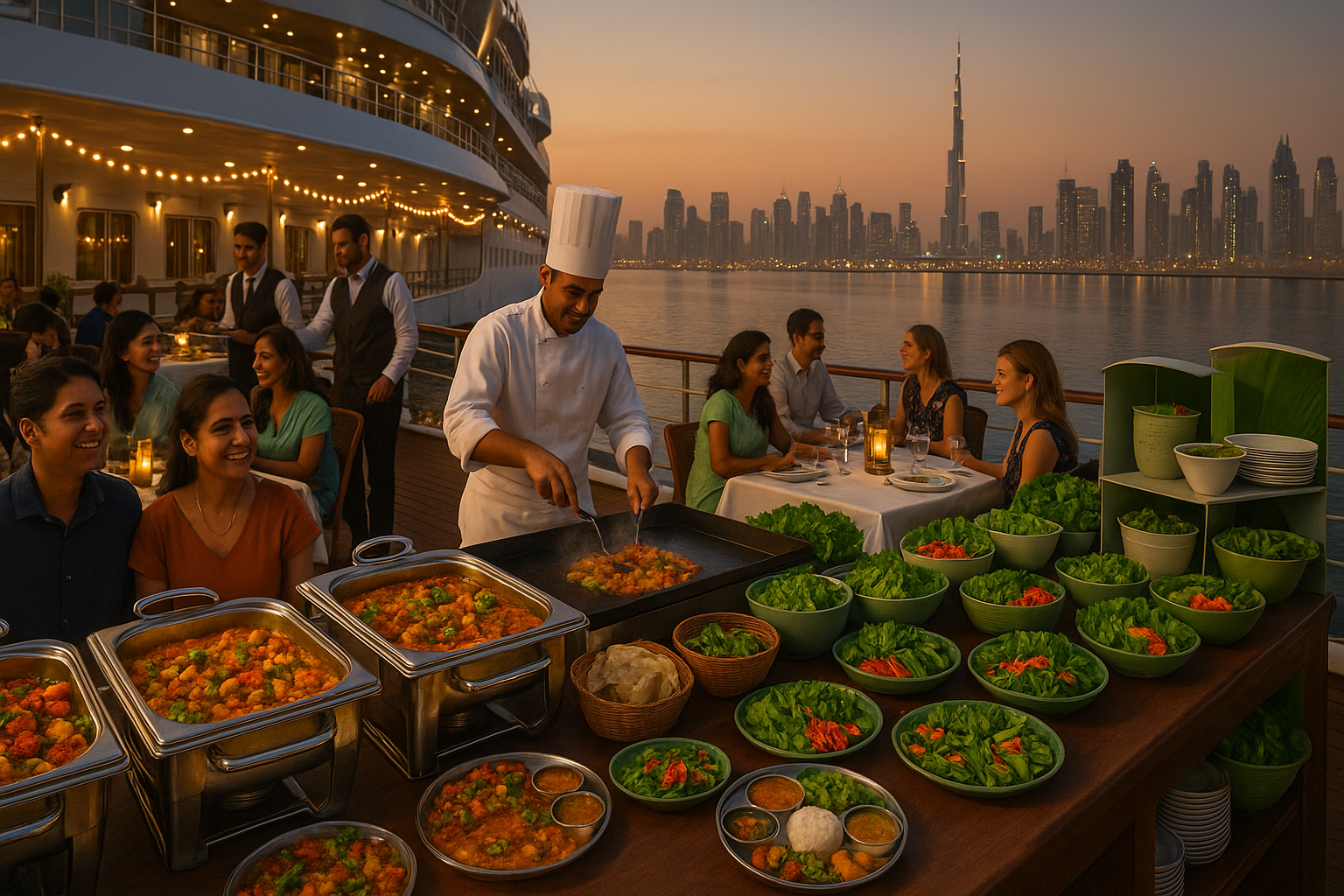
What Indian and Jain food options are available on Dubai & Middle East cruises?
Indian and Jain dining is widely available on Dubai dinner dhows and many Arabian Gulf sailings via vegetarian/Jain buffet counters, live-cooking stations, or pre-ordered strict Jain meals. Availability frequently affects vessel and operator selection.
Several operators and tour packages explicitly advertise dedicated vegetarian or Jain menus (Resorts World One, Ocean Empress, Lotus). Many dhow dinner services include Indian buffets and live street-food counters, permitting passengers to select a vessel that meets dietary requirements and booking lead times.
What meal formats are offered onboard — buffet, dedicated Jain/veg counters, or live‑cooking stations?
Buffet, dedicated veg/Jain counters, and live‑cooking or street‑food stations are common onboard. Dhows typically use buffets and a live counter; mega‑yachts and larger ships may offer multiple live stations and specialty counters.
Below are the common formats and where they are most likely found:
- Buffet — Standard on many dhow dinner cruises and on larger yachts and mega‑yachts that advertise Indian cuisine.
- Dedicated veg/Jain counter — Several vessels, including some dhows and mega‑yachts, provide separate vegetarian and Jain counters or pure‑veg/dry‑cruise options.
- Live‑cooking or street‑food counters — Live chaat, pav bhaji, pav‑style counters and other live stations appear frequently on Marina dhows and on upscale yachts; Ocean Empress is promoted with live cooking stations.
What typical dishes and menu examples should travellers expect for Indian and Jain meals?
Travellers should expect North/South Indian curries, tandoori items, pav bhaji and live chaat counters, with Jain variants removing root vegetables and offering Jain BBQ and thali selections.
Menus on advertised dhow and yacht dinners commonly include curries, tandoori/grilled vegetables, pav bhaji at a live counter, rice and breads, and Indo‑Asian options; Jain adaptations may replace root vegetables, present pure‑veg thalis, and include Jain BBQ items as noted in Jain tour itineraries and cruise product descriptions.
Requesting accommodation for strict Jain preparation requirements
Operators commonly accept strict Jain meal requests; pre-ordering at least 24 hours in advance and obtaining written confirmation is typically required. Requests are submitted via the booking form or through the concierge; reconfirmation at hotel check-in, transfer meeting point, or on boarding is recommended. Menu limitations and potential surcharges should be clarified. Claims of "certified" Vegetarian/Jain menus on some deployments should be verified with the cruise or tour operator.
What cruise routes and destinations are offered from Dubai and the Arabian Gulf?
Local boarding points include Dubai Marina, Dubai Creek and Dubai Water Canal; short regional sailings commonly visit Sir Bani Yas, Khasab, Muscat and Doha on 2–3 night itineraries.
These options group into short, night‑time city cruises from Dubai’s three main piers and multi‑night regional voyages that depart Dubai for nearby Gulf and Gulf‑of‑Oman ports. Local cruises are ideal for skyline sightseeing or dinner experiences; regional sailings serve as short turnarounds (2–3 nights) and can be combined into longer trips.
Which local routes (Dubai Marina, Dubai Creek, Dubai Water Canal) are best for evening dinner or sightseeing cruises?
Marina provides skyline and luxury dinner cruises; Creek suits heritage sightseeing and quieter traditional dinners; the Water Canal offers short city‑view cruises past Business Bay, Festival City and parts of Downtown. Marina and Water Canal routes are most commonly used for evening dinner services.
- Marina — Dubai Marina hosts skyline and luxury dinner cruises. Operators commonly advertise Indian buffets and live cooking counters; luxury vessels and mega‑yachts such as Ocean Empress and Lotus operate evening dining and entertainment.
- Creek — Dubai Creek offers heritage sightseeing and a quieter, traditional ambience; cruises focus on older Dubai landmarks and often use traditional dhows for calmer dinner experiences.
- Water Canal — Dubai Water Canal provides framed views of Business Bay, Festival City and sections of Downtown; it is frequently used for short sightseeing and evening dinner cruises that focus on urban landmarks.
Which short Arabian Gulf itineraries depart from Dubai (Sir Bani Yas, Khasab, Muscat, Doha)?
Operators advertise 2‑night Sir Bani Yas, 3‑night Oman (Khasab–Muscat) and 2‑night Doha sailings; departures can be combined to create 4–7 night cruises.
Resorts World One, for example, homeports in Dubai and lists a 2‑night Sir Bani Yas weekend cruise, a 3‑night Oman cruise calling Khasab and Muscat and a 2‑night Doha cruise. The operator notes that travellers can combine two or all three itineraries to form 4‑, 5‑ or 7‑night voyages. These short regional sailings are scheduled as quick turnarounds focused on one or two ports and may operate on specific departure days; departure dates and itinerary combinations must be verified with the cruise line.
How does route choice affect onboard dining (menu availability and logistics)?
Local evening cruises usually offer a single-event buffet or live-food counters; short dhow and marina dinner cruises are limited to the meal service provided during that sailing. Multi-night itineraries, for example Resorts World One, operate full-ship galleys and formal dining venues, providing continuous meal service, expanded menus, and certified vegetarian and Jain options where advertised.
An evening dhow or marina dinner cruise typically lasts 1.5–3 hours and offers a single buffet or live-food counters, often with vegetarian and Jain sections available. Strict Jain provisioning is more feasible on larger, multi-night ships that advertise dedicated Jain or vegetarian counters or certified menus. On short excursion dhows, strict requests often require pre-order or 24-hour notice and may be difficult to guarantee; confirmation of specific Jain provisioning and certification should be obtained from the operator prior to booking.
What are the typical durations for dhow, dinner and short Arabian Gulf cruises?
Dinner and sightseeing dhows usually run about 2–3 hours; short Arabian Gulf sailings commonly run 2–3 nights, and combined itineraries create 4–7 night options.
Below are typical advertised durations to help match trip length to schedule:
- Dhow dinner & sightseeing cruises — 2–3 hours (examples: 2 hours, 2.5 hours, 3 hours).
- Short Arabian Gulf sailings — 2‑night or 3‑night itineraries (examples: 2‑night Sir Bani Yas; 3‑night Oman/Khasab–Muscat).
- Combined itineraries — combining departures can create 4–7 night cruise options.
How long are typical dhow dinner and sightseeing cruises in Dubai?
Typical dhow dinner and sightseeing cruises last about 2–3 hours, depending on the operator.
- 2 hours — Dubai Marina Luxury Dhow (listed as a 2‑hour Dubai Marina dhow dinner cruise on Headout).
- 2.5 hours — Ocean Empress dinner cruise (listed as 2.5 hours).
- 3 hours — Lotus Mega Yacht dinner cruise (listed as 3 hours for a full evening experience).
Operators set precise boarding and return times; exact start and end times should be confirmed on the booking page before planning transfers.
What are the durations for short Arabian Gulf sailings and combined itineraries?
Short Gulf sailings are typically 2‑night (Sir Bani Yas, Doha) or 3‑night (Khasab–Muscat/Oman); combining departures can create 4–7 night cruise options.
Resorts World One deployment advertises 2‑night Sir Bani Yas weekend cruises, 3‑night Oman/Khasab–Muscat sailings, and 2‑night Doha departures; travelers can combine two or more of these departures to extend a trip to 4, 5 or 7 nights depending on the combination and schedule.
How do duration differences affect meal service and booking needs?
Short evening cruises are single‑event dinners; multi‑night sailings require continuous meal planning and provisioning, and operators may need advance special‑meal requests.
A single‑evening dhow typically serves one buffet dinner during the cruise. Multi‑night vessels (for example Resorts World One itineraries) provision several daily meals and certified vegetarian/Jain cuisine across nights, so guests should pre‑order any strict Jain or other special meals in advance; operators may require pre‑order notice (Arihant Travel notes a 24‑hour preference), and travelers should confirm pre‑order procedures at booking.
What price ranges and inclusions should travellers expect for Dubai dhow dinner cruises and short Gulf sailings?
Dinner dhow prices range roughly AED 120–300 (some listings show tickets from AED 45); fares usually include the buffet dinner and entertainment; transfers and alcoholic drinks may be extra. That range reflects offerings from basic sightseeing dhows to full‑service mega‑yacht dinners. Seasonal demand and vessel class cause price variation; consult current product pages for live rates.
Typical price bands, common inclusions and frequent add‑ons:
- Price bands — budget: AED 45–120; mid‑range: AED 120–199; luxury/mega‑yacht: AED 249–299+.
- Typical inclusions — buffet dinner (Indo‑Asian/Indian options), cruise duration (commonly ~2 hours), live entertainment (Tanoura, singers/DJ) and soft drinks on many listings.
- Common add‑ons — round‑trip hotel transfers (optional), alcoholic beverages, VIP seating or private tables, professional photography, special‑request surcharges (e.g., strict Jain provisioning).
What price ranges typify budget dhow dinners versus luxury mega‑yacht experiences?
Budget dhow dinners often start near AED 45–120; mid‑range dhows commonly sit in the AED 120–199 band; luxury mega‑yacht experiences commonly reach AED 249–299+.
Budget options (tickets advertised from AED 45) offer basic sightseeing or simple buffet service; mid‑range boats provide better decor, longer cruises and fuller entertainment; luxury vessels such as Lotus Mega Yacht and premium dhows reach the higher band with extra amenities.
What does the ticket price typically include (meals, transfers, entertainment)?
Ticket price commonly covers a timed cruise, a buffet dinner and onboard entertainment; hotel transfers and alcoholic beverages are frequently billed separately or offered as optional add‑ons.
- Typical inclusions: a timed cruise (many Headout and Marriott listings show ~2 hours), a buffet dinner (Headout and Marriott highlight 5‑star and Indian buffet options), and live entertainment (Tanoura performances, singers, DJs). Dedicated vegetarian or Jain counters may be available.
- Optional add‑ons: round‑trip hotel transfers (selectable), alcoholic beverages, VIP seating or private tables, professional photography, and pre‑ordered certified Jain or other special menus that may incur additional fees.
Included items are listed in the product page "Inclusions" or "What's Included" section.
How does price correlate with dining format and service (dedicated veg/Jain counters, live counters)?
Live‑cooking stations, dedicated veg/Jain counters and certified menus tend to place a cruise in the mid‑to‑luxury price band and can involve surcharges for strict Jain provisioning. Live‑cooking counters and larger food production (for example, Ocean Empress’s multiple live cooking stations) increase staffing and ingredient costs, which operators list as premium features. Operators offering certified Vegetarian/Jain menus on longer Gulf sailings (for example, Resorts World deployments) incur larger provisioning costs that can be reflected in higher fares. Strict Jain meals typically require pre‑ordering and may incur additional charges; applicable fees should be confirmed on the vendor’s product page.
Which vessel types operate Dubai cruises and which are best for dining or sightseeing?
Dhows, mega‑yachts, private yachts and ferries operate Dubai cruises. Dhows are commonly used for traditional buffet dining and cultural shows; mega‑yachts provide luxury dining, multiple lounges and resident DJs; private yachts and ferries suit small‑group sightseeing and short charters.
Operators list vessels such as Ocean Empress (glass dhow), Alexandra and Al Wasl (traditional dhows) for buffet dinners and family cruises. Lotus mega‑yacht offers VIP sky lounges, pool decks and a resident DJ for upscale evenings. Ferries and private yachts provide shorter sightseeing runs or intimate charters.
Recommendations by traveller type and dining ambience:
- Families — recommended: larger dhows (Ocean Empress, Al Wasl) for open seating, buffet dinners and family‑friendly shows. These vessels provide a relaxed, traditional ambience and kid‑friendly entertainment.
- Couples — recommended: classic dhows or mid‑range private yachts (Alexandra, Alexandra Sea Lounge) for intimate decks, skyline views and good value. These options offer quieter seating and romantic views.
- Luxury dining — recommended: mega‑yachts (Lotus mega yacht) for multiple lounges, live cooking stations, VIP sky lounge and resident DJs. Mega‑yachts provide premium menus and full‑service hospitality.
How does a traditional dhow compare to a mega yacht or private yacht for the dining experience?
Dhows provide a traditional wooden ambience with buffet dinners and cultural entertainment, mega‑yachts prioritise luxury seating, multiple live food stations and premium service, and private yachts focus on intimate, small‑group dining.
Dhows are anchored in tradition: many listings show continental or Indian buffets with dedicated veg/Jain counters and live cooking or street‑food counters (Ocean Empress advertises 8 live cooking stations and Jain/Veg counters). Dhows typically seat larger mixed groups and present cultural shows and open‑air decks. Mega‑yachts skew luxury — Lotus mega‑yacht advertises multiple lounges, a pool deck, cinema and a resident DJ with VIP areas and live stations — so menus and service feel more personalised and premium. Private yachts and ferries serve small groups for sightseeing or private dining and might offer bespoke catering rather than large buffet spreads.
Which vessel type is recommended for families, couples, or luxury dining experiences?
Families are recommended larger dhows; couples are recommended classic dhows or mid‑range yachts; luxury dining is recommended on mega‑yachts.
Practical recommendations by traveller type follow.
- Families — recommended: larger dhows (Ocean Empress, Al Wasl) for open seating and buffet dinners. Families benefit from calm waters, traditional entertainment and options for veg/Jain meals.
- Couples — recommended: classic dhows or Alexandra Sea Lounge for intimate seating and skyline views. Couples get quieter decks and good value without the full VIP pricing of mega‑yachts.
- Luxury dining — recommended: mega‑yachts (Lotus mega yacht) for VIP lounges, live cooking stations and resident DJs. Luxury guests receive premium menus, private areas and enhanced entertainment.
What entertainment is typical aboard different vessel types (Tanoura, live music, DJs, light shows)?
Tanoura, folk dance and live music commonly appear on dhows; resident DJs, dance/light shows and more nightclub‑style entertainment commonly appear on mega‑yachts; private yachts and ferries may include live music or no organised shows.
Dhows frequently feature Tanoura performances, live singers and instrumentalists and light‑show elements as part of the dinner cruise experience (many dhow products advertise Tanoura and a light show). Mega‑yachts often include resident DJs, larger sound systems, and club‑style lighting or staged performances (Lotus lists a resident DJ and multiple entertainment decks). Private yacht or ferry charters may include a hired musician or simply background music, so entertainment offerings may include Tanoura, live music, DJs or none depending on the operator.
Booking, cancellation, transfers and safety (including alcohol policies)
Booking windows and cancellation terms vary; many providers permit free cancellation up to 24 hours before departure. Transfer options are typically added during booking. Operators supply DTCM safety permits and indicate whether a cruise operates a licensed bar, is dry, or permits BYO.
Dubai dinner-cruise product pages commonly display cancellation and transfer options to enable policy comparison prior to payment. Booking platforms and operators list available add‑ons (transfers, seating) at reservation. Safety and alcohol regulations differ by vessel and are described in operator notes or FAQ pages.
Checklist for logistics and trust signals:
- Product pages state exact cancellation windows; many show "Free cancellation up to 24 hours".
- Transfer options are selectable at booking; checkout fields collect hotel details. Operator descriptions indicate whether transfers are shared or private.
- Operator-provided DTCM approval or safety permit numbers and basic vessel safety information are typically available in FAQs or product notes.
- Product or operator notes indicate whether a cruise offers licensed bar service, operates as a dry cruise, or allows BYO.
- Meeting points and pickup times are listed on product pages (common Marina Promenade/JBR boarding points). Operator contact details are provided for last‑minute changes.
What are the typical booking and cancellation policies for Dubai dinner cruises?
Many providers permit free cancellation up to 24 hours prior to departure; the exact cancellation window is specified on each product page. This policy commonly appears on major booking platforms and operator pages; several dhow dinner listings state "Free cancellation up to 24 hours" and offer book‑now/pay‑later options. Product pages often detail refund timing, partial‑refund conditions, and non‑refundable fares; booking confirmations and screenshots are useful as evidence for any refund claim.
Hotel transfers and typical meeting points
Shared and private hotel transfers are commonly offered; typical meeting points include Marina Promenade, JBR and Pier 7. Transfers are usually available as an add-on at checkout: options typically include round-trip shared coach transfers or private car upgrades where available; a pickup address is required. When transfers are not selected, operator pages and FAQs list meeting points; the confirmation voucher specifies the exact pier name and pickup time.
Are Dubai dhow cruises DTCM‑approved and how can travellers verify safety measures?
Many commercial dhow cruises operate with DTCM approval and valid safety permits. Operators may publish a DTCM permit number or appear in DTCM/operator listings, which can be used to confirm compliance. Operator pages and booking sites frequently display "DTCM‑approved" badges and include a safety FAQ covering life‑jackets, crew qualifications, and vessel condition. Requests for the DTCM permit number or written confirmation of safety measures are common; comparison of the permit against DTCM listings and a booking voucher that names the operating company and vessel facilitate verification.
Are cruises dry (no alcohol) or licensed — how to confirm an operator's alcohol policy?
Some cruises are dry; others are licensed. Product pages and operator notes indicate status (for example, Al Wasl is listed as a dry cruise; Lotus is noted as licensed). Verification from the operator is advised when status is unclear.
Alcohol policies vary by vessel and are normally shown on the product page or FAQ; typical labels include "Dry Cruise" and "Licensed bar". Listings commonly state whether drinks are included or sold onboard and specify age restrictions and BYO/no‑BYO rules. When listings are unclear, confirmation from the vendor or booking agent prior to purchase reduces the risk of unexpected limitations on board.
Certified vegetarian/Jain cuisine, pre‑ordering strict meals, and operator examples
Supplementary: Some operators advertise certified vegetarian/Jain menus (for example, Resorts World One); travellers should request menu PDFs, certification documents, ingredient lists and written confirmation when pre‑ordering strict meals.
Which operators or ships explicitly advertise certified vegetarian or Jain menus (operator examples)?
Operators that advertise certified vegetarian or Jain menus include Resorts World One, and dhow/yacht vessels such as Ocean Empress and Lotus; these are operator‑advertised claims and should be verified.
The following operators/ships advertise vegetarian/Jain options; these are operator claims and should be verified before booking:
- Resorts World One — Resorts World Cruises' Dubai deployment advertises certified Vegetarian and Jain cuisine (advertised by operator).
- Ocean Empress — listed by dhow/mega‑yacht operators with Jain/Veg counters (advertised by operator).
- Lotus — listed as a mega yacht offering veg/Jain‑friendly buffet and live cooking stations (advertised by operator).
How can travellers verify a cruise's 'certified' veg/Jain claim before booking (what to ask/verify)?
Verification requires documentary evidence of menus, certification documents, ingredient lists and kitchen segregation procedures, together with written confirmation of Jain‑compliant preparation.
Checklist for verification:
- Current menu PDF showing vegetarian/Jain dishes and live‑station offerings.
- Certification documents or letters supporting any “certified” vegetarian or Jain claim.
- Ingredient lists for strict items (confirmation that root vegetables and onion/garlic are excluded where required) and details on handling allergens and hidden animal products.
- Documentation of kitchen and counter segregation for strict Jain preparation and procedures to prevent cross‑contamination.
- Written confirmation from the operator’s concierge or support channel (email/WhatsApp) specifying menu items and preparation methods.
- Consultation of the /jain/ hub for templated questions and sample wording to send to operators.
For broader context on religious dietary compliance and Indian food availability on ships, see Halal Indian Food on Cruise Ships: Availability, Menus, and Dietary Compliance.
What lead time and possible fees apply for strict Jain meal requests?
Typical lead time is preferably 24 hours and fees or surcharges may apply depending on the operator; travellers should obtain written confirmation of availability and any surcharge.
Operators and booking platforms often ask for special‑meal requests at least 24 hours in advance; some product pages include an "additional information" or special‑meal field for requests. Fees vary by operator and vessel and may apply for dedicated counters or plated service, so travellers should get written confirmation of any surcharge and the cut‑off time before the 24‑hour window.
Notable itinerary examples and how they illustrate dining options (evidence detail)
Examples include Resorts World One 2‑night Sir Bani Yas, 3‑night Oman (Khasab–Muscat) and 2‑night Doha sailings; Ocean Empress and Lotus illustrate dhow/yacht dining setups with dedicated veg/Jain counters.
The following examples show how operators package Jain/vegetarian provisioning and where to research next:
- Resorts World One itineraries (2‑night Sir Bani Yas, 3‑night Oman Khasab–Muscat, 2‑night Doha) — these deployments advertise certified Vegetarian and Jain cuisine; menu PDFs and certification are available from the operator.
- Ocean Empress — a dhow/mega‑yacht option presented with separate Jain/veg counters; vessel listings and operator communications indicate how Jain meals are plated and segregated.
- Lotus — a mega yacht offering live cooking stations and veg/Jain buffet options; ingredient lists and kitchen segregation procedures are provided by the operator on request.
- Dhow cruise + tour packages (e.g., Jain tour packages including a dhow cruise and desert safari) — itineraries indicate land‑based tour operators may coordinate Jain meals for cruise evenings; documentation should specify whether the cruise operator or the tour operator supplies the written meal guarantee.
These examples provide supplementary evidence of operator claims; menus, certifications and service procedures should be verified directly with the named ship or booking partner prior to booking.