A cruise is a commercial passenger voyage aboard a cruise ship with scheduled itineraries, departure ports, ports‑of‑call, onboard accommodation, meals and shore excursions. The following outlines popular cruise itineraries and route‑related booking guidance for Indian travelers. Popular route regions include Asia, the Indian Ocean, the Arabian Gulf (Middle East) and the Mediterranean; representative itineraries range from short coastal 1–2 night sailings to regional crossings of 10+ nights.
Asia itineraries commonly run Mumbai→Singapore via Kochi, Colombo, Phuket and Penang, and typically last 7–18 nights. Indian Ocean island cruises (Mumbai→Lakshadweep and Cochin→Maldives via Lakshadweep) are island‑focused, typically 4–12 nights with snorkeling, lagoon and beach stops. Arabian Gulf sailings (Mumbai→Dubai or Mumbai→Abu Dhabi) commonly call at Muscat and run about 3–8 nights. Mediterranean cruises are typically accessed by flying to departure ports such as Barcelona or Venice and typically run 7+ nights.
Major homeports are Mumbai, Kochi (Cochin) and Chennai; travelers often fly to hubs such as Singapore or Dubai for additional options. Typical fares include accommodation, basic meals and onboard entertainment; specialty dining, alcohol, shore excursions and often taxes, port fees and gratuities are excluded. Vegetarian and Jain options are widely available; passengers can request meals at booking and reconfirm at check‑in. Domestic lines such as Cordelia and Jalesh focus on short coastal and island itineraries with Indianised dining and family entertainment. International lines such as Royal Caribbean, Celebrity and Silversea operate mega‑ships, premium and ultra‑luxury vessels.
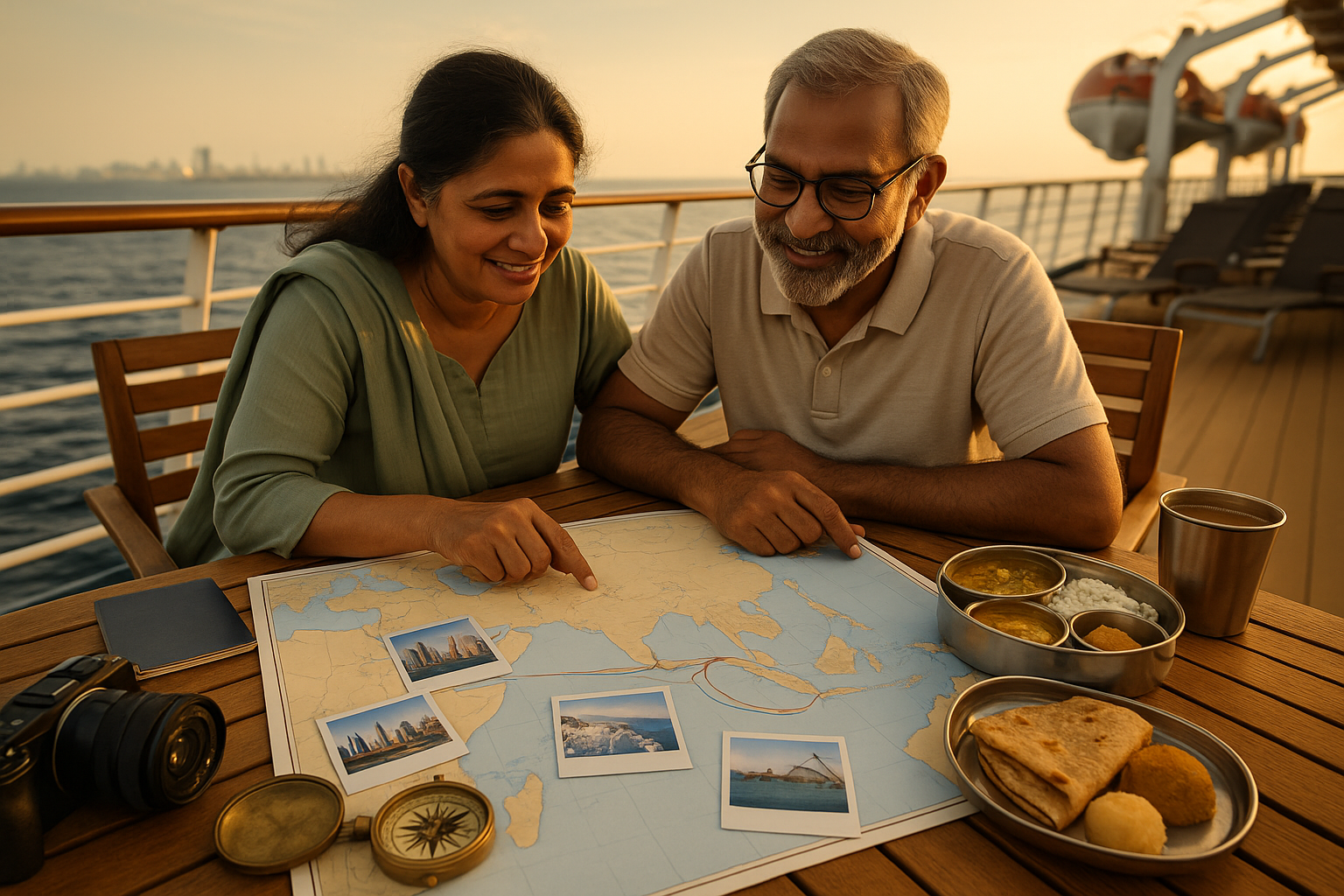
What are the most popular cruise routes for Indian travelers?
Asia, the Indian Ocean, the Arabian Gulf (Middle East) and the Mediterranean are the main regions for cruise travel from India; representative itineraries range from short 1–2 night coastal hops to regional crossings of 10 nights or more.
- Asia — Mumbai→Singapore via Kochi, Colombo, Phuket, Penang: typical durations 7–18 nights. Singapore‑based Southeast Asia loops calling Phuket and Penang appear on regional schedules.
- Indian Ocean — Mumbai→Lakshadweep (Agatti, Bangaram) and Cochin→Maldives via Lakshadweep: island‑focused itineraries, typically 4–12 nights.
- Middle East/Arabian Gulf — Mumbai→Dubai or Mumbai→Abu Dhabi; regional stops commonly include Muscat: cruises commonly run 3–8 nights.
- Europe/Mediterranean — reach by flight to embarkation ports such as Barcelona or Venice; Mediterranean cruises usually run 7+ nights and cover Western or Eastern Mediterranean itineraries.
Asia routes: common itineraries and representative stops
Asia routes commonly run Mumbai→Singapore or Singapore‑based Southeast Asia loops and typically last 7–18 nights.
Below are typical Asia itinerary examples:
- Mumbai→Singapore (via Kochi/Kochi, Colombo, Phuket, Penang, Langkawi): multi‑night crossings often in the 7–18 night range and promoted by lines with India sailings.
- Singapore‑based Southeast Asia loops (Singapore → Penang → Phuket → Langkawi → Bali options): popular short-to-mid regional itineraries that call major beach and cultural ports.
Indian Ocean routes (Lakshadweep, Maldives) — what to expect
Indian Ocean island cruises are island‑focused and are typically 4–12 nights with snorkelling, lagoons and beach stops.
Typical examples include:
- Mumbai→Lakshadweep (Agatti, Bangaram) — commonly offered as 4–5 night packages (operators such as Cordelia Cruises run Lakshadweep sailings).
- Cochin→Maldives (via Lakshadweep) — longer island itineraries commonly run 7–12 nights and highlight snorkeling, lagoons and resort stops (featured on some premium liners).
Middle East & Arabian Gulf routes (Dubai, Abu Dhabi, Muscat)
Middle East & Arabian Gulf sailings commonly run Mumbai→Dubai or Mumbai→Abu Dhabi, calling ports such as Muscat and Abu Dhabi, and can run about 3–8 nights.
These routes attract Indian travelers for short international crossings and city‑plus‑desert stopovers; Mumbai→Dubai sailings appear regularly and may include one or two Gulf ports en route, making them convenient options for a single‑sea, multi‑city trip.
Europe & Mediterranean options for Indian travelers (via flight connections)
Mediterranean cruises are usually reached after a flight to embarkation ports such as Barcelona or Venice and typically run 7+ nights.
Indian travelers commonly fly to major embarkation ports (Barcelona, Venice, Athens) and then join Western or Eastern Mediterranean itineraries that visit Italy, Greece, France or Spain; when planning, travelers should allow time for international flight connections to the embarkation ports.
Which itineraries are shortest and longest?
Shortest: Mumbai–Goa (1–2 nights).
Shortest: Mumbai–Goa (1–2 nights).
Medium: Lakshadweep / Maldives island cruises (4–7 nights).
Medium: Lakshadweep / Maldives island cruises (4–7 nights).
Longest: regional Asia crossings or extended/world cruises (10+ nights).
Longest: regional Asia crossings or extended/world cruises (10+ nights).
Which departure ports serve cruises from India?
Major Indian homeports are Mumbai, Kochi (Cochin) and Chennai. International hubs such as Singapore and Dubai serve as common embarkation points for travellers seeking a wider range of itineraries and ships.
Mumbai is the busiest Indian departure point for coastal and some long‑haul sailings. Kochi and Chennai primarily host regional and island routes. A concise breakdown of the primary Indian homeports and a short note on international hubs follows.
Major Indian homeports (Mumbai, Kochi/Cochin, Chennai) and what they serve
Mumbai, Kochi (Cochin) and Chennai serve domestic and coastal sailings and host some international departures; Mumbai handles the most long‑haul embarkations.
Below are the primary Indian homeports and the route types they typically host.
-
Mumbai
- It functions as India’s main embarkation hub for both short coastal trips and longer regional or international sailings.
- Mumbai handles popular short cruises (for example Mumbai–Goa) and longer departures to Lakshadweep, Maldives and beyond; operators such as Cordelia Cruises and vessels like Angriya typically use Mumbai as a port of embarkation.
-
Kochi (Cochin)
- It functions as a South‑India gateway for island and regional itineraries.
- Kochi commonly serves sailings to Lakshadweep, the Maldives and Sri Lanka and can be used for certain international segments by premium lines staging regionally focused cruises.
-
Chennai
- It functions primarily as a departure point for Bay of Bengal and Andaman‑focused routes.
- Chennai typically hosts domestic and coastal cruises to the Andaman Islands and nearby regional ports, with operators offering mostly regional itineraries.
International embarkation hubs (Singapore, Dubai): selection criteria
Flying to Singapore or Dubai expands itinerary variety, access to larger and luxury vessels, and exposure to promotional pricing, and it adds flight time, transfer costs, and potential visa requirements. Many international lines deploy mega-ships and a broader range of Southeast Asia and Arabian Gulf routes from these ports. Total door-to-door cost and travel time (airfare, transfers, visa processing) should be weighed against gains in ship class, onboard amenities, and ports visited. Use of an international embarkation hub is justified when the expanded itinerary, ship type, or price differential offsets the additional travel time and expense.
Typical ports of call and shore activities on common India‑region itineraries
Ports like Kochi, Colombo, Phuket and Malé typically offer cultural tours, beach and water activities, wildlife visits and shopping excursions.
Kochi appears frequently as a port of call and often anchors city‑heritage and short backwater excursions; passengers should expect a mix of cultural shore excursions and beach or nature options depending on the route.
Typical port stops on a Mumbai–Singapore itinerary
Mumbai–Singapore itineraries commonly call at Kochi, Colombo, Phuket, Penang and Langkawi and these ports offer city tours, temples, beaches and water‑based activities.
Kochi offers historic‑site and short backwater excursions and often appears on India→Singapore routes.
Below is a typical mapping of port → typical shore activities offered on these sailings:
- Kochi → city and heritage tours, short backwater boat trips and spice‑market visits.
- Colombo → temple and city tours, cultural performances and shopping excursions.
- Phuket → beaches, island boat trips and water sports (snorkelling, swimming).
- Penang → UNESCO/heritage city tours and food/market excursions.
- Langkawi → beach time, mangrove or wildlife boat tours and nature excursions.
Typical stops and activities on Mumbai–Maldives / Lakshadweep sailings
Mumbai–Maldives and Lakshadweep sailings typically call at Agatti, various Lakshadweep atolls and Malé and focus on snorkelling, lagoon visits and beach days.
Snorkelling is a common onboard‑sold shore excursion, with Agatti and the Lakshadweep atolls presenting lagoon swims and coral reef access.
Below is a typical mapping of island stop → common activities:
- Agatti (Lakshadweep) → snorkelling over coral reefs and guided lagoon trips.
- Lakshadweep atolls (general) → beach time, shallow‑lagoon excursions and reef snorkel options.
- Malé (Maldives) → gateway for resort day‑trips, short cultural market visits and snorkel/diving excursions (may depend on shore‑transfer availability).
Shore excursions: common examples by route type
Common shore excursions include temple and city tours, wildlife safaris, cultural performances and water sports.
Shore excursions may vary by port and season, but the examples below represent typical options offered on the route types above.
Below are representative shore excursions tied to those route types:
- Mumbai → Singapore (regional Asia calls) → temple and city walking tours, guided cultural‑heritage visits, beach and island boat trips, duty‑free shopping excursions.
- Mumbai → Maldives / Lakshadweep → snorkelling trips, lagoon and coral reef boat excursions, beach days and optional diving or resort day‑visits.
- Coastal India short cruises (Mumbai–Goa, Kochi departures) → backwater and houseboat visits, Kathakali or local dance performances, spice‑market and colonial‑site city tours.
- Sri Lanka / wildlife add‑ons (Colombo/Hambantota calls) → short wildlife safaris or nature‑reserve visits and cultural temple tours (may be seasonal).
What’s included in a cruise package?
Typical inclusions: accommodation, basic meals and onboard entertainment; excluded are specialty dining, alcohol, shore excursions, and often separate taxes/port fees/gratuities.
Published cruise fares cover the cabin, main dining and buffet meals, nightly shows and many onboard activities. Add-ons such as drink packages, specialty restaurants and shore excursions are sold separately. Cruise lines such as Celebrity Cruises list accommodation, meals and entertainment as standard inclusions and offer optional packages for drinks or Wi‑Fi. Advertised fares function as base prices; total cost commonly includes add-ons, taxes, port fees and gratuities and should be confirmed before booking.
Below are typical inclusions and exclusions.
-
Typically included:
- Accommodation (stateroom or suite)
- Basic meals in main dining rooms and buffets
- Onboard entertainment (theatre shows, live music)
- Many public facilities and some activities (pools, fitness classes, kids’ clubs)
-
Typically excluded:
- Specialty dining and premium restaurants
- Alcoholic drinks, bottled beverages and most bar purchases
- Shore excursions and private tours
- Gratuities and taxes/port fees, which are often billed separately
What is typically included versus excluded in cruise fares?
Included: cabin, basic meals, onboard entertainment.
The following lists common inclusions and exclusions.
- Included: accommodation (stateroom or suite), main dining/buffet meals, scheduled onboard entertainment and many public facilities.
- Excluded: specialty dining, alcohol and bar charges, shore excursions, and often gratuities and some taxes/port fees.
How do cabin types (inside, ocean-view, balcony, suite) affect price and inclusions?
Cabin tiers typically increase in price and space: inside → ocean‑view → balcony → suite. Inside cabins are the most affordable and usually lack windows. Ocean‑view cabins feature a window; balcony cabins include private outdoor space. Suites provide larger living areas and additional services or amenities. Perks such as priority boarding, included beverages, or access to exclusive areas vary by cruise line and fare; review fare inclusions and cabin benefits in the operator's official documentation.
Are taxes, port fees and gratuities usually included?
Taxes, port fees and gratuities are often billed separately or added to the advertised fare at checkout.
Fare breakdown: check the detailed fare breakdown on the cruise line or booking site to confirm whether taxes/port fees/gratuities are included, itemised, or available as a pre‑paid option. Cruise Critic notes that taxes, fees and port expenses are commonly itemised separately, and cruise booking pages (for example Celebrity Cruises) typically explain what is included and what requires an upgrade or add‑on.
What vegetarian and Jain dining options are available on Indian cruises?
Vegetarian and Jain options are available on Indian and some international cruises; such meals should be requested at booking and reconfirmed at check‑in.
Common procedures to arrange meals before and during a cruise:
- Vegetarian or Jain preference is typically indicated at booking.
- A follow‑up by email or phone to the cruise line or booking agent, with several days' lead time, is standard practice.
- Reconfirmation at check‑in and notification of dining staff on board is recommended.
Operators with stronger offerings include Cordelia Cruises (Indian chefs; pure‑vegetarian and Jain options), Royal Caribbean and other international lines (Indian dining sections on Asia sailings), and vessels marketed to Indian travellers that advertise vegetarian/Jain menus.
How to request vegetarian or Jain meals before sailing
Veg/Jain meals are best requested at booking, confirmed by email or phone, and reconfirmed at check‑in; allow several days' lead time for processing.
- At booking, indicate "vegetarian" or "Jain" in reservation notes and on any dietary‑preference form.
- The cruise line or travel agent should be contacted by email or phone to confirm the request; allow several days for the kitchen to log special meals.
- Reconfirmation at check‑in with reception or the dining team is recommended; remind staff at the first onboard dining service.
Which cruise lines are known to offer strong vegetarian/Jain options?
Domestic operator Cordelia Cruises offers dedicated vegetarian and Jain menus and Indian chefs on select sailings. Larger international lines such as Royal Caribbean and regional operators such as Dream Cruises provide Indian dining stations or themed Indian menus on certain Asia sailings; availability and depth of options vary by ship and itinerary.
Are pure‑vegetarian or strictly‑Jain dining sections available onboard?
Some ships provide pure‑vegetarian or strict‑Jain meals on request; availability varies by line and requests must be submitted in advance.
Operators such as Cordelia and other lines serving Indian markets offer pure‑vegetarian or strict‑Jain meal preparation upon request. Requests should be reconfirmed at check‑in; kitchens will follow specified ingredient and preparation restrictions when notified.
Which cruise lines operate popular routes from India and what are their strengths for Indian travelers?
Domestic lines like Cordelia and regional operators run short coastal and island itineraries with Indianised dining and family-focused services; international lines such as Royal Caribbean, Celebrity, Silversea and Dream Cruises provide mega‑ship, premium and ultra‑luxury options from regional hubs.
Domestic and coastal operators (Cordelia, Jalesh and regional lines)
Cordelia, Jalesh and other regional operators focus on short coastal and island itineraries and often provide Indian menus, family entertainment and local shore excursions.
They typically sail routes like Mumbai–Goa and Mumbai–Lakshadweep and cater to families and first‑time cruisers.
The main domestic offerings include:
- Cordelia — Cordelia operates Goa and Lakshadweep sailings and often features Indian chefs, Bollywood‑themed nights and Jain/vegetarian options.
- Regional weekend operators (Angriya, Jalesh and similar) — These operators run 1–5 night getaways suited to families and short breaks, with familiar Indian cuisine and family‑oriented entertainment.
- Shore experiences — Domestic cruises typically include local excursions (beaches, forts, island snorkeling) that appeal to multi‑generational groups.
International operators serving India‑region itineraries (Royal Caribbean, Celebrity, Silversea, Dream Cruises)
Royal Caribbean, Celebrity, Silversea and Dream Cruises operate India‑region sailings across mega‑ship family, premium, and ultra‑luxury market segments. Operators focus on different onboard features depending on ship class and itinerary.
The key operator strengths are:
- Royal Caribbean — targets the mega‑ship family market and often offers large water parks, surf simulators, and extensive children's programmes.
- Celebrity — a premium line noted for elevated design, specialty dining, and spa and wellness facilities.
- Silversea — serves the ultra‑luxury segment with all‑suite accommodations and highly personalised service.
- Dream Cruises — operates short regional sailings and often includes Bollywood‑style entertainment, spa facilities, and duty‑free shopping.
Typical onboard amenities and entertainment by operator type
Mega‑ship operators prioritise family features; premium lines prioritise specialty dining and wellness; luxury lines concentrate on inclusivity and personalised service. Families find expansive kids' clubs and activity zones. Luxury seekers may prioritise inclusive service and curated wellness.
Compare typical amenities by operator type:
- Mega‑ship / Family (Royal Caribbean, similar) — Kids' clubs, water parks, high‑energy entertainment, multiple casual dining options and large entertainment venues. Some sailings include Indian dining sections.
- Premium (Celebrity) — Specialty restaurants, refined bars, comprehensive spa and fitness centres; premium lines may offer Ayurvedic or regional wellness options on Asia/India sailings.
- Ultra‑luxury (Silversea) — All‑suite cabins, personalised butler/service, fewer guests and highly curated shore excursions.
- Regional/domestic (Cordelia, Jalesh) — Indianised buffets and vegetarian/Jain options, Bollywood nights and family shows; wellness offerings often include traditional Ayurveda on selected cruises.
Traveller priorities align with operator strengths: families — mega‑ship or domestic operators for kids' facilities; food‑focused travellers — lines offering Indian/Jain menus; luxury seekers — premium or ultra‑luxury lines for personalised service and wellness.
For ship and menu recommendations, see Best Cruises for Indian Food Lovers: Top Cruise Ships with Authentic Indian Cuisine.
How do luxury cruises compare with budget cruises from India?
Luxury cruises cost more but include fuller services, premium dining and deeper, more curated excursions; budget cruises are lower‑cost with pared amenities and pay‑for extras.
Here’s a compact comparison:
- Luxury: are typically higher‑fare, often more inclusive (meals, many onboard activities, some drinks/Wi‑Fi packages), feature speciality dining, spas, larger cabins or suites, and curated shore excursions (examples: Celebrity, Royal Caribbean, Dream Cruises, Cordelia on premium itineraries).
- Budget: are typically lower‑fare (examples: Mumbai–Goa INR 6,000–15,000; short Lakshadweep 4–5 nights INR 25,000–50,000) and often charge extra for speciality restaurants, alcoholic drinks, spa treatments and many shore excursions.
Traveller profiles short mapping: families and value travellers often choose budget or mid‑range lines; honeymooners and luxury seekers favour premium/ultra‑luxury ships; seniors may prefer luxury or family‑friendly premium ships with strong medical/Indian dining support.
Typical price ranges and amenity differences
Luxury fares are higher and are typically more inclusive; budget fares are lower and often add fees for specialty dining, drinks and excursions.
Luxury fares are typically found on premium lines and can align with longer international itineraries (for example, some Cochin–Maldives or longer Asia sailings are quoted in higher buckets such as INR 80,000–1,50,000 for multiday premium voyages). Luxury packages often include more inclusive elements (meals in speciality restaurants, selected shore excursions, spa credits or bundled Wi‑Fi) and higher cabin standards and personalised service, as seen on Celebrity, Royal Caribbean and Dream Cruises. Budget fares are typically for short coastal or entry‑level ocean cruises (examples from India: Mumbai–Goa INR 6,000–15,000; Lakshadweep 4–5 nights INR 25,000–50,000) and can limit inclusions to basic meals and entertainment, with speciality dining, drinks, spa and many shore excursions sold a la carte.
Which traveller profiles are best matched to budget vs luxury cruises?
The following mapping links traveller profiles to the cruise segment most suitable for their common needs and preferences:
- Families — well suited to budget, family‑oriented mid‑range, and premium mega‑ships offering kids' clubs, pools and family entertainment (Cordelia and Royal Caribbean operate many family sailings).
- First‑time cruisers — well suited to budget or mid‑range short itineraries that provide a low‑commitment introduction to cruising (short Mumbai–Goa sailings or weekend options).
- Honeymooners — well suited to luxury ships or intimate alternatives (Dream Cruises, Celebrity, Kerala houseboats) that provide private balconies, specialty romantic dining and upscale shore experiences; often select inclusive packages.
- Seniors — well suited to luxury or accessible mid‑range lines that provide medical facilities, Indian and vegetarian dining options, and gentle shore excursions (Cordelia and several premium lines offer these services).
- Luxury seekers — well suited to premium and ultra‑luxury lines offering suites, personalised service, high‑end dining and curated excursions (examples include Celebrity and other premium operators).
Practical planning: visas, health and onboard connectivity
Domestic round‑trip cruises usually do not require a passport; itineraries that call any international port do — check each itinerary. Wi‑Fi is usually charged separately; buy packages or use local eSIMs.
Do domestic Indian cruises require a passport?
Purely domestic round‑trip cruises from Indian ports do not require a passport. Passports and any required visas are necessary for itineraries that call at foreign ports (for example: Maldives, Sri Lanka, Singapore). Domestic operators such as Cordelia Cruises and Angriya operate regional routes that typically accept government‑issued photo ID (for example, Aadhaar card or passport) for boarding; accepted documents vary by operator and by itinerary. Operators specify ID and boarding‑document requirements at booking and in pre‑departure communications.
Is Wi‑Fi included on Indian cruises and how to manage connectivity costs?
Wi‑Fi on Indian cruises is typically charged separately or offered in paid packages.
Action tips:
- Purchase Wi‑Fi packages in advance (online or via the cruise line) to secure lower rates and avoid higher onboard prices.
- Shipboard connectivity is often limited at sea; using an eSIM or purchasing a local SIM at ports of call provides a more economical data option, as noted by cruise.travel.in and Mauzee Holiday.
- For sustained connectivity, compare package data allowances, speeds, and session limits, and select a plan aligned with anticipated usage to avoid unexpected charges.
Health, insurance and other travel documentation to check before booking
Travel insurance (including medical‑evacuation coverage), required vaccinations, and cruise‑line health declarations should be reviewed prior to booking.
Check these items before booking:
- Travel insurance: policies should cover medical evacuation, onboard treatment, repatriation, and cruise‑related incidents; limits and exclusions should be reviewed in the policy wording.
- Passport & visa: passport validity and visa requirements for each international port on the itinerary must be verified; official government websites and the cruise line provide current guidance.
- Vaccinations: required or recommended vaccinations and any local health advisories for destination ports should be confirmed via public‑health authorities.
- Cruise health declarations and testing: cruise operators may require online health forms, test results, or proof of vaccination prior to embarkation; line‑specific policies and timelines should be consulted.
- Prescriptions & onboard care: sufficient prescription medication should be carried for the entire trip; information about onboard medical facilities and any restrictions should be obtained from the cruise operator.
Coverage for evacuation and cruise‑related incidents should be verified with both the insurer and the cruise line.