This guide defines "Cruise" as cruise ship travel and identifies cruises homeporting in Singapore that provide Indian, Jain or Halal dining, and explains how those dining options affect itineraries, fares and the booking process. It serves as an operator‑to‑ship reference for travellers seeking information on operators sailing from Marina Bay, onboard Indian and Jain meal formats, and the impact of dining choices on short Asia itineraries and budgets.
Genting Dream and Royal Caribbean routinely provide Indian cuisine and can arrange Jain meals on request; Carnival and Disney Adventure offer Indian options but availability on Singapore sailings may vary. Most Singapore homeport sailings depart from Marina Bay Cruise Centre Singapore (MBCCS) at 61 Marina Coastal Drive; the nearest MRT is Marina South Pier (NS28), about a 5–10 minute walk. Typical onboard Indian dining includes buffet stations (curries, dal, biryani, naan), South Indian breakfasts (idli, dosa, sambar), snacks (samosa, pakora) and pre‑ordered Jain meals that omit root vegetables (for example potato and onion) and require separate vegetarian preparation.
Carnival operates the branded Indian specialty restaurant Masala Tiger on select ships (Carnival Celebration, Carnival Jubilee, Mardi Gras). Specialty Indian venues are typically chargeable and accept reservations; Genting Dream lists specialty‑dining fees of approximately SGD 38–68 per person. Common short Singapore itineraries include 2‑night Singapore→Melaka and 3‑night Singapore→Penang→Melaka or Singapore→Phuket, with Genting Dream operating 2–5 night sailings year‑round. Genting Dream’s Lido buffet routinely features daily Indian stations and a segregated Halal section with separate preparation. The following sections address operators and MBCCS, menus, specialty dining, itineraries, fare inclusions and exclusions, carrier comparisons, booking procedures (including the site’s /book action) and ship‑level confirmations for Jain and Halal arrangements.
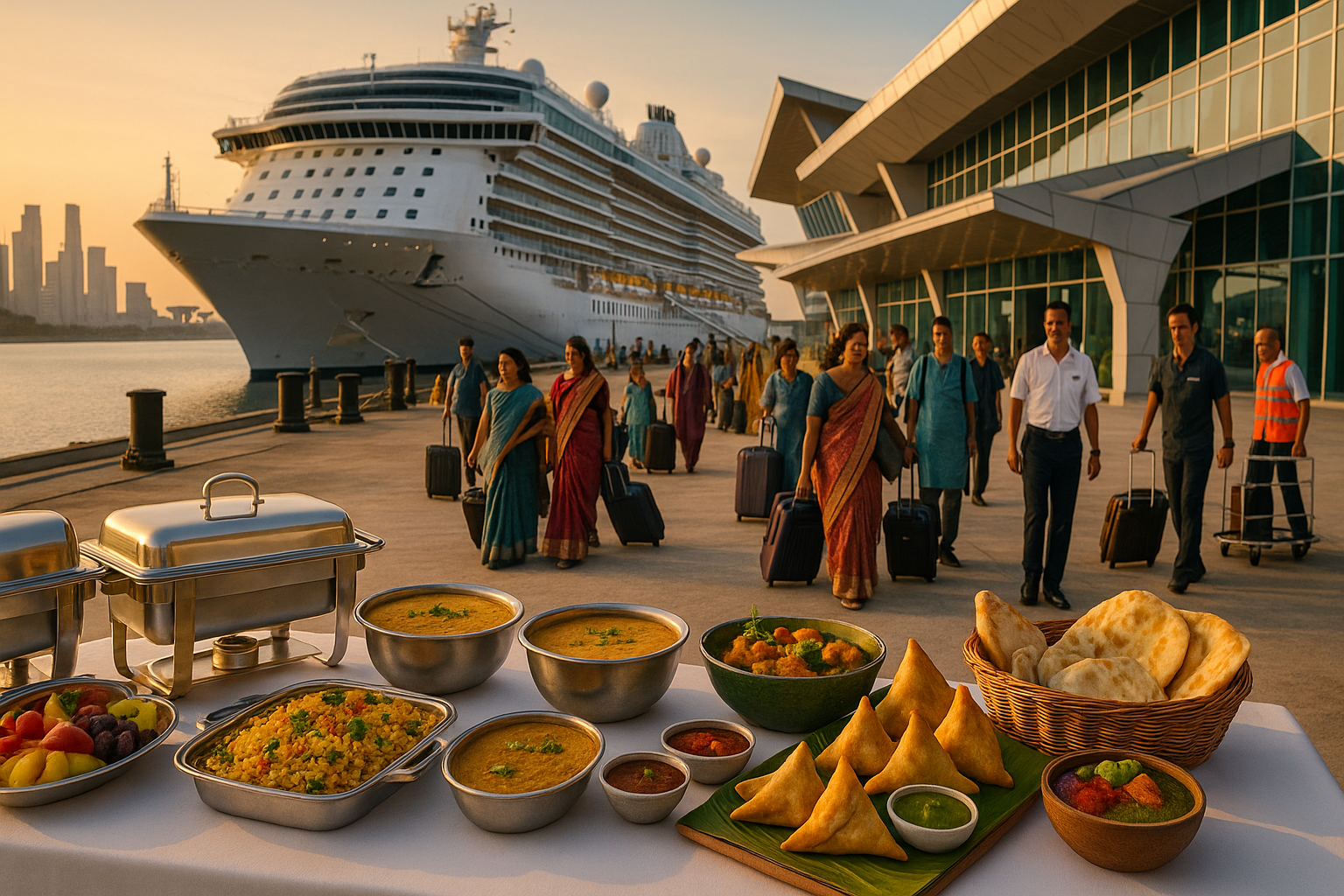
Which cruise lines departing Singapore offer Indian or Jain meals?
Genting Dream and Royal Caribbean routinely provide Indian cuisine and can arrange Jain meals on request; Carnival and Disney Adventure provide Indian options, though availability on Singapore sailings can vary.
Genting Dream operates year‑round from MBCCS and features dedicated Indian buffet stations with Jain meals available on request. Royal Caribbean includes Indian dishes in main dining rooms and accommodates Jain requests. Carnival operates a branded Indian specialty restaurant (Masala Tiger) on select ships. Disney Adventure may provide Indian and Jain meals by request once its Singapore sailings commence.
Which operators homeporting in Singapore most often provide Indian or Jain meals?
Genting Dream and Royal Caribbean most often provide Indian meals and can arrange Jain meals on request; Carnival and Disney Adventure offer Indian options with variable availability.
The lines homeporting from Singapore and their typical Indian/Jain approach are:
- Genting Dream — Genting Dream offers daily Indian stations in the inclusive buffet (The Lido) and can arrange Jain meals on request or pre‑order.
- Royal Caribbean — Royal Caribbean provides Indian dishes in main dining rooms and accommodates Jain meals when requested in advance.
- Carnival — Carnival operates Masala Tiger, a branded Indian specialty restaurant on select ships; availability on Singapore‑departing sailings may vary.
- Disney Adventure — Disney Adventure may cater to Indian preferences and Jain requests by advance notice once Singapore sailings are active.
Where do these cruises board in Singapore (MBCCS and terminals)?
Most Singapore homeport sailings depart from Marina Bay Cruise Centre Singapore (MBCCS).
MBCCS is located at 61 Marina Coastal Drive and is the primary terminal for Genting Dream and many other homeported sailings; the nearest MRT is Marina South Pier (NS28), about a 5–10 minute walk. Passengers check in at the MBCCS terminal building—note that MBCCS is separate from HarbourFront terminals, so plan transfers to Marina South Pier or taxi/drop‑off at the cruise centre.
What Indian and Jain meal options are available on Singapore cruises?
Cruise dining from Singapore typically includes Indian buffet stations (curries, dal, biryani, naan/roti), South Indian breakfasts (idli, dosa, sambar), snacks (samosa, pakora) and pre‑ordered Jain meals without root vegetables.
Common menu categories with typical examples and their usual onboard locations follow.
- Breakfasts — South Indian breakfast items: idli, dosa, sambar, vada, poha, aloo bhaji — typically in the buffet and main dining room morning service.
- Buffets — Indian stations (Lido or Lido-style buffet): mixed vegetarian and non‑veg curries, dal, biryani, rice, breads, snacks and desserts — usually available at breakfast, lunch and dinner.
- Mains / Curries — Curries and vegetarian mains: paneer makhani, palak paneer, chole, chicken tikka masala, lamb rogan ghosh, vegetable korma — typically in the buffet and the main dining room; expanded on Indian‑themed nights.
- Dal & legumes — Dal makhani, butter dal fry, chana dal — usually in buffet and main dining room menus.
- Rice & biryani — Biryani, pulao, plain basmati rice — typically served as mains in the buffet and main dining room.
- Breads — Naan, roti, paratha, puri — usually available at dinner in the buffet and main dining room; specialty restaurants may offer tandoor items.
- Snacks & sides — Samosa, pakora, raita, chutneys — commonly at buffet snack stations, tea service or appetizer sections in main dining rooms.
- Desserts — Gulab jamun, kheer, rasgulla and other Indian sweets — typically appear in buffet dessert counters and main dining room dessert courses.
- Themed & specialty dining — Indian‑themed nights or specialty Indian restaurants may present expanded menus and tandoor items beyond the regular buffet/main dining offerings.
Typical Indian dishes and meal categories onboard
Typical Indian dishes and meal categories served on Singapore sailings include curries, dal, biryani and other rice dishes, breads (naan, roti, paratha), South Indian breakfast items (idli, dosa), snacks (samosa, pakora) and desserts (gulab jamun, kheer). These items are commonly available in the buffet, the main dining room and during themed Indian nights.
Common categories and their typical onboard locations:
- Curries — available in the buffet and main dining room; examples: paneer makhanwalla, paneer mutter, chicken tikka masala, lamb rogan ghosh, vegetable korma.
- Dal — available in the buffet and main dining room; examples: dal makhani, butter dal fry.
- Biryani & rice — available in the buffet and main dining room; examples: biryani, pulao, plain basmati rice.
- Breads (naan/roti/paratha) — served at dinner in the buffet and main dining room; some ships offer tandoor breads in specialty restaurants.
- South Indian breakfasts — served at breakfast in the buffet and main dining room; examples: idli, dosa, sambar, vada, poha.
- Snacks & sides — offered at buffet stations, tea service, or as starters in the main dining room; examples: samosa, pakora, chutneys, raita.
- Desserts — available at buffet dessert counters and in main dining room dessert courses; examples: gulab jamun, kheer, rasgulla.
- Themed nights & specialty restaurants — expand the Indian menu beyond regular buffet and main dining room choices and may feature dedicated Indian stations.
How are Jain meals adapted onboard and what restrictions are observed?
Jain meals require omitting root vegetables and strict vegetarian preparation.
Jain meals are defined by excluding root vegetables (for example, potato and onion) and by requiring separate vegetarian preparation. Jain meals can be requested as pre‑ordered special meals at booking or by informing dining staff on Day 1; cruise lines that sail from Singapore — including Genting Dream and Royal Caribbean — may provide Jain options on request. Jain meals may be prepared separately by the galley or offered as dedicated buffet portions, but they may have lead times and a more limited range compared with standard Indian menus; some specialty restaurants might not be able to convert every dish to a full Jain specification.
Do any ships offer dedicated Indian restaurants or specialty Indian dining?
Yes — some cruise lines operate dedicated Indian specialty restaurants (for example, Carnival's Masala Tiger on select ships); these are distinct from the inclusive buffet or main-dining Indian options offered aboard many ships.
Carnival’s Masala Tiger is a clear instance-level example of a permanent, branded Indian specialty restaurant: it appears on specific Carnival ships and advertises tandoor cooking, kebabs, naan and a wide range of vegetarian dishes prepared from a curated menu. By contrast, ships such as Genting Dream and others commonly provide Indian stations or themed Indian dishes in the Lido/buffet or main dining rooms as part of the inclusive fare; those buffet/main-dining options rotate daily and are designed for mass service rather than the plated, restaurant-style experience of a specialty venue.
Masala Tiger and other dedicated Indian restaurants — which ships and what to expect?
Masala Tiger is a Carnival-branded Indian specialty restaurant available on select Carnival ships (Carnival Celebration, Carnival Jubilee, Mardi Gras) and it serves tandoori, kebabs, naan and vegetarian options.
Known specialty venues and what to expect:
- Masala Tiger (Carnival Celebration, Carnival Jubilee, Mardi Gras) — clay‑oven tandoori items (tandoori chicken, fish with cumin pilaf), beef kebabs, hot naan, and a variety of vegetarian dishes; presented as a dedicated restaurant experience and availability varies by ship.
Are specialty Indian dining venues chargeable and do they take reservations?
Specialty Indian restaurants are usually chargeable and commonly take reservations, though exact fees and booking rules vary by ship.
Specialty dining is typically run as an a‑la‑carte or cover‑fee experience separate from the included buffet/main‑dining service. For example, Genting Dream lists specialty‑dining fees in the ~SGD 38–68 per person range for its charged venues, and Carnival’s Masala Tiger is promoted as a dedicated restaurant with table bookings on the ship pages; by contrast, the Lido/buffet and main dining rooms provide inclusive Indian stations or themed nights at no extra cost. For short itineraries or popular sailings, reserve specialty tables early and budget the per‑person fee where applicable, and always check the specific ship’s dining page for that sailing’s policy.
Which itineraries from Singapore commonly run 2–3 night sailings to Penang, Melaka and Phuket?
Common short sailings from Singapore include 2‑night Singapore→Melaka and 3‑night Singapore→Penang→Melaka or Singapore→Phuket; these short itineraries often have stronger Indian buffet offerings on ships that homeport in Singapore.
These quick turnarounds are marketed as weekend getaways or short escapes and are especially common on Genting Dream, which homeports year‑round in Singapore and runs 2–5 night sailings. Short sailings attract regional passengers looking for brief trips, so lines serving Singapore tend to program familiar regional dishes in the buffet and offer dietary accommodations (vegetarian, halal, Jain) more consistently than occasional repositioning cruises.
Common 2–3 night route examples from Singapore
Sample short itineraries are listed below with typical nights and season/frequency information.
- 2N Singapore → Melaka — 2 nights; typically scheduled as weekend or short‑break sailings and run year‑round (often weekly on Genting Dream).
- 3N Singapore → Penang → Melaka (or Port Klang) — 3 nights; common round‑trip option, operated frequently by Genting Dream with weekly departures and year‑round sailings, with passenger peaks in shoulder months.
- 3N Singapore → Phuket — 3 nights; common short beach port option on Genting Dream and similar Asia‑focused ships, scheduled year‑round with seasonal demand variations.
Which short itineraries typically provide the most substantial Indian dining options onboard?
Short Singapore homeport sailings on Genting Dream typically provide the most substantial Indian dining onboard.
Genting Dream’s year‑round homeporting in Singapore and its large Indian/Malaysian/Singaporean passenger mix drive consistent Indian offerings. The Lido buffet regularly includes dedicated Indian stations (curries, biryani, breads, South Indian breakfast items), and the ship advertises halal, Hindu‑vegetarian and Jain accommodations. These 2–3 night itineraries target local and regional travellers; the ship schedules daily buffet Indian options and commonly programs Indian-themed nights more often than ships that only call occasionally.
What is included in the fare for cruises from Singapore?
Standard Singapore cruise fares typically include accommodation, basic meals in buffets and main dining rooms, and onboard entertainment. Items commonly excluded are specialty dining, gratuities, shore excursions and Wi‑Fi.
Below is a breakdown of items commonly included in the headline fare and items often charged extra.
The following are usually included in the headline fare:
- Accommodation in the booked stateroom or suite.
- Basic meals at inclusive venues such as buffets and main dining rooms (for example, The Lido or Dream Dining Rooms on Genting Dream).
- Use of public facilities and scheduled entertainment (pools, theatre shows, and basic children's programmes).
The following are usually excluded from the headline fare:
- Specialty dining venues (additional per-person charges).
- Gratuities/service charges (often added automatically).
- Shore excursions and private tours.
- Onboard Wi‑Fi, alcoholic and specialty beverages, spa treatments, photo purchases and most other add-ons.
Are Indian meals included in the standard fare or charged as specialty dining?
Indian dishes are usually available in inclusive buffet and main dining venues; dedicated Indian specialty restaurants, where present, are typically chargeable.
Inclusive venues commonly feature Indian stations or themed nights—examples include The Lido on Genting Dream and Indian options in main dining rooms on some Royal Caribbean sailings—providing curries, breads and vegetarian choices without extra cost. If a ship has a dedicated Indian specialty restaurant (for example, Carnival’s Masala Tiger-style concept on certain ships), that venue normally carries a cover charge or per‑meal fee. Specific dietary requests should be submitted at booking or on embarkation day to allow time for fulfilment.
Common extras usually excluded from the headline fare (gratuities, specialty dining, shore excursions, Wi‑Fi)
Common extras usually excluded are gratuities, specialty dining fees, shore excursions and Wi‑Fi.
The list below provides typical exclusions and realistic cost guidance for trip budgeting:
- Gratuities: Many lines auto‑charge gratuities; on Genting Dream this is listed as SGD 27 per person per night (Interior/Oceanview), SGD 33 (Balcony) and SGD 40 (Palace). Amounts vary by cruise line and cabin type.
- Specialty dining fees: Specialty restaurants often charge per person; Genting Dream lists specialty dining around SGD 38–68 per person. Specialty venues increase per‑meal spend compared with buffet or main dining.
- Shore excursions: Excursion prices vary by activity and destination; example budgets are about SGD 50–150 per person for popular day tours.
- Wi‑Fi: Full internet access is usually sold separately; Wi‑Fi packages may start from around SGD 15 per day depending on the plan and line.
- Other extras: Bar drinks, spa services, specialty experiences, travel insurance, port charges (~SGD 50–90 on some itineraries) and occasional fuel surcharges (example: Genting Dream noted SGD 15/guest/night in specific booking conditions) are typically excluded and add to the final cost.
Buffet and main dining tend to result in lower food costs; specialty restaurants and premium packages increase per‑person charges and total cruise cost.
Genting Dream vs Royal Caribbean — which cruise is best for Indian meals?
Genting Dream offers more frequent Indian buffet stations and a documented Halal‑friendly setup; Royal Caribbean offers Indian dishes in main dining rooms and provides Jain meals on request.
Side-by-side comparison:
- Frequency / variety: Genting Dream — daily Indian stations at The Lido and frequent vegetarian and Indian options; Royal Caribbean — Indian dishes appear in the main dining room and on menus, but buffet presentations are less frequent.
- Halal / Jain handling: Genting Dream — segregated Halal section and Muslim‑friendly food preparation documented; Royal Caribbean — Jain meals available on request and segregated Halal stations are not commonly documented.
- Specialty venues: Genting Dream — emphasis on an inclusive buffet plus paid specialty venues; Carnival operates Masala Tiger as a dedicated Indian specialty restaurant on several ships; Royal Caribbean typically uses main‑dining offerings and special‑meal requests.
Which line offers more frequent Indian dishes in the buffet and main dining rooms?
Genting Dream typically features daily Indian buffet stations; Royal Caribbean tends to offer Indian dishes in main dining rooms and by request.
Genting Dream’s Lido buffet regularly includes Indian stations at meals, so passengers often find dal, curries, naan and Indian breakfast items available each day. Royal Caribbean ships commonly list Indian options in the main dining room and will prepare Jain or other special meals if requested in advance, but Indian items are more likely to appear on request than as guaranteed daily buffet staples.
Which line provides dedicated Halal or Jain stations and specialty Indian restaurants?
Genting Dream reports a dedicated Halal section at its Lido with segregated preparation and Muslim‑friendly food handling. Royal Caribbean provides Jain and strict vegetarian meals by advance request but has limited public documentation of segregated Halal stations. Carnival operates the Masala Tiger paid specialty restaurant on selected ships, including Carnival Celebration, Carnival Jubilee and Mardi Gras.
Best choice for strict vegetarian or Jain travellers on short Singapore sailings
For strict vegetarian or Jain travellers on short Singapore sailings, Genting Dream is the better choice. The ship offers daily Indian buffet stations and documented pre‑order support for Jain meals; reconfirmation at booking is advised.
Royal Caribbean can provide Jain meals on request. Indian dishes may not appear at every buffet service on Royal Caribbean sailings, so travellers with strict requirements should pre‑book dietary requests and reconfirm with the cruise line and speak with dining staff on Day 1.
How to request Indian, Jain or other special dietary meals when booking a Singapore cruise
Special meal requests are normally submitted at the time of booking and reconfirmed on embarkation Day 1. The cruise operator's online booking form or customer‑service team records dietary requirements; include party size and cabin number. A Day‑1 reconfirmation with the onboard dining team allows time for ingredient sourcing and for the restaurant manager to plan service.
When and how to submit a special meal request — at booking, before sailing, or onboard?
It is recommended to submit special meal requests at booking, reconfirm them on Day 1 onboard, and communicate requests via the booking form, email, or telephone. Submitted requests should specify cuisine type (Indian or Jain), any dietary restrictions, cabin number or cabin type, and party size.
Timing and methods:
- At booking — submit the special meal request via the booking form or through a travel agent. Providing details at booking allows the galley to plan. Required details include: cuisine type (Indian/Jain); specific restrictions (for example, Jain instructions); cabin number or cabin type; and party size.
- Pre-departure reconfirmation — requests should be reconfirmed via email or the cruise line's manage‑booking service a few days before departure to keep the request active.
- Onboard (Day 1) — the restaurant manager or dining team can be contacted on Day 1 to confirm preparation details, service times, and any final adjustments.
Booking, cabin types & where to book (including link to /book)
Cabin type affects fare inclusions and service level. Interior, Oceanview, Balcony and Palace cabins differ in included amenities and in priority for specialty services. Palace cabins frequently include added benefits such as dedicated dining or butler service, which can provide additional dining support. Availability should be checked and special meal requests submitted at the time of booking either through the site's booking page or directly with the cruise line. The site's booking page captures dietary requests: Book Cruises with Indian Cuisine Included: Indian, Vegetarian, and Jain Menu Options.
Who to contact if a special meal request isn't met during the cruise?
Escalation sequence: dining venue manager, guest services, senior onboard staff. Retain booking confirmation and special-meal documentation for verification.
Escalate to the following onboard contacts in order; present documentation and use the sample wording below.
- Dining venue manager — initial escalation should be to the dining venue manager; present the booking confirmation and explain the discrepancy. Request that the correct dish be provided at the next service.
- Guest services — if the dining venue manager cannot resolve the issue, escalate to guest services to confirm kitchen notes and to reissue the special-meal request. Request a formal written follow-up.
- Senior onboard staff — if unresolved after guest services, request involvement of a senior guest services officer or ship manager to coordinate with culinary leadership.
Documentation and suggested phrasing
- Documentation to present: booking confirmation or email showing the special-meal request, booking reference, cabin number, and party size.
- Sample wording: "Booking (ref ___) included an Indian/Jain special-meal request for [date]. The meal served does not match the request. Request that the correct meal be provided and that expected availability be confirmed in writing."
- If escalation is required: "Request escalation to guest services and the culinary team, and request written confirmation of when the special meal will be provided."
Can Jain and Halal meals be arranged on ships like Genting Dream?
Yes — Genting Dream can arrange Jain meals on request and operates a segregated Halal section at its buffet; limitations and any specialty fees depend on menu and lead time.
Quick facts for Genting Dream:
- Availability: Genting Dream can provide Jain meals on request and offers Indian/Jain options in its inclusive dining areas.
- Preparation: Dream Cruises markets Genting Dream as an OIC/SMIIC-standard Halal-friendly cruise (carrier-sourced); The Lido buffet contains a segregated Halal section with separate preparation and a surau onboard.
- Fees & limits: Inclusive buffet/main dining usually covers Halal/Jain options, but specialty restaurants and specialty dishes are chargeable (specialty dining often listed ~SGD 38–68/person) and some requests require advance notice.
Can Genting Dream provide Jain meals and segregated Halal food preparation?
Genting Dream provides Jain meals on request and operates a segregated Halal section at its buffet (The Lido) with separate preparation.
Key points:
- Jain meals: Guests can request Jain-specific meals; the ship’s food guide and guest reports note chefs accommodate strict vegetarian/Jain requirements when informed in advance.
- Segregated Halal: The Lido has a dedicated Halal section with segregated handling and preparation areas; the carrier describes the ship as Halal-friendly under OIC/SMIIC standards (this is a carrier-sourced claim).
- Practical step: Inform the cruise line at booking and reconfirm on embarkation day so the galley can plan separate preparation as needed.
Are there extra charges or limitations when requesting Jain or Halal meals?
Jain and Halal accommodations are usually included in inclusive dining when prepared in buffet or main dining rooms. Specialty dishes, specialty-restaurant bookings, and extensive special requests may incur additional charges and require advance notice. Genting Dream’s inclusive restaurants typically serve Indian and vegetarian/Jain options without extra cost. Strict Jain preparations often require advance notice; highly customized or plated specialty items may need pre-booking or attract extra fees.