A cruise is a packaged passenger voyage aboard an oceangoing or river vessel offering scheduled itineraries, stateroom accommodation, onboard dining and entertainment, and shore excursions. This page provides guidance on selecting itineraries, onboard dining (vegetarian/Jain), cabin adjacency and group booking options for Indian joint families. Framed as a single travel product that bundles destinations, cabins, food and event services, cruises enable planning of large multigenerational trips with fewer separate arrangements.
Short‑haul Asia (Singapore/Malaysia), the Gulf (Dubai/Abu Dhabi), the Mediterranean and India coastal & river cruises are the most popular destination categories for multigenerational travel; these routes combine shorter flights or local departures, extensive family facilities and readily available Indian or vegetarian dining. River cruises add calm, culturally rich days ashore. Short‑haul sailings are operated by lines such as Royal Caribbean and Resorts World Cruises, Gulf sailings by MSC and Costa, and domestic options include Cordelia, Resorts World One, Antara and M.V. Mahabaahu. Typical itinerary lengths are 3–5 nights for elders or families with young children and 7–10 nights for week‑long international trips. Recommended seasons include Dubai Oct–Mar, Mediterranean May–Sep, Singapore year‑round and India coastal Oct–Apr. Most mainstream lines offer vegetarian menus and can accommodate strict‑Jain requests when notified in advance.
Connecting cabins are adjacent staterooms joined by an internal lockable door. Reservation protocols typically require selection of adjacent rooms, submission of a connecting‑cabin request to group sales or the booking agent, written confirmation and reconfirmation at check‑in. A group‑block reserves a negotiated set of cabins, whereas a full‑ship charter rents the entire vessel and provides exclusive use of dining rooms and public spaces. The guide covers destinations, dining, cabins, group booking and amenities. A comparison checklist and liaison with group sales or a specialist agent assist with complex reservations.
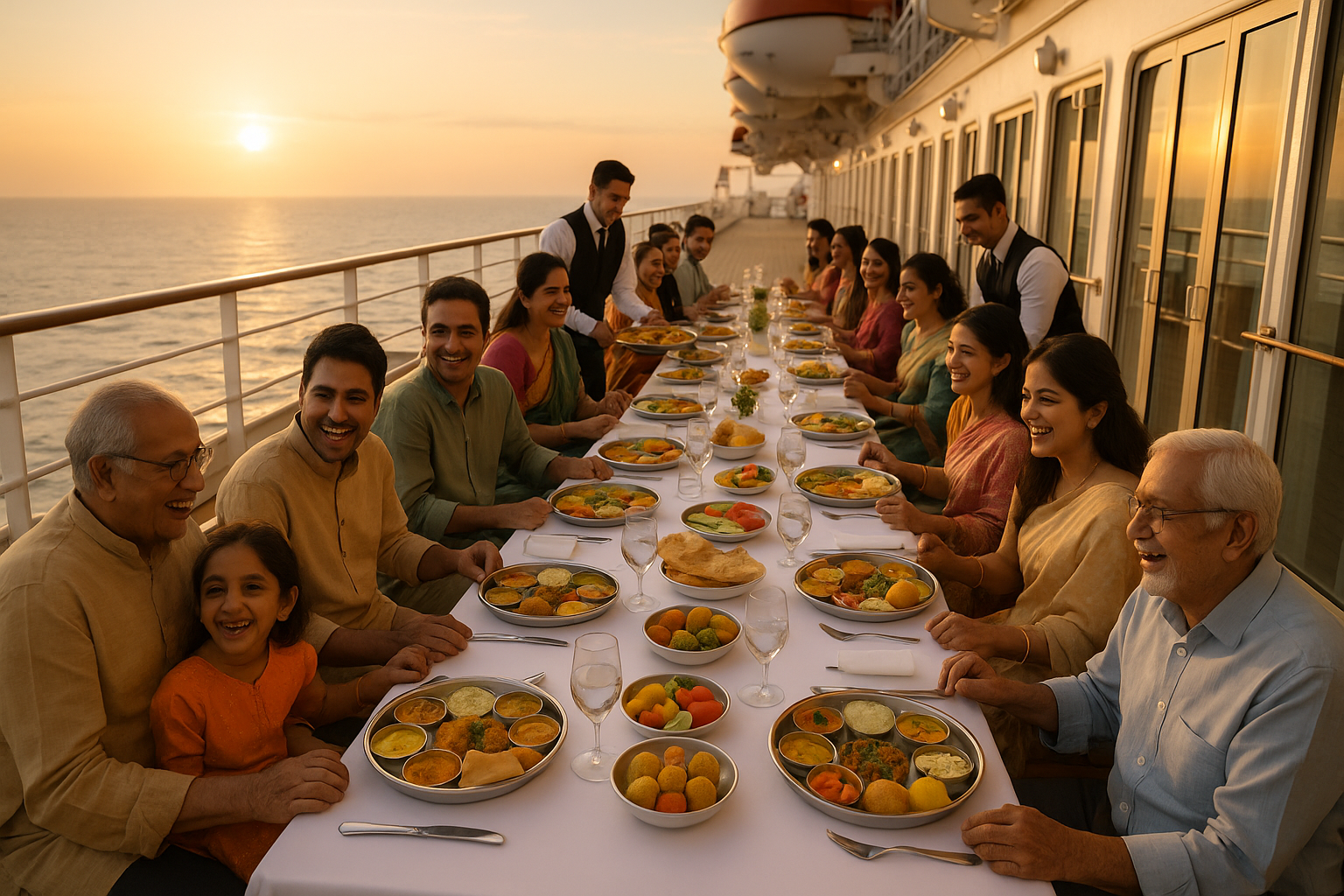
Which destinations and itineraries are most popular with Indian joint families?
Short‑haul Asia (Singapore/Malaysia), Gulf (Dubai/Abu Dhabi), Mediterranean and India coastal & river cruises are the most popular for Indian joint families, offering ease of travel, family activities and familiar dining options.
The top cruise categories are short‑haul, Middle East/Gulf, Mediterranean and domestic coastal & river sailings. Cruises in these categories combine shorter flights or local departures, extensive family facilities (kids’ clubs, pools, entertainment) and readily available Indian or vegetarian dining; river cruises provide calm, culturally rich days ashore for older guests and children alike.
Which short‑haul itineraries (Singapore, Dubai, Goa) work best for multigenerational joint families?
Short‑haul itineraries to Singapore, Dubai and Goa suit multigenerational joint families: they reduce travel time and provide extensive family facilities plus widely available Indian and vegetarian dining options.
Here are short‑haul examples with pros and sample operators:
- Short‑haul Singapore–Malaysia sailings — Pros: very short flights, strong family facilities and Indian dining options; operators known to run these include Royal Caribbean and Resorts World Cruises.
- Short‑haul Dubai/Gulf cruises — Pros: simpler visa processes for many passengers, family‑friendly shore excursions and vegetarian/Jain menu options; operators known to run Gulf sailings include MSC and Costa.
- Short‑haul Goa/coastal sailings from India — Pros: minimal transfers, familiar food and evening entertainment; domestic operators known to run these include Cordelia Cruises and Resorts World One.
Which domestic coastal and river cruises from India are easiest for large joint families?
Domestic coastal and river routes — Mumbai–Goa coastal cruises, Kerala backwaters and Ganges/Brahmaputra river cruises — are preferable for large multigenerational groups, since they avoid visa requirements and reduce transfer times.
Coordination is simpler for large groups: Cordelia and Resorts World One operate Mumbai–Goa and Lakshadweep coastal sailings; river operators such as Antara and M.V. Mahabaahu offer luxury and experiential Ganges and Brahmaputra itineraries. These options provide logistical advantages for families — simpler travel with no visa requirements, shorter local transfers and shore excursions adapted for elderly passengers and children.
What cruise length and season suit multigenerational trips?
For multigenerational cruises, 3–5 nights is often appropriate when the group includes elderly members or young children; 7–10 nights is preferable for international itineraries with multiple ports. Optimal season depends on the region.
Recommended durations and best seasons by region:
- 3–5 nights — suited to groups with elderly passengers or young children; short durations reduce mobility strain and work well for domestic coastal and river sailings.
- 7–10 nights — suited to week-long international cruises and Mediterranean itineraries, allowing more time ashore and a wider range of excursions.
- Best seasons by region: Dubai/Arabian Gulf — Oct–Mar; Mediterranean — May–Sep; Singapore/Malaysia — year‑round; India coastal cruises — Oct–Apr.
What vegetarian and Jain dining options are offered onboard for Indian joint families?
Most mainstream cruise lines offer vegetarian options across venues and accommodate Jain/strict‑vegetarian requests when notified in advance. Ships provide vegetable‑forward dishes in the buffet, vegetarian courses in the main dining room, and prepare strict‑vegetarian/Jain meals by prior request. Availability varies by ship and itinerary.
Typical venue distinctions:
- Buffet — flexible self‑serve choices and hot stations offering a wide selection of vegetarian items.
- Main dining — multi‑course menus; kitchen staff prepare strict‑vegetarian/Jain plates when requested.
- Specialty restaurants — may offer vegetarian or Jain dishes by prior arrangement; advance notice is usually required.
Requesting vegetarian or Jain menus in advance
Dietary requirements should be recorded at booking, followed up with group sales and the ship’s maître d', and reconfirmed before boarding; allow 2–4 weeks' notice for large groups. At booking, the reservation should be marked “vegetarian/Jain” and specific restrictions added to passenger information. For group reservations, group sales should be contacted by email or telephone. Once booking confirmation is issued, the ship’s group coordinator or maître d' should be emailed to confirm arrangements and repeat the request. For strict‑vegetarian or Jain needs, exact instructions should be provided (no onion/no garlic, no root vegetables, separate preparation surfaces) and a sample wording supplied: “Strict‑vegetarian/Jain meals requested for [names]; no onion, no garlic, separate cooking surfaces preferred.” Dietary requests should be reconfirmed a few days before boarding. For more on booking options and menu guarantees, see Book Cruises with Indian Cuisine Included: Indian, Vegetarian, and Jain Menu Options.
Which dining venues (buffet, main dining, specialty) typically serve vegetarian/Jain meals?
Vegetarian/Jain options appear in the buffet (most flexible), main dining rooms (curated set menus with requests) and sometimes in specialty restaurants (by prior arrangement).
- Buffet — flexible self‑serve salad bars, hot counters and daily stations that often have multiple vegetarian choices and make it easy for families to mix familiar dishes.
- Main dining — the assigned main dining room offers plated, multi‑course vegetarian or strict‑vegetarian/Jain alternatives when staff receive advance notice; these are usually cooked to order rather than self‑serve.
- Specialty restaurants — may offer vegetarian/Jain dishes but typically require advance requests or a pre‑arranged menu for strict dietary rules; availability may vary by ship.
Which cruise lines are known to offer comprehensive Jain or strict‑vegetarian menus?
Cruise lines noted for vegetarian and Jain meal accommodations include MSC, Costa, Royal Caribbean and Indian river operator Antara.
- MSC: Provides vegetarian dining and can accommodate Jain or strict‑vegetarian meal requests; frequently cited for amenities catering to Indian families.
- Costa: Provides vegetarian options and can accept Jain/strict‑vegetarian requests on specific sailings.
- Royal Caribbean: Offers vegetarian selections across dining venues and can be requested to provide stricter vegetarian or Jain meals.
- Antara (Indian river cruises): Offers regionally influenced vegetarian menus for Indian travellers and can arrange stricter vegetarian/Jain meal plans.
Availability and the level of Jain or strict‑vegetarian service vary by ship and itinerary; written confirmation should be obtained in advance.
What are connecting (interconnected) cabins and how do they work for joint families on cruise ships?
Connecting cabins are adjacent staterooms joined by an internal door that provides private internal access and preserves separate sleeping areas. These configurations enable large family groups to remain close without sharing a single room; availability and exact layouts vary by ship and cabin category. Industry sources such as Cruise Critic and specialist travel agents list connecting options as a family‑friendly search filter, and Rainforest Cruises cites interconnected cabins among ship features for family suitability.
What are connecting/interconnected cabins (simple definition)?
Connecting cabins are adjacent staterooms linked by an internal lockable door, allowing private passage between rooms and maintaining separate external entry doors. The internal door is normally lockable from either side, permitting independent use of each cabin. Common configurations include a single hinged internal door between two cabins or a door linking a suite and an adjoining stateroom. Not every adjacent pair of cabins connects; connection availability and exact door style vary by ship.
How many cabins can typically be interconnected and which layouts suit joint families?
Most commonly, ships link two adjacent cabins; some family suites combine multiple rooms or connect a suite to a neighbouring cabin—recommended when grandparents, parents and children need both proximity and privacy.
Here are common configurations and recommended layouts for family groups:
- Two-room connect (most common): recommended for families who want two private bedrooms with an internal door between parents and children.
- Family suite + adjacent cabin: recommended when parents prefer a larger suite (living area) and children or grandparents use the nearby connected cabin for separate sleeping space.
- Multi-room family suites (on some ships): recommended for very large groups who want shared living/dining space plus separate bedrooms; availability may be limited and varies by ship.
How are connecting cabins reserved and confirmed when booking for a large family?
Adjacent staterooms should be selected at the time of booking and a "connecting cabins" (or "interconnecting") request recorded on the reservation or communicated to group sales or a travel agent. Written confirmation (email or booking note) of the connection should be obtained and retained for presentation at boarding. Connection assignments can change; reconfirmation close to sailing and again at boarding is advised.
- Adjacent cabins should be selected when booking online, or a travel agent can be asked to hold specific cabin numbers.
- The reservation should be marked with "connecting cabins" (or "interconnecting") and group sales or the travel agent notified; booking guides such as Cruise Critic recommend contacting group sales or an agent for adjacency requests.
- Written confirmation (email or booking note) that the cabins will be connected should be obtained and retained for boarding.
- Connections should be reconfirmed with group sales or the travel agent a few weeks before sailing and again at boarding; assignment changes may occur and reconfirmation is advised.
What group booking and private dining options are available for Indian joint families?
Families can book group‑blocks (seat or cabin allotments with concessions) or full‑ship charters; private dining and reserved dining rooms are available through group sales with advance notice.
Cruise lines (for example Celebrity Cruises) promote Groups & Events and can accommodate private dining or reserved rooms; Indian travel agents (for example Thomas Cook and Regale Voyage) note group packages that include customised Indian/vegetarian menus and event coordination. Contact the cruise’s group sales team early to discuss cabin allotments, dining rooms, special menus and on‑board arrangements.
What’s the difference between a group‑block booking and a full‑ship charter?
A group‑block reserves a set number of cabins at negotiated group rates and often includes reduced deposits or flexible payment terms. A full‑ship charter leases the entire vessel and provides exclusive use of cabins, dining rooms and public spaces.
- Group‑block: Reserves a fixed number of cabins or berths at negotiated rates. Suitable when an extended family requires many but not all cabins and prefers separate bookings or payment flexibility within the block.
- Full‑ship charter: Leases the entire ship for exclusive use, allowing control of dining, entertainment scheduling and onboard catering. Suitable for very large family gatherings, multiple-family events or celebrations requiring full privacy and customised services.
How to request private vegetarian group dining or a reserved dining room for a celebration
Requests for a reserved dining room and vegetarian/Jain menu are submitted to the cruise line's group sales or events team with full event details. A lead time of 4–8 weeks is typical for larger parties; written confirmation of the agreed menu and space is required.
Typical event details:
- date and number of diners
- preferred dining time and seating layout
- religious/vegetarian/Jain requirements (for example: no onion/garlic)
- any AV, decoration or accessibility needs
The catering team will propose plated, buffet or set‑menu options and provide customization and pricing. Vegetarian/Jain requirements should specify whether onions/garlic must be excluded, whether separate preparation or labeling is required to prevent cross‑contamination, and request clearly listed ingredients and allergen information.
Sample request template (bracketed fields indicate required values): To: Group Sales Subject: Private family celebration — [ship name], [date]
A private family celebration is scheduled on [ship name] on [date] for [number] guests. A reserved dining room and a vegetarian/Jain menu (no onion/garlic) are requested. Provision of menu options, seating layout, price per guest, lead times for menu confirmation, and any restrictions on decorations or AV should be provided. Written confirmation of the agreed menu and dining space is required.
Menu confirmations should be provided in writing.
What minimum group sizes, deposits and discounts should joint families expect?
Operator-dependent minimums, staged deposits, and negotiable discounts or on-board credits commonly apply to larger blocks.
- Minimum group sizes: Each cruise line or operator sets its own minimums. A group-block normally requires a modest block of cabins; a charter requires booking the entire ship. Ship capacities vary by operator.
- Deposits and payment timelines: An initial contract deposit is required at booking, followed by staged payments. Final balance is due according to the cruise line's group contract; exact deadlines vary by operator.
- Refunds and cancellation: Group bookings are subject to the cruise line’s group cancellation and refund terms. Contracts normally specify non-refundable portions and penalty schedules.
- Discounts and extras: Discounts, complimentary berths, or on-board credits may be negotiated for larger blocks. Fees for private dining rooms, entertainment, decorations and similar extras are negotiated and confirmed at contract stage.
What family‑friendly amenities should multigenerational Indian families prioritise when choosing a cruise?
Medical access and elder accessibility, supervised childcare and kids’ clubs, varied dining with vegetarian/Indian options, and quiet communal spaces are primary priorities for multigenerational groups.
Ships that provide onboard medical facilities, wheelchair‑friendly public areas and accessible cabins; well‑staffed kids’ clubs and reliable babysitting; and vegetarian/Indian dining with flexible meal times are preferable.
Cabin placement should reflect grandparents’ mobility and medical needs; children's ages determine the relative importance of kids’ clubs, pools and teen zones.
Priority categories, listed in recommended order:
- Medical facilities & proximity to care (infirmary access, crew trained for basic emergencies)
- Accessibility & cabin features (wheelchair‑accessible cabins, elevators, bathroom grab bars)
- Kids’ clubs, babysitting and teen zones (supervised programmes and on‑demand childcare)
- Dining options (vegetarian/Indian menu availability, flexible dining venues)
- Quiet communal spaces and family gathering areas (lounges, libraries, intergenerational activities)
Which onboard amenities matter most for grandparents versus children?
Grandparents should prioritise medical access, accessibility and quiet communal spaces; children should prioritise supervised kids' clubs, shallow pools and teen zones.
The groups have different needs; priorities depend on vulnerability and age. Grandparents with mobility limitations or chronic conditions require accessible cabins close to elevators and convenient access to the ship's medical centre. Children under school age require secure, supervised kids' clubs and shallow or family pools.
- Grandparents — priority features:
- Medical access and clear emergency procedures.
- Accessible cabins (roll-in showers, grab bars) and proximity to elevators.
- Quiet communal spaces (lounges, early-seating dining) and calm shore-excursion options.
- Children — priority features:
- Supervised kids' clubs with age-appropriate programming and trained staff.
- Family pools, splash areas and organised family activities.
- Babysitting services for evenings and dedicated teen zones for older children.
Prioritisation guidance: if daily assistance is required, prioritise accessibility and proximity to medical facilities; if very young children are present, prioritise reliable kids' clubs and evening babysitting.
Do mainstream cruise lines provide medical facilities and accessibility suitable for elderly family members?
Most mainstream ships have basic medical facilities and wheelchair‑accessible public spaces; arrange special assistance and mobility aids with the line before travel.
Ships typically carry an onboard medical centre staffed for basic care and emergencies and maintain wheelchair‑accessible public areas and accessible cabins on many vessels. These facilities could meet routine needs but do not replace a shore hospital for serious conditions, so families should check infirmary capabilities, arrange special assistance, reserve accessible cabins, and notify the cruise line of mobility aids or medical requirements well before sailing.
Are kids’ clubs, babysitting and teen programmes available across major lines and how do they differ?
Kids’ clubs and teen programmes are common across major lines; mass‑market ships usually have larger supervised clubs and water parks; premium lines offer smaller, curated programmes. Babysitting and specialised sessions may incur additional fees.
The following list compares typical age ranges, supervision models, and cost differences:
- Age ranges — typically: toddlers/preschool (may start at age 3), children (approximately 3–12) and teens (approximately 13–17).
- Supervision models — staff‑led youth teams; mass‑market lines (Royal Caribbean, Carnival, MSC) typically operate large branded programmes and activity zones; premium lines tend to offer smaller, specialised classes and dedicated teen spaces.
- Costs — daytime kids’ club programmes are often included in the cruise fare; babysitting, private childcare and premium workshops frequently carry extra fees and may require advance reservation.
Age cutoffs, staff credentials, availability of evening babysitting, and detailed programme descriptions must be confirmed with the cruise line or booking agent before purchase.
How to compare cruise lines, cabin types and fares for joint‑family bookings?
Key comparison points include price per person, inclusions (meals/drinks), dining flexibility, cabin adjacency and cancellation policy. A checklist facilitates side‑by‑side evaluation.
Comparison of 3–4 cruise options (cruise line, ship and itinerary) should include the same cabin category on the same sailing date. Attention should be given to what the fare covers; Cruise Critic and Thomas Cook recommend checking inclusions and cancellation terms. Translate each offer into a per‑person value, allowing families to weigh space and privacy against total cost.
Checklist for comparing fares, inclusions and cabin configurations
Checklist for comparing fares, inclusions and cabin configurations:
- Price per person and base‑fare inclusions — meals, drink packages, Wi‑Fi, transfers, taxes and fees specified to allow direct comparisons.
- Dining flexibility — assigned versus open/main dining, access to specialty restaurants, availability of dining packages, and policies on private or group dining.
- Cabin adjacency — availability of interconnecting cabins or adjacent staterooms for the selected sailing; confirmation of cabin numbers and deck plan.
- Cancellation policy and change fees — deadlines for penalty tiers, refundable versus non‑refundable fare conditions, and fees for name or date changes.
- On‑board credits and promotions — shipboard, linewide or third‑party credits and their application per cabin or per booking.
- Extras and passenger pricing — third/fourth guest fares, rollaway/crib availability, and age restrictions for family cabins.
A spreadsheet or a comparison tool such as Cruise Critic can record each cruise, cabin and fare against these items to calculate true cost per person and overall net value.
Which cabin types and configurations (interconnecting, suites, family cabins) typically offer the best value for large families?
Family cabins, suites and interconnecting balcony cabins typically offer the best space and privacy per person; inside cabins are the least expensive but provide the least privacy.
Value varies with the metric used: cost per person, required privacy and cabin layout. Family cabins and suites provide the most usable space and separate sleeping areas, which can reduce the effective cost per person for multigenerational groups. Interconnecting balcony cabins deliver privacy and outdoor space at lower cost than suites. Inside cabins offer the lowest cost per person but lack a balcony and have limited living area; ocean‑view and balcony cabins occupy the middle of the price‑and‑space spectrum.
- Inside: lowest cost per person, minimal space and privacy; suitable for groups prioritising price or spending most time ashore or in public ship areas.
- Ocean‑view: increased natural light and slightly more space than inside cabins; modest increase in cost per person.
- Balcony: private outdoor access and additional living area; higher cost per person.
- Suite: greatest space and privacy, higher cost per person; often includes perks (priority seating, access areas); appropriate for elderly passengers or as a parents’ suite in multigenerational trips.
- Family cabins / interconnecting cabins: multiple bedrooms or adjoining staterooms that balance space and cost per person, which keeps children close and provides separate sleeping areas for adults.
By family composition:
- Toddlers: interconnecting or adjacent cabins provide quick access between rooms and caregivers.
- Multigenerational groups: a suite for elderly passengers combined with interconnecting cabins for parents and children maximises comfort and privacy.
- Teenage‑heavy groups: multiple balcony cabins can balance privacy with per‑person cost.
When is it better to contact group sales or an agent instead of booking online?
Group sales departments or a travel agent should be consulted for bookings that exceed standard online booking capabilities. Typical scenarios include guaranteed interconnecting cabins, large groups, private dining or reserved event space, and strict dietary or religious requirements. Cruise Critic and cruise travel guides advise contacting group sales for complex bookings and special requests.
- Large groups (multiple cabins or 8+ passengers) — group rates, deposit schedules and contract terms often differ.
- Connecting or guaranteed adjacent cabins — availability commonly requires handling through group or central inventory.
- Private or reserved dining, cultural meals or religious observance spaces — lines can confirm catering and dining-room allocations.
- Special dietary or religious needs (strict vegetarian, Jain) or medical/accessible accommodations — group sales or an agent can obtain written confirmation.
- Events, celebrations or onboard private venues — coordination with ship services and advance booking is typically required.
Required details for initial contact: tentative sailing dates, cabin types, a complete passenger list with ages, a clear list of dietary or special requests, and any supporting documentation. Early engagement with group sales improves the chance of securing interconnecting cabins, private dining and other special arrangements.
Practical booking & travel logistics for Indian joint families (supplementary)
Check passport validity, visa requirements, whether connecting cabins are bookable online, and typical group deposit/timeline rules—contact group sales for final confirmation.
What documents and visas do Indian passengers need for international cruise itineraries?
Indian passengers require a valid passport; visas are required for some international itineraries (for example, Schengen visas for Mediterranean/Europe sailings or a UAE visa for Dubai). Visa and travel‑document requirements vary by port of call and by cruise line; requirements should be verified in advance.
Here are the key document and visa points to verify before booking and travel:
- Passport validity: Passport validity requirements differ by cruise line and port of call; some destinations require several months of validity beyond the travel dates.
- Common visas: Destination visas may be required (for example, Schengen visas for Europe/Mediterranean itineraries or a UAE visa for Dubai departures or calls).
- Transit and shore-visit visas: Some ports require a transit or short‑stay/shore‑visit visa regardless of whether passengers disembark; requirements vary by stop.
- Cruise line and embassy guidance: Cruise line travel‑document rules and embassy or consulate visa policies should be reviewed well in advance and reconfirmed shortly before sailing.
Can Indian families reserve connecting cabins together when booking online?
Connecting cabins may appear in online inventories; if not, submit a request through the cruise line's group‑sales office or a booking agent and obtain written confirmation. If an online inventory includes an "Interconnected" or "Interconnected Cabins" filter, those cabins can be reserved directly via the booking interface. When adjacency is not selectable, provide the sailing, ship and preferred cabin numbers in the request. Record any rooming‑list deadlines and reconfirm interconnection at final payment and again during check‑in.
Do most cruise lines provide dedicated prayer spaces or other religious accommodations?
Some cruise lines provide dedicated prayer spaces, and many accommodate religious requirements when notified in advance. Availability varies by operator and by ship; lines that serve Indian passengers often list cultural accommodations such as prayer areas and vegetarian or Jain meal options. Requests for quiet spaces, preferred dining times, or private use of a lounge for group prayers are normally handled through group sales at the time of booking and again with guest services on the day of boarding.
What are typical booking timelines, deposit schedules and cancellation considerations for group bookings?
Group bookings typically require staged deposits, final payment several months before departure, and contain stricter cancellation windows. Name‑change and rooming‑list flexibility are defined in the group contract and should be confirmed in writing.
Typical timelines and policies:
- Lead times: booking well in advance secures adjacent cabins and early‑bird pricing; group fares and space tend to sell out earlier on popular sailings.
- Deposits: staged deposits are common (initial deposit on booking plus subsequent instalments); deposit amounts vary by cruise line and by the group contract.
- Final payment: final payment is typically due several months before departure; the contract specifies the exact deadline.
- Cancellation windows: cancellation penalties often increase as the sailing date approaches; group contracts commonly define fixed cancellation tiers and associated penalties.
- Flexibility: name‑change policies, rooming‑list deadlines, and guest‑swap rules prior to final payment should be documented; obtain written confirmation for special‑needs arrangements.