Cruise: the travel product represented by cruise travel and cruise ship travel; this page explains how Halal Indian food is provisioned, verified, and requested on cruise ships, and how availability varies by operator and itinerary. Halal Indian food is offered via main dining rooms, buffets (often pork‑free only), specialty Indian restaurants, and room service; preparation may be pre‑packaged or freshly prepared, and full halal certification across a ship’s kitchens is uncommon and can differ by sailing.
The guide moves from provisioning to operator policies: many mainstream lines accommodate halal or halal‑style requests but scope and notice periods vary — MSC requires requests at least two weeks before departure, Celebrity asks passengers to request at booking and confirm 30 days before sailing, and Royal Caribbean supplies halal‑certified meat only on Dubai and Singapore departures with a Special Needs form 90 days before departure. Request halal at booking, submit the special‑meal form or email the access/special‑needs team, follow up before sailing, and confirm onboard with the dining manager.
At sea, halal means no pork or pork‑derived ingredients and avoidance of alcohol; zabiha is distinct from halal‑style offerings. Shared kitchens and buffets create cross‑contamination risks; passengers should prefer plated made‑to‑order service and ask chefs to use separate pans, trays, or utensils. Middle East and Southeast Asia routes are most halal‑friendly due to passenger demand and established supplier networks, with Mediterranean and selected Asian departures also likely.
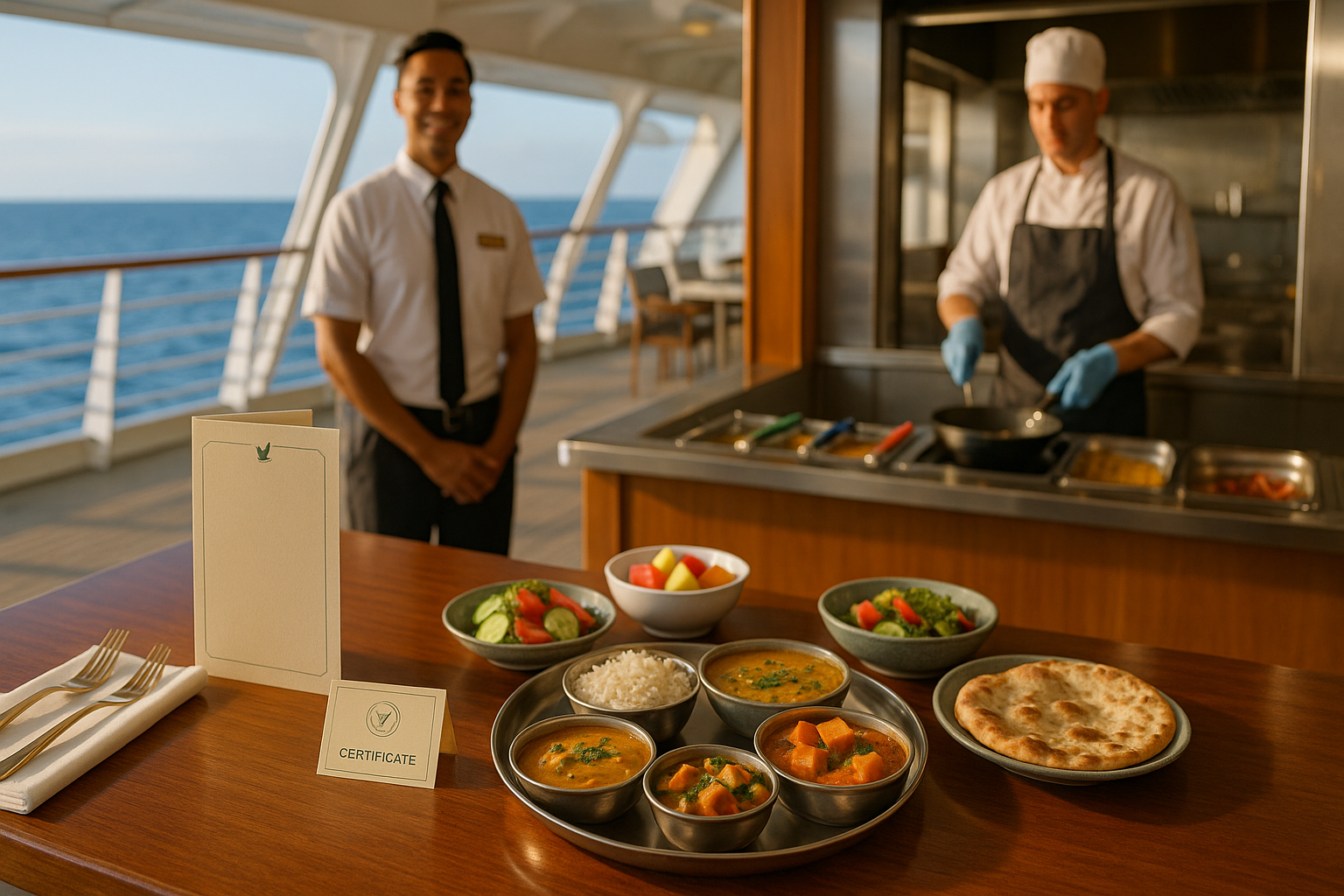
How is Halal Indian food served onboard cruise ships?
Halal Indian food is offered via main dining rooms, buffets (often pork‑free only), specialty Indian restaurants, and room service; preparation may be pre‑packaged or freshly prepared depending on ship and supplier.
Availability varies by cruise line, ship, route and advance notice, so guests should confirm specifics with the cruise line or dining manager. Many mainstream ships accommodate halal or halal‑style requests, but full halal certification across a ship’s kitchens is uncommon and practices can differ by sailing.
Dining venues and how halal options are delivered (main dining, buffet, specialty restaurants, room service)
Main dining, buffets, specialty Indian restaurants and room service each deliver halal Indian dishes differently.
Below are typical venues and how they usually deliver halal Indian options:
- Main dining room — handles special halal requests; meals may be freshly prepared on request or served from pre‑packaged halal items depending on ship capabilities.
- Buffet/Lido — usually provides pork‑free Indian stations but uses shared kitchens and therefore items are often not halal‑certified.
- Specialty Indian restaurant (e.g., Carnival’s Masala Tiger) — offers tandoori, kebabs, naan and vegetarian dishes with fresher preparation; certification is not guaranteed.
- Room service — can fulfil pre‑ordered Indian dishes; some lines supply pre‑packaged halal meals for room service upon request.
Guests should confirm how each venue handles ingredients, separate preparation, and labeling before dining.
What 'halal' means in practice at sea (no pork, no alcohol, ingredient checks)
At sea 'halal' means no pork or pork‑derived ingredients and avoidance of alcohol in food; zabiha (ritual slaughter) is distinct from halal‑style or pork‑free offerings.
Zabiha refers to meat slaughtered to Islamic ritual standards, while many ships provide “halal‑style” meals (pork‑free, alcohol‑free, or vegetarian/seafood) when zabiha‑certified meat is unavailable. Halal certification should be used only when the cruise line or supplier documents a certifier; otherwise vegetarian and seafood dishes are often the safest options. Sauces and processed ingredients may contain alcohol or pork derivatives, so passengers should request ingredient checks and should verify certification or separate preparation with the dining manager. For travellers seeking reliable vegetarian or Jain alternatives, see Cruises with Dedicated Vegetarian and Jain Food Options: Best Choices at Sea.
Specialty Indian restaurants and Indian menu examples
Masala Tiger and other specialty Indian venues provide full Indian menus onboard but they may not be halal‑certified and often operate pork/alcohol‑free only.
Examples of specialty Indian experiences and their typical certification status follow:
- Masala Tiger (Carnival) — tandoori, kebabs, naan and vegetarian sides; Masala Tiger showcases Indian specialty dining but is not usually presented as halal‑certified unless the cruise line documents certification.
- Indian nights in main dining rooms — rotating curries, biryanis and vegetarian choices; these offerings tend to be pork‑free and may use seafood/vegetarian dishes when halal meat isn’t available.
- Halal‑labelled Indian buffets (observed on some sailings) — user footage documents halal‑labelled stations on occasion; such buffets may be labelled pork‑free but may not indicate fleet‑wide certification.
- Pre‑packaged or supplier‑provided halal meals — some ships use certified pre‑packaged halal items or source halal meals from suppliers for specific requests or routes.
Passengers who require certified halal meals should request documentation and confirm preparation and serving procedures with the cruise line or onboard dining manager.
Which cruise lines offer halal food and how do their policies differ?
Mainstream lines including MSC, Celebrity, Royal Caribbean, Princess, Carnival, NCL, and Disney offer halal options, but scope, certification, and notice periods vary by ship and route.
In practice this means some lines provide halal meals in main dining rooms or on specific itineraries, while full halal certification or separate kitchens are rare; passengers should confirm provision for the exact ship and sailing.
Major mainstream cruise lines — who offers what (MSC, Celebrity, Royal Caribbean, Princess, Carnival, NCL, Disney)
Major mainstream lines offer halal options; scope and notice requirements differ by operator and route.
The following operators offer halal options; scope and notice requirements follow.
- MSC — MSC offers halal options on select ships and routes; MSC requires halal meal requests at least two weeks before departure, and buffet areas may be pork-free but are not necessarily halal-certified.
- Celebrity — Celebrity offers halal options fleet-wide; Celebrity requires passengers to request halal food at booking and confirm 30 days before departure.
- Royal Caribbean — Royal Caribbean offers halal-certified meat only on Dubai and Singapore departures; Royal Caribbean requires the Special Needs form 90 days before departure for halal meat, and other routes may only provide pork-free or requested meals without certification.
- Princess — Princess offers halal options upon request; Princess requires a minimum of two weeks’ notice and is strongest on Asia‑Pacific and Middle East itineraries.
- Carnival — Carnival supports halal requests and has Indian dining venues on some ships, but Carnival does not generally claim fleet‑wide halal certification and availability may vary by ship.
- Norwegian Cruise Line (NCL) — NCL supports religious dietary requests including halal; NCL’s halal availability may vary by ship and itinerary and should be confirmed.
- Disney — Disney offers halal options in main dining on request; Disney requires a five weeks advance request and availability is more limited (not typically at quick‑service venues or room service).
Fleet and route variability: when a line offers halal on some ships/routes but not others
Availability depends on ship, route and departure port.
Some lines supply halal-certified ingredients only for specific embarkation ports or markets—Royal Caribbean, for example, serves halal-certified meat on Dubai and Singapore departures only and requires 90 days’ notice—while the same line’s other sailings may only accept halal requests without certified supply. Supply chain, catering contracts, and crew training can affect whether halal options are offered on a given ship, and cross-contamination risk is higher in shared kitchens. You should confirm halal provisioning for the exact ship, itinerary and departure port before booking.
Are there dedicated halal or Muslim-friendly cruise operators?
Yes—specialist operators and packaged halal cruises exist.
Dedicated halal operators and packages (for example, the M/V Piano Land reported as a fully Muslim‑friendly ship, Halal Cruises Club-style themed sailings, and HalalCruises.ca packaged halal cruises) focus on 100% halal food, prayer facilities, and Muslim‑friendly amenities; such single‑ship “fully halal” claims should be independently verified. Specialist operators differ from mainstream lines by providing dedicated halal provisioning and faith‑focused services but may have narrower itineraries or pricing tradeoffs, so travellers should verify certification, services and itinerary details before booking.
How to request and confirm halal meals when booking and onboard
Request halal at booking, submit special meal forms or email the access/special needs team, and reconfirm at embarkation with the dining manager.
Many cruise lines handle halal as a special meal request that you must request before sailing and confirm again once onboard. Requesting early improves the chance of certified or pre-packaged halal items; confirming at embarkation clarifies preparation, labeling, and cross‑contamination controls.
Step-by-step request process (pre-booking, special meal forms, boarding confirmation)
Follow these sequential actions to request halal meals: indicate at booking, submit the special-meal form or email the access team, follow up before sailing, and confirm onboard with dining staff.
- Request — Add “halal” to your reservation at booking and ask your travel agent to record the dietary requirement in the booking.
- Submit — Complete the cruise line’s special meal form via the website or app and select/describe “halal” in the dietary requirements section.
- Email — Contact the access/special needs department for verification or complex requests (for example, Royal Caribbean’s special_needs@rccl.com is used for severe/medical dietary support) and request written confirmation.
- Follow up — Contact the cruise line or agent again within the line’s advance‑notice window (see timelines below); you should reconfirm the request in writing.
- Confirm — On embarkation day, meet the dining manager or head waiter to confirm how halal meals are sourced, labeled, and served, and to request ingredient/supplier details if needed.
Who to contact and what documentation or written confirmation to request
Contact the cruise line’s access/special‑needs department, your travel agent, and the ship’s dining manager; request written supplier and certification details when available.
Contact the access/special‑needs team to register the request formally and ask your travel agent to log it in the booking. Contact the dining manager or head waiter on embarkation to confirm handling and labeling. You should request written confirmation of supplier or certifier names and whether meals are pre‑packaged or prepared separately; if the line cannot provide certification, they may provide ingredient lists or packaging labels instead.
Advance notice timelines by cruise line and route
Typical notice ranges from two weeks to 90 days depending on the cruise line and route; follow up 1–2 weeks before sailing to reconfirm.
- Typical notice — Notice may range from 2 weeks to 90 days depending on the operator and itinerary; follow up 1–2 weeks before embarkation.
- MSC Cruises — 2 weeks minimum notice for halal meal requests.
- Celebrity Cruises — 30 days minimum notice and confirm 30 days before departure.
- Royal Caribbean — 45–60 days for Kosher/Halal in many cases, and up to 90 days for halal meat on some Dubai and Singapore departures.
- Disney Cruise Line — 5 weeks minimum notice for formal halal requests.
- General guidance — Many sources advise requesting halal meals 30–90 days before departure for best results; you should always reconfirm in writing and again on embarkation day.
Certification, verification, and cross-contamination risks
Certification varies by ship and supplier; some meals or pre‑packaged items may be halal‑certified while whole‑kitchen certification is uncommon—verify the certifier and packaging in writing, and mitigate cross‑contamination by preferring plated service and coordinating with the chef.
Are cruise ship halal meals certified? (short answer and nuance)
No universal certification exists; certification varies by ship, route, and supplier.
Some cruises source pre‑packaged halal‑certified meals for special requests, while entire kitchens are rarely certified halal. Availability often depends on itinerary demand and the supplier the ship uses, so travelers may see certified items on some sailings but not others.
How to verify halal certification and supplier information
Ask for the certifier name, supplier/brand, packaging or batch details, and written confirmation from the cruise dining or access team.
Ask the cruise line or dining team for the following items before boarding:
- A certifier name and copy or photo of the certificate (for example IFANCA, JAKIM, HFA, if the ship supplies such documentation).
- Supplier/brand name and batch or lot number shown on packaging or delivery paperwork.
- Clear ingredient list and country of origin for the meat product or pre‑packaged meal.
- Confirmation that no alcohol is used in the recipe or cooking process for your meal.
- An email or written note from guest services or the dining manager confirming the details so you can reconfirm on embarkation day.
Cross-contamination risks (shared kitchens, buffets) and reasonable mitigation steps
Shared kitchens, buffets, shared fryers, grills, utensils, and sauces create real cross‑contamination risks; passengers should prefer plated service and speak with the chef to reduce exposure.
Shared cooking equipment and service lines can transfer meat juices, oil, or utensils between halal and non‑halal items, and buffet stations commonly mix serving utensils and condiments.
For clearer protection, you should take these mitigation steps before and after boarding:
- Request plated, made‑to‑order service in the main dining room rather than using the buffet.
- Ask the chef or dining manager to prepare your meal using separate pans, trays, or at a different time and to change gloves/utensils between tasks.
- Request that fryers, grills, and cutting boards be cleaned or a separate set used for your halal meal where feasible.
- Avoid shared self‑service stations, sauces, and condiment dispensers; request sauces be served on the side or freshly plated.
- Choose seafood or vegetarian dishes when certification/handling is unclear, as they often reduce halal‑meat handling concerns.
- Meet the dining manager or chef on embarkation day to confirm procedures and inspect packaged‑meal labels if the ship provided certified products.
Which itineraries and destinations are most halal-friendly for dining?
Middle East and Southeast Asia routes are the most halal-friendly, followed by Mediterranean and select Asian departures, driven by passenger demand and local supply chains.
Cruise lines and caterers match provisioning to expected passenger demographics, so routes with higher Muslim demand (UAE, Malaysia, Indonesia, Turkey) have stronger halal sourcing and certified‑meat logistics. Dedicated regional operators (for example, Genting Dream) and mainstream ships on Dubai or Singapore sailings can further improve availability. The regional ranking by likelihood is:
- Most likely — Middle East: due to consistently high Muslim passenger demand on UAE/Dubai/Abu Dhabi sailings and established local supplier networks that supply halal‑certified meat.
- Most likely — Southeast Asia: due to regional operators (e.g., Genting Dream) and frequent embarkations from Singapore/Port Klang with halal certification pathways and local suppliers.
- Likely — Mediterranean: due to concentrated demand in Turkey and select ports where local sourcing and occasional certified suppliers make halal provisioning easier.
- Likely — Selected Asian departures (e.g., Singapore departures): because embarkation from Singapore often gives ships access to halal‑certified meat and logistics used by some lines.
- Less likely — Other long‑haul routes (Caribbean, Alaska, Northern Europe): these routes may offer halal meals on request but typically lack the same certified supply networks and rely more on pork‑free/seafood or vegetarian options.
Regions most likely to be halal-friendly (Middle East, Southeast Asia, Mediterranean, selected Asian departures)
Middle East and Southeast Asia rank highest due to strong local demand and supplier networks.
- Middle East — Middle East has the highest likelihood because UAE/Dubai/Abu Dhabi sailings attract large Muslim passenger volumes and local provisioning contracts that can supply halal‑certified meat.
- Southeast Asia — Southeast Asia has high likelihood because operators like Genting Dream and ports such as Singapore and Port Klang have established halal suppliers and certification channels.
- Mediterranean — Mediterranean is likely because demand around Turkey and some European ports drives local sourcing options and occasional halal provisioning by cruise lines.
- Selected Asian departures — Selected Asian departures (for example, Singapore) are likely because embarkation at these ports gives ships access to certified suppliers and tailored provisioning.
How departure ports and supply chains (e.g., Dubai, Singapore) affect certified meat availability
Departure ports like Dubai and Singapore improve access to halal‑certified meat because local suppliers and logistics support certified supply chains.
Ships load bulk provisions at embarkation and major resupply ports, so ports with halal‑certified wholesalers make it operationally feasible to stock pre‑packaged halal meat and reduce cross‑contamination risk. For example, some lines provide halal‑certified meat only on Dubai and Singapore departures because those ports offer reliable certified suppliers and logistics. Travelers should choose or book departures from Dubai, Singapore, Malaysia, Indonesia, or Turkey when possible and request halal meals well in advance (commonly 30–90 days) to increase the chance of receiving certified meat.
Practical considerations and supplementary options
Passengers can usually bring limited packaged, non‑perishable halal snacks; ships may provide prayer guidance or rooms; dedicated halal packages exist but may trade itinerary and price for faith‑aligned services.
Many practical traveler concerns are not about daily provisioning but about continuity and comfort: bringing food, finding prayer space, managing Ramadan, and deciding between mainstream lines with halal requests or specialist halal sailings. Check your cruise line’s policy before packing or booking and confirm any special requests in writing.
Can I bring my own halal food onboard and what are the rules?
Most lines allow limited packaged, non‑perishable halal snacks but restrict perishables and individual ship and port rules may vary.
CruiseRegal and travel guides recommend shelf‑stable items (sealed snacks, dry mixes, packaged dates) for emergencies and continuity; fresh meat, large quantities, or unpackaged perishables are commonly restricted and ports may enforce additional customs rules. You should check the specific cruise line’s carry‑on and embarkation policies, declare any food if required, and pack emergency snacks in original, sealed packaging for smoother screening.
Prayer facilities, Ramadan considerations and onboard religious services
Many ships provide prayer guidance or quiet areas; some ships may offer dedicated prayer rooms, Qibla markers, and Ramadan‑aware services, but availability is ship‑dependent and should be requested in advance.
Guides report that select ships and itineraries (especially Middle East or Southeast Asia routes) include prayer spaces, Qur’an availability, and Qibla direction indicators; crew can often supply prayer timetables or a room key on request. Passengers should contact guest services or the cruise’s special‑needs/access team before sailing to arrange suhoor/iftar timing, quiet space for congregational prayer, or any religious services.
Fully-halal ships, dedicated packages and tradeoffs (price, itinerary, authenticity)
Dedicated halal cruises and fully‑halal ships exist, but they may cost more, offer narrower itineraries or schedules, and require independent verification of full‑kitchen halal claims.
Specialist operators and themed sailings (for example, offerings promoted by HalalCruises.ca and the M/V Piano Land concept noted in industry coverage) provide alcohol‑free environments, gender‑segregated options, and halal‑focused menus. The tradeoffs include potentially higher price, fixed group itineraries, and fewer sailing dates compared with mainstream lines that accept halal meal requests; passengers should verify certification and exactly which venues/kitchens are halal before booking and compare those guarantees against mainstream options like MSC, Royal Caribbean, or Genting Dream that may offer halal meals on specific routes.