This guide examines which cruise ships and onboard venues provide authentic Indian buffet and specialty dining for Indian, vegetarian, and Jain travellers. It focuses on buffet and Main Dining Room offerings, ship-level specialty restaurants (for example, Masala Tiger), and the operational steps required to secure suitable meals.
Major mainstream lines serving Indian dishes include Royal Caribbean, Carnival, Norwegian, Celebrity and Princess. Indian entrées commonly appear in the Main Dining Room and the buffet. Some ships run themed Indian nights or have dedicated specialty restaurants that expand the menu.
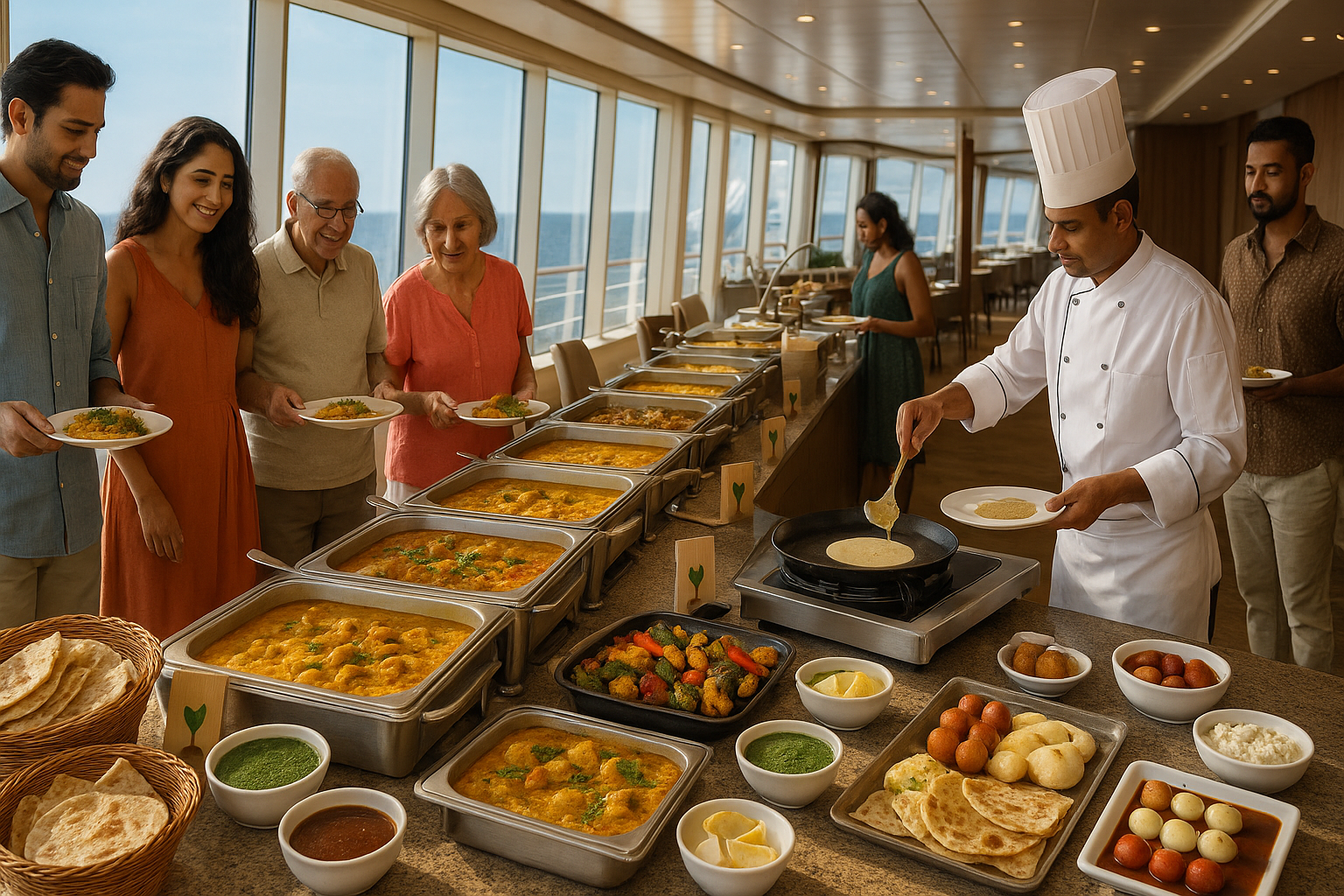
Buffet venues (Windjammer, Marketplace, Lido, Horizon) commonly include an Indian section or rotating station and simplify recipes for high-volume service. Specialty venues such as Masala Tiger provide tandoor cooking and dedicated menus; these venues may charge à la carte prices and are available only on select ships. Carnival lists Masala Tiger on Carnival Celebration, Carnival Jubilee and Mardi Gras. Masala Tiger frequently offers a complimentary lunch buffet; dinner mains typically range from $15 to $38.
Special-diet requests should be submitted via the cruise dining portal or by email at least 48 hours before sailing and confirmed with the dining manager or head chef on the day of boarding. Buffets can be evaluated by authenticity, chef provenance, variety, frequency of Indian offerings, and availability of vegetarian and Jain options.
What cruise lines serve authentic Indian food for Indian travellers?
Major mainstream cruise lines that commonly serve Indian dishes include Royal Caribbean, Carnival, Norwegian, Celebrity and Princess. Basic Indian options are often available fleet‑wide; fuller specialty venues are ship‑specific.
Many ships include Indian entrees in the main dining room and buffet; some vessels schedule Indian‑themed nights or operate dedicated specialty restaurants offering expanded menus. Availability varies by ship, itinerary and homeport; menus for individual sailings are published and can be consulted prior to travel.
Which cruise lines consistently serve Indian dishes across multiple ships?
Royal Caribbean, Carnival, Norwegian, Celebrity and Princess commonly offer Indian dishes across multiple ships.
The following lines and a quick note on breadth:
- Royal Caribbean — commonly lists Indian entrees in Main Dining Rooms and the Windjammer buffet across many ships; select ships run Indian‑themed nights or expanded specialty menus.
- Carnival — commonly includes Indian dishes in MDRs and buffets and places a Masala Tiger specialty restaurant on select ships.
- Norwegian — commonly features Indian options in buffets and Main Dining Rooms, with some ships offering more extensive specialty or themed Indian stations.
- Celebrity — commonly offers Indian dishes across several ships’ MDRs and may feature elevated regional and vegetarian options on select vessels.
- Princess — commonly serves Indian selections in buffets and MDRs, with some ships emphasizing regional dishes and vegetarian choices.
How do cruise lines differ in authenticity, frequency and variety of Indian offerings?
Cruise lines vary in menu depth, frequency of Indian service, and vegetarian/Jain accommodation — some lines run daily Indian entrees in main dining rooms (MDRs) and buffets; others restrict Indian fare to themed nights or ship‑specific specialty restaurants.
Casual buffet and MDR Indian items tend to be milder and aimed at general palates; specialty restaurants and Indian‑themed events present fuller regional menus, tandoor cooking and stronger spice profiles. Vegetarian and Jain options are commonly available across many lines; a minority of ships employ Indian‑trained chefs or maintain dedicated menus to increase authenticity. Passengers should check the ship’s dining listings or contact dining services for details on regional dishes, daily availability and specialty‑restaurant reservations.
What dining venues on cruise ships typically offer Indian cuisine?
Indian cuisine on cruise ships appears in buffet venues, main dining rooms (MDRs), specialty Indian restaurants, and pop‑ups or live‑cooking events. Buffets and MDRs provide broader daily availability; specialty restaurants deliver focused authenticity and traditional techniques. Pop‑ups and themed nights temporarily expand regional variety and live offerings.
Below are common venue types and concise tradeoffs.
- Buffet (Windjammer, Marketplace, Lido, Horizon): self‑service station areas on most ships that may include an Indian section or a rotating Indian station.
- Wider daily variety and rotating choices; recipes often adapted for high‑volume service.
- Typically more vegetarian options and extended access throughout the day.
- Authenticity and regional depth may be limited compared with specialty venues.
- Main dining room (MDR): the ship’s sit‑down, included dinner service with a changing menu.
- Indian entrees appear on plated menus with steadier placement and consistent preparation.
- Dishes may be milder or adapted for broad guest tastes; regional items may appear regularly.
- Availability varies by sailing and ship; consult the daily MDR menu.
- Specialty restaurant (example: Masala Tiger): a paid or reservation‑only venue focused on Indian cuisine.
- Dedicated menus, techniques such as tandoor cooking, and more authentic preparation.
- May charge a cover or à la carte prices and are present only on select ships.
- Provide greater regional depth and presentation than buffet sections.
- Pop‑up / themed night: intermittent Indian‑themed evenings or live‑cooking stations in buffets or special areas.
- Themed nights expand buffet selections, introduce live stations, and showcase additional regional dishes for one evening.
- Frequency and timing vary by itinerary and passenger mix; offerings may rotate between sailings.
- Check the daily program for scheduled themed events.
For a focused comparison of buffet and à la carte approaches on cruise ships, see Buffet vs. À la Carte: Indian Cuisine Dining on Cruise Ships.
Do buffets or main dining rooms usually offer more Indian variety?
Buffets usually offer wider daily variety and rotating Indian stations; main dining rooms provide plated regional items with steadier menu placement. Buffets commonly rotate Indian dishes and may run dedicated sections or themed nights, providing more simultaneous choices. Buffets tend to present a broader selection across meals; main dining rooms present curated, plated entrees that appear reliably on the evening menu. The ship's daily menu indicates rotation and exact offerings, which vary by vessel and sailing.
Are specialty Indian restaurants more authentic than buffet options?
Specialty Indian restaurants typically provide greater authenticity: dedicated menus, tandoor cooking and dedicated chef teams. Buffets prioritize breadth and accessibility and often simplify recipes to suit volume service.
- Specialty: Dedicated Indian restaurants present targeted recipes and techniques (for example, tandoor cooking) with chef teams focused on Indian cuisine, supporting higher authenticity.
- Buffet: Provide greater variety and convenience; dishes are frequently simplified for high-volume service, which can reduce regional nuance.
- Main dining room: MDRs combine plated presentation and accessibility, offering regular Indian entrées typically adapted for broad palates.
- Pop‑up/themed nights: Deliver short runs of authentic dishes; offerings are temporary and vary by itinerary.
When do ships run Indian‑themed nights or pop‑up events, and how do they affect buffet offerings?
Ships run Indian‑themed nights intermittently—often on cultural/port days or one evening per cruise—and those events expand buffet selections and add specialty stations. On themed nights the buffet (for example Windjammer) often increases the number of Indian dishes, adds live‑cooking or carving stations, and showcases regional varieties that aren’t on the regular rotation. Frequency and scope may depend on itinerary and passenger demographics (some departures historically feature more Indian options), so passengers should check the daily program or ship app to know when a themed night or pop‑up is scheduled.
Which cruise line offers the best Indian buffet for authentic flavors?
Top picks are Royal Caribbean (consistent Windjammer and Main Dining Room Indian offerings), Norwegian (buffet sections often dedicated to Indian dishes), and select Carnival ships with Masala Tiger.
Royal Caribbean earns high marks: Windjammer nights and Main Dining Room menus regularly include multiple Indian curries and vegetarian options, and passenger praise appears repeatedly on Reddit and Royal Caribbean Blog. Norwegian often dedicates buffet sections to Indian dishes on many ships, as highlighted by VacationFun4Everyone and passenger reports. Carnival’s Masala Tiger (on Carnival Splendor) provides an onboard Indian lunch buffet and a paid dinner menu that corroborate line-level investment in authentic techniques such as tandoor cooking.
Ranked selections with brief justification:
-
- Royal Caribbean — consistent shipwide Indian offerings; repeated passenger praise on Reddit and Royal Caribbean Blog.
-
- Norwegian — buffets frequently include a dedicated Indian section; coverage on VacationFun4Everyone and passenger reports.
-
- Carnival (select ships with Masala Tiger) — dedicated Indian venue (Masala Tiger on Carnival Splendor) offering a complimentary lunch buffet and a specialty dinner menu; supported by Carnival’s Masala Tiger listing and Carnival-focused blogs.
Perceived authenticity varies with individual taste and itinerary; the ship’s current menu and recent passenger reviews should be consulted before booking.
What criteria should be used to judge an Indian buffet at sea?
Key evaluation criteria: authenticity, regional variety, menu frequency, vegetarian and Jain options, and chef background.
- Authenticity — evidence of traditional techniques and ingredients, such as tandoor cooking, use of whole spices, and region-specific sauces.
- Chef background — presence of Indian-trained chefs or menu notes describing techniques; chef credentials correlate with flavor fidelity.
- Variety — representation of regional cuisines (North Indian gravies, South Indian dosa/idli, coastal seafood specialties, street-food chaat) rather than a single generic curry.
- Frequency — regular appearance of Indian dishes in the main dining room or buffet; consistent listings indicate operational capability.
- Vegetarian and Jain options — availability of sufficient vegetarian dishes and explicitly Jain-friendly preparations (separate cooking and avoidance of root vegetables), which affect suitability for many Indian diners.
CruiseSolutioner and CruiseDiscover cite trained Indian chefs, regional variety, and vegetarian friendliness as key authenticity indicators.
Which specific ships or itineraries are known for standout Indian buffets?
Examples of ships and itineraries with notable Indian buffet offerings:
- Royal Caribbean: Windjammer and Main Dining Room on some ships run daily or themed Indian nights; Reddit threads and the Royal Caribbean Blog report recurring curries and positive passenger feedback. Southampton departures may feature expanded Indian options.
- Norwegian Cruise Line: Buffet layouts on multiple ships frequently include a dedicated Indian section, per VacationFun4Everyone and passenger reports. Indulge-style food‑hall concepts on certain NCL ships provide Indian stations, with CruiseCritic forum threads praising those offerings.
- Carnival Splendor: Masala Tiger offers an included lunch buffet and an à la carte dinner, as described on Carnival’s Masala Tiger pages and Carnival-focused blogs.
These examples vary by sailing and season; recent passenger reviews and the ship’s current menus should be consulted before sailing.
How much does passenger feedback (reviews/forums) influence 'best' buffet rankings?
Passenger feedback is weighted heavily: volume, recency, and cross-platform corroboration increase confidence in rankings. Greater weight is assigned to buffets that receive consistent praise on Reddit, CruiseCritic and specialist blogs (for example, Royal Caribbean praise on Reddit reported by Royal Caribbean Blog and NCL praise on CruiseCritic boards). Recent, repeated positive reports raise a line’s score; corroboration with operator signals — official menus or a listed venue such as Masala Tiger on Carnival — further increases confidence. Passenger feedback reflects flavor preferences and consistency; cross-checks against official menus and current ship dining offerings verify accuracy.
Which ships have a dedicated Indian restaurant such as Masala Tiger?
Some Carnival ships carry Masala Tiger, and a few other cruise lines operate dedicated Indian specialty venues. Current ship listings on cruise-line operator pages should be consulted prior to booking.
Carnival’s official Masala Tiger page lists the venue as “available on” specific ships. Fan sites report Masala Tiger on Carnival Splendor; this may reflect older or ship-specific offerings and must be confirmed with Carnival’s site.
The following Carnival ships are listed by Carnival as carrying Masala Tiger; listings are subject to change and must be confirmed on carnival.com:
- Carnival Celebration
- Carnival Jubilee
- Mardi Gras
Other cruise lines operate dedicated Indian specialty venues or host Indian specialty nights; examples cited in industry roundups include Royal Caribbean, Celebrity Cruises, Norwegian Cruise Line, Princess, and Holland America. Availability varies by ship and itinerary and requires confirmation on each operator’s official dining pages.
Which ships currently have Masala Tiger or equivalent dedicated Indian venues?
Carnival lists Masala Tiger on specific ships and other lines may run dedicated Indian venues; verify operator pages for the most current ship listings.
Here are select Carnival ships the operator advertises as carrying Masala Tiger:
- Carnival Celebration
- Carnival Jubilee
- Mardi Gras
Note: independent fan sites report Masala Tiger on Carnival Splendor; that may reflect past or ship‑specific offerings and should be verified on Carnival’s official dining page.
Is lunch at Masala Tiger included in the fare and what are typical dinner prices?
Masala Tiger commonly offers a complimentary lunch buffet included in the cruise fare and an à la carte dinner with main courses often priced around $15, with premium mains sometimes reaching about $38.
Carnival’s operator page confirms Masala Tiger’s buffet/dinner format but does not list full prices; menu PDFs and fan‑posted menus report that lunch is included and that dinner mains often start near $15 with premium items up to $38, so use those figures as examples and verify current menus on the ship or Carnival’s site.
How authentic are the menus and cooking methods at these specialty venues (tandoor, Indian‑trained chefs)?
Authenticity signals include use of traditional clay tandoor ovens, Indian‑trained chefs or crew, and regionally focused menus; Masala Tiger advertises tandoor cooking at over 1000 degrees.
Authenticity signals:
- Traditional tandoor cooking: Carnival advertises a clay oven/tandoor and high‑temperature tandoor preparations as a core feature.
- Chef provenance: some cruise lines may employ Indian‑trained chefs or crew who prepare regional dishes, but chef origins may vary and should be confirmed with the line.
- Regional menu depth and signature dishes: menus for Masala Tiger and similar venues commonly feature tandoori kebabs, butter chicken, biryani, chaat, paneer dishes, and vegetarian options—menu variety that supports a stronger authenticity claim.
How can Indian, vegetarian and Jain travellers secure suitable Indian meals onboard?
Special-diet requests can be submitted via a cruise line's pre-sail dining portal, cruise app, or reservation email; most lines require at least 48 hours' lead time for kitchen planning. Confirmation with the dining manager or head chef on embarkation day verifies arrangements and reduces the risk of misunderstandings.
Can passengers pre‑order custom Indian meals or request special diets before sailing?
Yes — passengers can pre‑order or request special diets via the cruise dining portal or email and should allow 48+ hours lead time, then confirm with the ship’s dining team on embarkation.
Most lines provide a dining request form in the booking portal or accept emails/calls to reservations; cruisediscover and Cruise Solutioner recommend using the portal or email and speaking to the dining manager for final confirmation.
Availability of halal and Jain Indian food on cruise ships
Many cruise lines accommodate halal and Jain dietary requirements when requests are submitted in advance. Ingredient and preparation details can be provided by the dining manager or head chef; limitations may apply. Kitchens commonly prepare religiously required meals on request; explicit specification of halal or Jain requirements, provision of documentation or certification where relevant, and reconfirmation on boarding day help verify compliance.
Practical steps: how to request, document, and confirm special‑diet meals
The following actions should be completed before sailing and on the day of boarding to request, document, and confirm special‑diet meals.
- Review cruise line website and app menus and dining‑options pages to determine whether the ship offers Indian cuisine or specialty Indian restaurants.
- Pre‑order via the cruise dining portal or the special‑requests email/online form as early as possible, with a minimum lead time of 48 hours before sailing.
- If no portal exists, reservations or guest services should be contacted and the special‑diet team requested to log the requirement.
- Requests should state the dietary category (for example, “vegetarian”, “Jain”, or “halal”), list ingredient restrictions, and include full passenger names, cabin number, and sail date.
- Menu previews, ingredient lists, and allergen labeling should be requested; obtain written confirmation if available.
- All confirmations, portal entries, and emails should be saved and screenshots retained; where a dining manager or head chef contact is provided, confirmations should be forwarded.
- Specialty Indian restaurants should be reserved through the cruise app or reservations when available to increase the likelihood of authentic options.
- On the day of boarding, in‑person reconfirmation with the dining manager or head chef is recommended to review planned menus and verify ingredient details.
- At each meal, servers should be informed of dietary notes and ingredients confirmed before consumption; the dining manager should be consulted for alternative dishes if a requested item is unavailable.
- Documentation (screenshots and emails) should be kept accessible and guest services contacted if confirmed requests are not honored.
Practical costs, reservations and what to expect from specialty vs buffet Indian dining
Buffet Indian sections are usually included in the cruise fare; specialty Indian restaurants commonly charge à la carte or cover fees, require reservations, and offer greater tandoor-driven authenticity.
Buffets (Windjammer / Marketplace / Main Dining Room) provide breadth and repeatability at no additional charge. Specialty venues (Masala Tiger) feature focused techniques, signature dishes and paid dinner service.
How do specialty restaurants compare with buffet Indian sections in authenticity and cost?
Specialty restaurants offer higher authenticity and culinary technique but cost more and usually require reservations; buffet sections provide greater variety, included self‑serve options, and larger portions.
Comparison (Masala Tiger vs Windjammer/Marketplace):
- Specialty restaurants (example: Masala Tiger) — Pros: clearer authenticity signals (tandoor cooking, curated à la carte menus), plated dishes with chef attention, sides commonly included with mains; Cons: additional charges for dinner, smaller plated portions, reservations often required.
- Buffets / Windjammer / Marketplace — Pros: wide selection, ability to sample multiple dishes and take repeat servings, included in the cruise fare; Cons: lower chef-driven technique per plate, menus standardized for high volume, dishes frequently milder.
- Cost and reservations — Specialty venues incur extra fees and require advance booking; buffet sections are typically included in the fare and do not require a separate reservation.
Typical price ranges, reservation requirements and what’s usually included
Buffet Indian items are usually included in the cruise fare. Specialty Indian dinners are commonly charged per entrée; Masala Tiger mains typically range from $15–$38. Specialty-restaurant reservations are recommended in advance.
Masala Tiger provides a complimentary lunch buffet included in the fare and an optional paid dinner service. Most dinner main courses are approximately $15, with premium mains up to $38; starters and desserts typically range from $4–$12. Sides are often included with the purchase of a main course at specialty venues. Early booking of specialty-restaurant reservations—when dining reservations open or prior to peak sailings—improves the likelihood of securing preferred dinner times.
Cooking methods and chef provenance: what to ask for if authenticity matters
Verify use of a tandoor, presence of Indian‑trained chefs, and availability of region‑specific dishes when assessing authenticity.
Key details for dining staff to confirm:
- Whether a traditional clay tandoor oven is used and which dishes are prepared in it.
- Chef training and menu development: whether on‑board chefs have Indian or region‑specific training and who develops the specialty menu.
- Regional coverage: presence of North Indian, South Indian, or coastal/seafood dishes for regional authenticity.
- Ingredient sourcing and preparation: availability of staples (basmati rice, paneer, whole spices), spice sourcing, and policies on adjusting heat levels or ingredient substitutions.
- Service formats and cost implications: distinctions between included lunch buffets (e.g., Masala Tiger) and paid à la carte dinners, and associated reservation requirements.