This guide covers availability and expectations for Indian cuisine onboard cruise ships for Indian travellers, including vegetarian, Jain and halal needs. It describes which cruise lines and ships provide Indian cuisine, the types of venues where it appears, a dish taxonomy, signals of authenticity, itinerary correlations, and the pre‑booking process for special‑diet Indian meals.
Major mainstream lines—Royal Caribbean, Celebrity, Norwegian, Carnival, Princess, Holland America and P&O—commonly provide Indian dishes in main dining rooms, buffets or specialty venues, though availability varies by ship. Royal Caribbean and Celebrity frequently list Indian entrees in nightly main‑dining menus; Norwegian, Princess and P&O often operate Indian stations in buffet/marketplace areas. Carnival operates a branded specialty restaurant, Masala Tiger, on select ships such as Carnival Celebration, Carnival Jubilee and Mardi Gras. Royal Caribbean and Celebrity run culinary programmes that include trained Indian chefs. Authenticity is signalled by trained chefs, tandoor use, regional menus, spice customisation and themed events. Buffets provide breadth of choices, main dining rotates entrees, and specialty venues offer more authentic menus.
Sailings to and from India and Asia, and ships carrying many South Asian passengers, typically expand Indian offerings as a result of local provisioning and passenger demand. For special diets, passengers should request customised vegetarian, Jain or halal meals at least 48 hours before sailing and follow up with the ship’s dining manager or head chef. Ship‑specific menus should be confirmed with reservations or the dining team prior to booking.
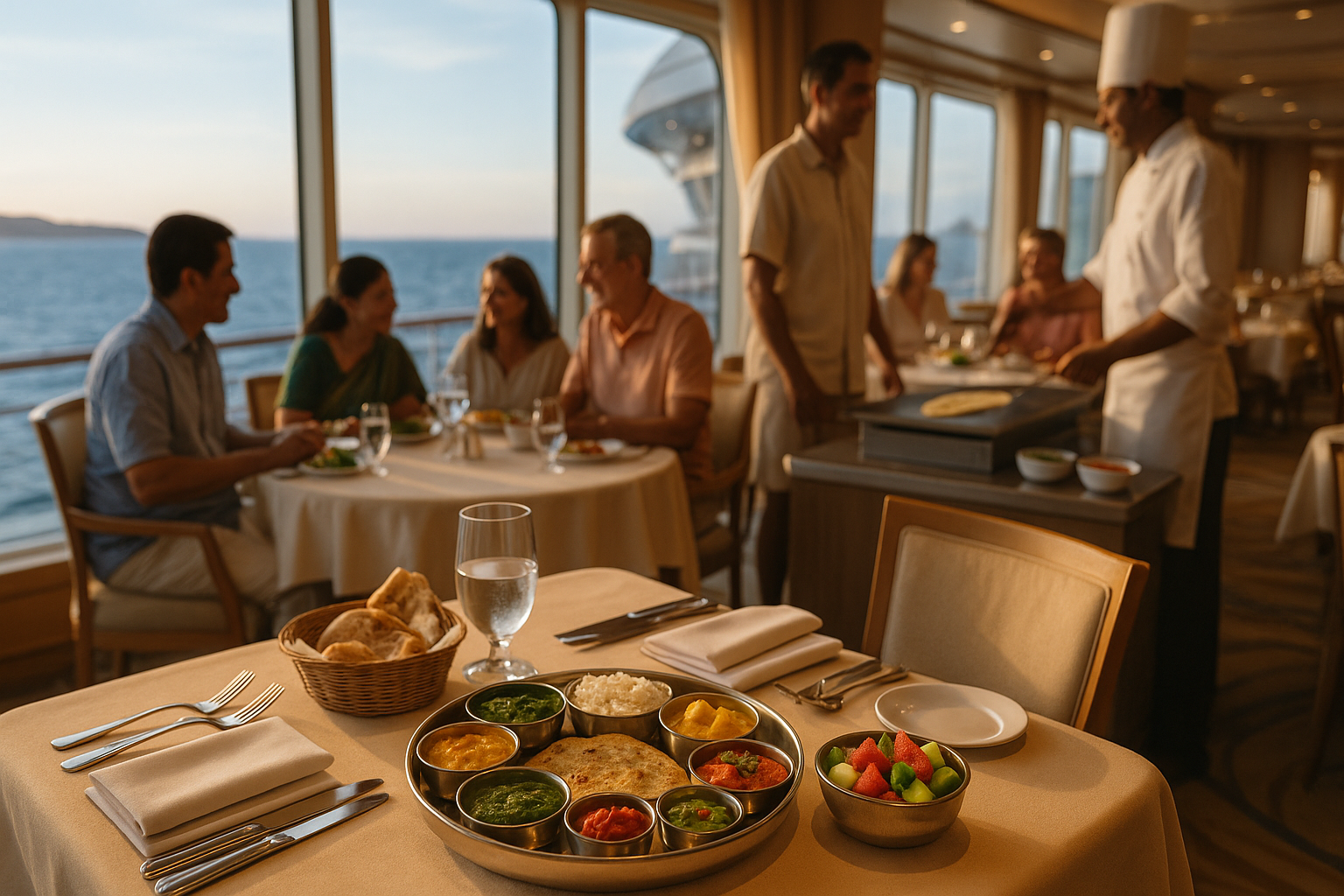
Which cruise lines offer Indian cuisine?
Major mainstream lines—Royal Caribbean, Celebrity, Norwegian, Carnival, Princess, Holland America and P&O—commonly offer Indian dishes in main dining rooms, buffets, or specialty venues; availability is ship-specific. Royal Caribbean and Celebrity frequently list Indian entrees on nightly main-dining menus. Norwegian, Princess, P&O and Holland America regularly feature Indian stations in buffet or marketplace venues. Carnival provides buffet and main-dining Indian dishes and a branded specialty restaurant on select ships.
Exact menus and specialty-restaurant availability are published on each ship's dining page and the cruise line's app.
Short grouped summary by typical offering level (everyday/main dining, buffet-dominant, specialty):
- Everyday / main dining: Royal Caribbean, Celebrity — Indian entrees commonly appear on nightly main-dining menus; menus are published on ship dining pages and the cruise line app.
- Buffet-dominant: Norwegian, Princess, P&O, Holland America — Indian sections frequently appear in buffet or marketplace venues; daily menus or buffet listings are available via ship pages and onboard apps.
- Specialty / dedicated venues: Carnival (Masala Tiger on select ships) and select ships across other lines that may host Indian specialty nights; specialty-dining lists and reservation requirements are listed on cruise line sites and apps.
For ship-specific recommendations and rankings, see Best Cruises for Indian Food Lovers: Top Cruise Ships with Authentic Indian Cuisine.
Which cruise lines have dedicated Indian specialty restaurants onboard (examples)?
Some ships host dedicated Indian specialty restaurants. Carnival's Masala Tiger is an example; other lines operate branded or pop-up Indian venues.
- Carnival — Masala Tiger (available on select ships such as Carnival Celebration, Carnival Jubilee and Mardi Gras; see Carnival dining pages for ship-specific listings).
- Royal Caribbean — dedicated Indian menus and occasional themed Indian dining on select ships; individual ship dining and specialty-restaurant listings in the cruise line app or website list availability.
- Celebrity — elevated Indian specialty offerings and themed culinary events on certain sailings; ship dining and reservations information provides details.
- Norwegian and other mainstream lines — Indian specialty nights, pop-ups, or chef programs may occur on select ships; specialty-dining listings or promotional materials indicate availability.
Availability is ship-specific; dining options for a specific sailing should be verified prior to booking.
Which cruise lines are best for vegetarian and Jain‑friendly Indian menus?
Royal Caribbean, Celebrity, and select Princess and Holland America sailings frequently offer broader vegetarian options and accept Jain‑friendly requests; specifics should be confirmed with the ship's dining team.
- Royal Caribbean — frequently offers daily vegetarian Indian entrees in the main dining room and buffet (Windjammer on many ships); the line commonly lists vegetarian options every night, making it well suited for vegetarian and Jain passengers.
- Celebrity — frequently provides elevated vegetarian and regional Indian dishes on many itineraries; availability varies by ship.
- Princess & Holland America — frequently include vegetarian Indian entrees and milder, homestyle preparations on many sailings; availability varies by ship.
- Norwegian & Carnival — often provide substantial vegetarian options via buffet stations and specialty Indian venues (Carnival’s Masala Tiger offers many vegetarian dishes); these lines commonly feature broad buffet selections.
- P&O — on UK‑centric itineraries often includes British‑Indian style vegetarian options in buffet and main dining; availability varies by ship.
Jain‑specific ingredient rules and food‑handling practices should be confirmed with the dining manager prior to sailing. Custom or special‑diet Indian meals should be requested in advance; 48 hours or more notice is commonly recommended for custom preparations.
Which cruise line offers the most authentic Indian cuisine onboard?
Authenticity varies by line and ship. Public reports frequently cite Royal Caribbean and Celebrity among lines offering the most authentic Indian cuisine, with trained Indian chefs, dedicated menus, and themed Indian events identified as contributing factors.
Authenticity is signalled by measurable indicators and should be checked per ship and sailing.
The following ordered signals are used to assess authenticity:
- Presence of trained Indian chefs or dedicated culinary teams.
- Use of traditional techniques and equipment (tandoor, slow‑cooking).
- Regional dish variety across North/South/coastal menus.
- Spice customisation and authentic spice blends.
- Frequency of Indian menus, Indian nights, or themed culinary voyages.
Passenger feedback and menu descriptions commonly reference Royal Caribbean's Windjammer and main dining room curries and periodic "Indian night" offerings. Celebrity receives praise for elevated, regionally influenced Indian dishes on select itineraries. Carnival operates specialty venues (Masala Tiger) with tandoor cooking on some ships, indicating invested equipment and dedicated venues; availability is ship‑specific. Princess, Norwegian, and Holland America include Indian dishes on many sailings and occasionally host themed nights, with staffing and program depth varying by vessel. Confirmation of trained Indian chefs and menu frequency for the specific ship and sailing is recommended.
What criteria define 'authentic' Indian cuisine at sea?
Authenticity is signalled by trained Indian chefs, regular regional menus, traditional techniques (tandoor), spice customisation, and themed Indian events—each is a measurable indicator.
The following measurable signals are used to assess authenticity:
- Trained Indian chefs or dedicated culinary teams — staffing that reflects Indian culinary training.
- Traditional techniques and equipment — tandoor ovens, clay‑oven cooking, and slow‑cooking methods.
- Regional menu variety — explicit North Indian, South Indian, coastal/seafood, and street‑food selections.
- Spice customisation and authentic blends — ability to adjust heat and use classic masalas.
- Frequency and prominence — regular Indian menus, Indian nights, or specialty‑restaurant availability.
Which cruise lines employ trained Indian chefs or dedicated culinary teams?
Lines frequently cited for Indian‑trained chefs or programs include Royal Caribbean and Celebrity; evidence appears at ship and program level, so verify per ship.
Royal Caribbean and Celebrity are repeatedly mentioned in operator pages and guides as running culinary programs that include trained Indian chefs or teams focused on Indian cuisine. Carnival operates Masala Tiger on select ships with tandoor ovens, indicating a dedicated Indian venue and specialist kitchen equipment that may be staffed by chefs trained in Indian techniques. Princess, Norwegian, and Holland America include Indian offerings and may employ chefs with relevant training on specific ships, but this is variable and should be confirmed with the ship’s dining or culinary team for a given sailing.
How do passenger feedback and onboard events reflect authenticity?
Passenger feedback and themed events often corroborate authenticity when reviews repeatedly praise Indian dishes and lines run Indian nights or culinary voyages.
Social proof supports authenticity claims: Royal Caribbean receives frequent positive Reddit and blog mentions praising its curries and Windjammer Indian nights, indicating consistent passenger satisfaction. Guides and review sites note that themed events, specialty Indian restaurants, and dedicated culinary voyages (including Bollywood‑themed sailings) often coincide with more authentic menus and invested staffing. Passenger feedback should be treated as corroborative evidence — repeated, specific praise for regional dishes, tandoor items, or chef engagement strengthens the case that a particular ship’s Indian cuisine is authentic.
What dining venues onboard typically serve Indian food — buffet, main dining room, or specialty restaurant?
Indian dishes appear in buffets (breadth), main dining rooms (rotating daily entrees), specialty restaurants (depth/authenticity), and sometimes casual outlets or room service; quality and variety vary by ship.
Ships commonly place Indian options across multiple venues according to demand and the ship’s concept. Royal Caribbean’s Windjammer-style buffets and the main dining room regularly feature Indian entrees; some lines offer dedicated Indian specialty restaurants. Breakdown of typical venues serving Indian food onboard:
- Buffet — Breadth: Buffets (for example, Windjammer-style or Lido Marketplace) provide a wide selection of familiar Indian dishes and vegetarian options for self-service.
- Main dining room — Rotating entrees: The main dining room often rotates an Indian entrée on the daily menu, presenting different curries or regional classics each night.
- Specialty restaurant — Depth/authenticity: Paid or reservation-only Indian restaurants (for example, Carnival’s Masala Tiger and other dedicated venues) offer region-specific dishes and traditional techniques.
- Casual outlets & room service — Convenience: Casual quick-serve venues and room service may include Indian items or accommodate special requests; availability varies by ship and day.
Are regional Indian dishes more likely to appear in buffets or specialty restaurants?
Buffets onboard cruise ships offer a broad selection of familiar regional Indian items; specialty restaurants present more region-specific dishes and traditional techniques.
Buffets prioritize variety and crowd-pleasing items, providing common curries, rice dishes, and vegetarian options suited to diverse tastes. Specialty restaurants and themed culinary events focus on depth and authenticity; they typically feature specific regional preparations, chef-driven recipes, and tandoor or coastal cooking techniques. Themed buffet nights (for example, an "Indian night" in a Windjammer) may expand regional selections, but greater regional depth is more common in dedicated specialty venues or during cultural culinary events.
Availability of Indian dishes from casual outlets, room service, or on‑the‑go venues
Casual outlets, grab‑and‑go stations, and room service sometimes offer Indian options, though availability varies. Common grab‑and‑go items include samosas, wraps, and simple curry preparations on busy days; selection is inconsistent across sailings.
Room service and main dining staff can often prepare Indian dishes upon request. Advance notification via the cruise app or the dining manager increases the likelihood that requested dishes will be available. For takeaway snacks, advance requests are recommended; staff can advise on portioning for travel, and the head chef or cruise app can confirm timing and availability of specific regional items.
Types of Indian dishes available on cruises
Typical offerings include North Indian classics such as butter chicken, biryani, and dal; South Indian staples including dosa, idli, and sambar; coastal seafood curries; and street‑food snacks such as samosa, vada pav, and chaat, frequently prepared in milder, cruise‑adapted versions.
Menus vary by ship and itinerary. Indian dishes commonly appear in the main dining room, buffets (Windjammer-style), themed nights, and specialty restaurants (for example, Masala Tiger on Carnival). The three broad categories most commonly offered at sea are:
Which North Indian classics are typically offered onboard?
North Indian classics commonly available on cruise ships include butter chicken, chicken or vegetable biryani, dal, and paneer preparations; these are frequently prepared in milder, broadly palatable versions.
Frequent offerings in the Main Dining Room or buffet include:
- Butter chicken — creamy tomato-based sauce, typically mild to medium heat.
- Biryani (chicken or vegetable) — aromatic basmati rice cooked with spices and served as a main entrée.
- Dal (lentil stews) — mildly spiced lentil preparations.
- Paneer dishes (saag paneer, paneer tikka) — vegetarian mains with moderate seasoning.
Which South Indian and coastal dishes are commonly available at sea?
Typical South Indian options include dosa, idli and sambar; coastal offerings include prawn and fish curries when provisioning allows.
Examples commonly offered, depending on ship provisioning and itinerary:
- Dosa (plain or masala) — thin fermented crepe, frequently presented at breakfast or at a live cooking station.
- Idli with sambar — steamed rice cakes accompanied by lentil-tamarind stew; a milder staple.
- Sambar — tangy lentil and vegetable stew, served as a condiment or side.
- Seafood curries (prawn curry, local-style fish curry) — featured on menus or buffet stations when fresh seafood is stocked.
What Indian street‑food snacks and small plates are available onboard?
Common Indian street‑food snacks and small plates found onboard include samosa, vada pav, assorted chaats, and small tandoor plates. These items are typically served at buffets, during themed Indian nights, or on specialty snack menus.
Typical examples and when they show up:
- Samosa — fried pastry filled with spiced potato and peas; commonly offered at buffet and snack stations.
- Vada pav — spiced potato fritter served in a bun; appears during themed events or at Indian food stations.
- Chaat varieties (bhel puri, papdi chaat) — served at Indian nights or designated buffet counters.
- Small tandoor plates (tandoori chicken, kebabs, paneer tikka) — featured on specialty-restaurant menus or during themed events such as Windjammer Indian nights and at venues like Masala Tiger.
Which ships and itineraries are most likely to feature expanded Indian dining options?
Sailings to and from India and other Asian ports, and ships based where many South Asian passengers board, typically feature expanded Indian menus. Confirmation of offerings for a specific sailing is available on a ship's dining page or from the reservations department.
Cruise lines increase Indian menu options on India/Asia itineraries; provisioning in nearby ports permits sourcing of regionally familiar ingredients and passenger demographics raise demand. Sailings that board large numbers of South Asian passengers commonly feature expanded Indian offerings across main dining rooms, buffets, and specialty venues.
Itinerary and ship selection both affect availability: an India-focused route makes expanded menus practical; ships that frequently serve ports with significant South Asian passenger traffic or that market India cruises are more likely to provide broader Indian choices.
Do sailings that visit India and nearby ports (Mumbai, Goa, Cochin) typically feature expanded Indian menus?
Sailings to India and nearby Asian ports commonly expand Indian culinary offerings, reflecting local provisioning and passenger composition.
Cruise lines market India itineraries with cuisine as a key element; provisioning from ports such as Mumbai and Cochin facilitates expanded menus. Higher proportions of South Asian passengers increase demand for Indian dishes, leading to daily or themed Indian selections across dining venues.
Which specific ships frequently feature dedicated Indian restaurants or expanded Indian menus?
Select ships frequently include dedicated Indian restaurants or expanded Indian menus, and Carnival's Masala Tiger is a clear ship‑level example.
Here are representative ship‑level examples:
- Carnival (Masala Tiger) — Masala Tiger is available on select Carnival ships such as Carnival Celebration, Carnival Jubilee, and Mardi Gras, showing how a specialty venue can be ship‑specific.
- Celebrity Cruises — Celebrity actively markets India cruises and highlights cuisine for India sailings, so Celebrity ships on India/Asia itineraries commonly expand Indian options.
- Royal Caribbean & Norwegian — These lines often include Indian dishes in main dining rooms and buffets and run Indian‑themed nights on select ships; availability varies by ship and embarkation base.
Availability is variable by ship and sailing, so expect "select ships" and "select sailings" rather than a line‑wide guarantee.
How to check a specific sailing's menus and culinary events before booking
Ship dining pages and communications with the reservations team or the onboard dining manager provide verification of menus for a specific sailing.
Checklist for verification:
- The ship's dining pages and sample menus on the cruise line website or app provide listings of specialty restaurants and sample daily menus.
- The reservations team or the ship's dining manager/head chef confirm whether Indian dishes, themed nights, or specialty restaurants (for example, Masala Tiger) are scheduled for the sailing.
- Pre-cruise menu PDFs and event schedules in the app or booking portal list themed culinary events and specialty-restaurant availability.
- Dining pages may be updated closer to departure; the reservations team confirms dietary accommodations, vegetarian and Jain options, and specialty-restaurant reservation policies.
How to request customised vegetarian, Jain or halal Indian meals before sailing
Special-diet requests for vegetarian, Jain or halal Indian meals should be submitted in writing to the booking agent or cruise-line reservations and confirmed with the ship's dining team. Clear written instructions should list ingredients and allergens.
Steps to request customised Indian meals before sailing:
- Special-diet requests should be registered with the booking agent or cruise-line reservations at booking or when the requirement is identified.
- Requests should be submitted at least 48 hours before sailing and include a complete ingredient list, declared allergens, and any strictures (for example, prohibition of root vegetables for Jain meals or halal meat specifications).
- A pre-boarding confirmation with the ship's dining manager or head chef clarifies preparation methods and sourcing for specific dietary requirements.
- On boarding day, passengers should verify receipt of the request with the dining manager or the assigned server to confirm that the kitchen received the instructions.
Contacts to arrange vegetarian, Jain or halal meals
Initial contact is the booking agent or cruise line reservations team, which records dietary requirements. Onboard coordination is managed by the ship's dining manager and, when necessary, the head chef. The dining manager is the point of contact before boarding for complex Jain or halal requirements.
- Booking agent / travel agent or cruise line reservations — contacted at the time of booking to record dietary requests and add reservation notes.
- Dining manager — consulted for ingredient, preparation and spice-level specifications; contacted before boarding and on the day of boarding if required.
- Head chef — engaged via the dining manager for menu customization or substitutions that require kitchen-level handling.
How far in advance to request Jain, halal or other special‑diet Indian meals?
Custom vegetarian, Jain, or halal meals should be requested at least 48 hours before sailing. For complex Jain restrictions (no root vegetables; in some cases, no onion/garlic), large group requests, or specialty-restaurant bookings, the cruise line should be notified several weeks before departure. Pre-boarding confirmation with the dining manager is recommended to finalize preparation details.
What information or wording should be provided to allow correct meal preparation (allergens, Jain restrictions, spice level)?
A concise checklist facilitates communication with onboard culinary staff. The sample phrasing below can be added to a reservation or sent to the dining manager.
Checklist:
- Diet type: e.g., "Jain", "Vegetarian (no eggs)", or "Halal"; indicate whether halal meat is required.
- Specific ingredients to avoid: e.g., "no onion, no garlic, no potatoes, no mushrooms."
- Allergens: list common allergens (peanuts, tree nuts, dairy, gluten, shellfish).
- Spice level: "mild", "medium", or "hot".
- Portion/serving format: e.g., "separate plate for each guest" or "family-style bowl for 4".
- Confirmation: request acknowledgement from the dining manager or head chef upon boarding.
Sample phrasing (for reservation or direct message):
Special-diet request — reservation #_____.

Diet: [Jain / Vegetarian (no eggs) / Halal]
Avoid: [list specific ingredients — e.g., no onion, no garlic, no potatoes]
Allergens: [list — e.g., dairy: no ghee; peanuts: avoid]
Spice level: [mild / medium / hot]
Serving: [individual plated meals / family-style portions / bread on the side]

Confirmation requested from the dining manager or head chef that these instructions have been received and will be followed.

## Practical booking & dining FAQs (availability, reservations, fees)

Often yes—many ships include Indian dishes regularly; specialty Indian restaurants usually require reservations and may have a fee; halal and Jain options are typically available with advance notice.
Availability depends on the cruise line, ship and itinerary (Royal Caribbean often lists Indian dishes on the main dining room and Windjammer buffet); confirm per sailing with the line or on the ship's menu.

### Do cruise ships usually have Indian dishes available daily?
Often yes—many major lines often list at least one Indian dish daily in the main dining room or buffet.
This depends on ship and itinerary (Royal Caribbean commonly features Indian entrees in dining rooms and the Windjammer); confirm per sailing with the menu or reservations.

### Are reservations or extra fees required to dine at a dedicated Indian specialty restaurant onboard?
Dedicated Indian specialty restaurants commonly require reservations and may carry a cover charge or additional fee. Examples include Carnival’s Masala Tiger and other specialty venues. Specialty dining policies and sailing-specific details vary by cruise line and voyage.

### Halal and Jain Indian food availability on cruise ships
Many cruise ships provide halal and Jain Indian meals when requested in advance. Special-diet requests are typically submitted at booking and reconfirmed with the dining manager or the cruise line before departure; availability and preparation procedures vary by sailing.