A cruise is a commercial passenger voyage on a purpose‑built ship that bundles accommodation, dining, entertainment and port calls on a published itinerary. This guide provides India‑specific, practical information for first‑time passengers, emphasising onboard dining and dietary needs, fare inclusions, itineraries, document requirements, embarkation logistics, packing, cabin selection and trip safeguards. Onboard dining coverage notes that modern cruise lines commonly provide vegetarian, Jain and Indian dishes; such requests are typically submitted at booking or via online check‑in and reconfirmed with guest services after boarding. Lines with India/Asia sailings, including Royal Caribbean and Celebrity Cruises, often adapt menus across main dining, buffet and specialty venues. Fare expectations are summarised: the base fare usually covers the cabin, main dining and buffet meals, scheduled entertainment and pool/gym access; extras commonly include drinks, specialty restaurants, spa services, shore excursions, Wi‑Fi and some gratuities. Recommended beginner‑friendly routes include 3–5 night domestic departures from Mumbai, Goa, Chennai or Kochi and short international circuits such as Singapore–Malaysia, the Maldives or Dubai. Documentation guidance: passports are required for international sailings (check 6‑month validity); domestic trips may accept government ID; closed‑loop exceptions can apply. Pre‑embarkation actions include completing online check‑in, uploading ID, submitting health forms, adding a payment card, arriving the day before when feasible and keeping medicines plus a change of clothes in carry‑on luggage. The guide concludes with packing advice, cabin‑location and seasickness tips, insurance and gratuity notes, and booking‑timing checklists intended to reduce surprises on a maiden voyage.
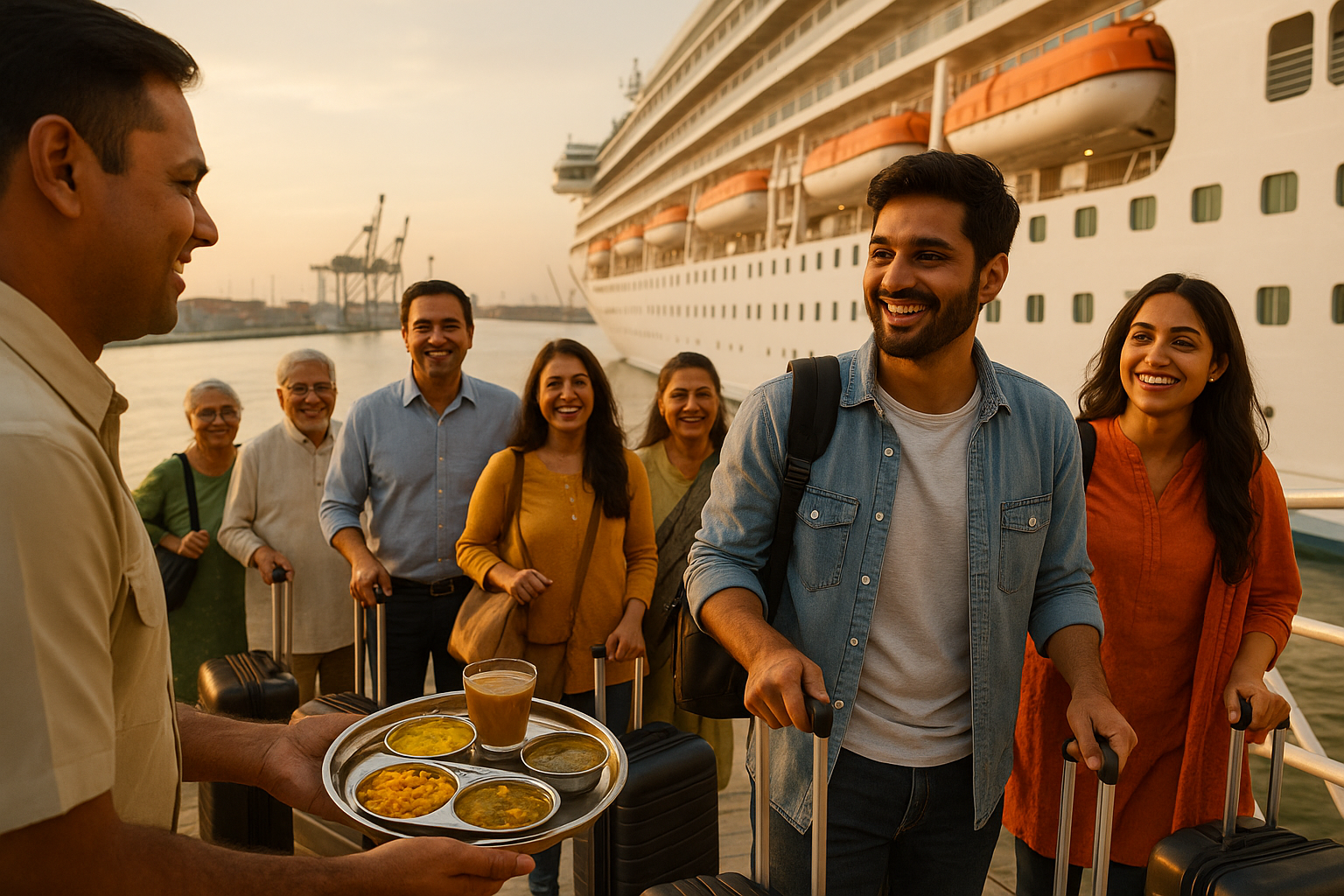
What onboard dining and dietary options (vegetarian, Jain, Indian cuisine) can Indian passengers expect?
Yes — modern cruise lines commonly provide vegetarian, Jain and Indian dishes; request during booking or online check‑in and confirm with guest services once onboard. Onboard dining typically covers the main dining room, buffets and specialty restaurants, and many ships add Indian touches (masala chai, Jain meal options) on sailings that serve India/Asia markets. The dietary request process begins in the booking system or online check‑in and continues with a reconfirmation at embarkation; specific cruise lines such as Royal Caribbean and Celebrity Cruises (and other mainstream lines operating India/Asia circuits) may have stronger Indian/vegetarian provisioning across dining venues.
Availability of vegetarian, Jain and Indian dishes and how to request them
Vegetarian, Jain and Indian dishes are commonly offered on mainstream cruise lines. Dietary requests can be submitted at booking, via online check‑in, or at the port through guest services.
Follow these practical steps to register and confirm a special-meal request:
- Submit the dietary requirement when booking or within the cruise line’s booking portal; specify vegetarian, Jain, or preferred Indian regional options and any exclusions (for example, no onion/garlic).
- Complete the dietary preference field during online check‑in so the request is recorded by onboard catering.
- Contact the booking agent or cruise line by email or phone to supply additional details after confirmation.
- On the day of boarding, reconfirm arrangements with guest services and the dining team to confirm ingredient handling and preparation methods.
Which cruise lines and ships are known for comprehensive Indian/vegetarian dining options?
Lines with regular India‑market sailings (large mainstream lines and some premium ships) often offer Indian and vegetarian menus across main dining rooms, buffets and specialty events.
Examples and common provisions:
- Royal Caribbean — mainstream, family‑oriented line that frequently includes Indian dishes in the main dining room and buffet, and provides India‑focused programming on select sailings.
- Celebrity Cruises — operates India/Asia circuits and highlights regional cuisine on select ships and itineraries; Indian dishes are included on menus and during themed dining nights.
- Other mainstream and premium lines (varies by ship) — elements of comprehensive provisioning include Indian dishes in the main dining room, dedicated buffet stations or themed nights, and specialty‑restaurant options available on request.
How are special meals prepared and served (Jain, no onion/garlic), and what follow-up should passengers do onboard?
Special meals are provided on request and are normally prepared within the ship's main galley rather than in a separate production kitchen. Vegetarian and Jain requirements are treated as special orders; ingredient restrictions (for example, no onion or garlic for Jain meals) are typically specified at embarkation with the maître d' or guest services for ingredient clarification and any required escalation.
Dining management and guest services serve as the onboard escalation points for ingredient lists, substitutions, or situations where a served dish does not meet the stated requirement.
For more detailed information on menu offerings and meal examples, see Cruises with Indian Cuisine: What to Expect Onboard for Indian Travelers.
What is included in a cruise fare and what counts as extras?
Base fare typically includes passenger accommodation (cabin), main meals in primary dining venues, scheduled entertainment and access to standard ship facilities such as pools, lounges and fitness centres.
Common extras include alcoholic and specialty beverages, specialty restaurants, spa treatments, shore excursions, onboard Wi‑Fi and premium internet packages, laundry services, certain gratuities, and retail or photo purchases. These extras are offered a la carte or as prepaid packages by many cruise lines, including Royal Caribbean and Celebrity Cruises.
What standard items are usually included in the base cruise fare?
Typical items included in a base cruise fare:
- Cabin (stateroom) with basic in-room amenities (safe, hair dryer).
- Main dining room and buffet meals for breakfast, lunch and dinner.
- Scheduled entertainment and evening shows in the theatre.
- Access to pools, hot tubs and the ship gym/fitness centre.
- Basic onboard activities and some children's clubs/programming.
- Ship transit between ports and access to most shipboard public spaces.
Which common onboard services and experiences are normally charged extra?
Cruise fares commonly exclude several add‑on services that are billed separately. Typical extras include alcoholic drinks, specialty restaurants, spa and salon treatments, shore excursions, Wi‑Fi, professional photos and certain paid onboard classes or activities. Gratuities may be applied automatically or included in some packages.
High‑impact extras commonly charged separate from the base fare (may be covered by fare or packages):
- Alcoholic drinks and premium non‑alcoholic beverages (drink packages optional).
- Specialty restaurants (steakhouses, sushi bars, chef's table).
- Spa and salon services (massages, treatments, hair styling).
- Shore excursions and guided tours at ports of call.
- Wi‑Fi packages and enhanced connectivity plans.
- Professional photos and paid classes or workshops.
- Gratuities — may be added automatically to the onboard account or included in some packages.
Timing for pre-purchasing packages (drinks, Wi‑Fi, excursions) versus individual purchases
Pre-purchasing drink, Wi‑Fi, or excursion packages is advantageous when projected consumption or usage makes the package less expensive than individual purchases, or when shore excursions have limited capacity and a specific tour is a high priority. Short cruises and travellers with low alcohol consumption often save by paying as they go; longer sailings, large groups, or high alcohol consumption typically favour packages.
Cost assessment: The package cost per night is calculated as package price ÷ cruise nights and compared with estimated daily spending on drinks and Wi‑Fi plus the total cost of planned excursions. Excursions with limited capacity are best booked in advance when participation in a particular tour is required.
Which itineraries and ports of call are best for first‑time Indian cruisers?
Start with short domestic departures (3–5 nights) from Mumbai, Goa, Chennai and Kochi or nearby international circuits like Singapore–Malaysia, the Maldives or Dubai for easy logistics and family‑friendly options. These domestic cruises and short international circuits are easiest to arrange, lower‑risk for a maiden voyage, and suit travellers who want minimal flights and simpler paperwork. First‑time cruisers should pick routes that match their comfort level: domestic cruises for a gentle intro, Singapore–Malaysia or Dubai for short international exposure, and the Maldives for couples or honeymooners seeking idyllic stops.
Which short domestic itineraries from Indian ports are best for a maiden voyage?
Common domestic departures: Mumbai, Goa, Chennai and Kochi on 3–5 night sailings — ideal for families, seniors and budget travellers seeking a gentle introduction.
Here are typical short domestic options and who they suit:
- Mumbai departures (3–5 nights): short sailings that often include Goa or nearby coastal stops; should suit families and first‑timers who prefer minimal travel to the port.
- Goa departures (3–5 nights): weekend‑style cruises focusing on beaches and onboard family entertainment; should suit younger families and budget travellers.
- Chennai departures (3–5 nights): routes that may touch Sri Lanka or southern ports; should suit multigenerational groups and seniors who want comfortable shore time.
- Kochi departures (3–5 nights): launches into Kerala coast or nearby islands, good for relaxed pacing; should suit seniors and travellers seeking cultural shore excursions.
What nearby international routes (Southeast Asia, Dubai, Maldives) are easiest and most beginner‑friendly from India?
Beginner‑friendly international circuits include Singapore–Malaysia, Phuket, Dubai and the Maldives. These itineraries feature short‑haul flights, straightforward airport‑to‑port transfers and cruise schedules suited to first‑time passengers. Singapore–Malaysia sailings appeal to families by combining city visits, beaches and shopping with simplified logistics. Dubai departures provide convenient air connections from multiple Indian cities and relatively simple visa procedures. Maldives cruises often include visa‑on‑arrival arrangements and offer a resort‑style, low‑stress experience. Visa regulations vary by itinerary; visa and entry requirements should be confirmed for each traveller prior to booking.
Which destinations offer the best value for Indian families: Southeast Asia, Mediterranean, or Dubai?
Southeast Asia and Dubai offer strong value combined with shorter travel times; the Mediterranean provides wider destination variety but involves longer flights and Schengen visa requirements.
Quick comparative guide for families:
- Southeast Asia (Singapore–Malaysia, Phuket): lower travel time, competitive pricing, family activities such as theme parks, beaches and shopping. Suitable for cost‑effective, activity‑rich cruises. Costs vary by season.
- Dubai & nearby Middle East: short flights, straightforward logistics, family‑friendly shore options and large shopping centres. Suitable for convenience and predictable costs.
- Mediterranean: greater destination variety and cultural depth, including historic cities and island options. Travel time is longer and Schengen visa requirements apply; overall costs and logistics tend to be higher.
What documents (passport, visas, and paperwork) do Indian travellers need for domestic and international cruises?
Passport: required for international voyages; domestic cruises that remain within Indian waters often accept government-issued photo ID instead of a passport. International itineraries require a passport valid for at least six months beyond the return date. Visas are required for ports that are not visa-free. Closed-loop exceptions exist for some itineraries; for Indian nationals, confirmation with the cruise line and relevant consular authorities is required prior to booking.
Domestic and international rules: domestic departures from India that remain within national waters typically accept government ID. Any itinerary calling at foreign ports requires a passport and the appropriate visas.
Documentation checklist:
- Itinerary ports — determine whether departure and return occur at an Indian port or a foreign port.
- Passport validity — passport must have at least six months' validity beyond the return date.
- Visa requirements — confirm visa requirements for each port with the embassy/consulate, the cruise line (e.g., Royal Caribbean, MSC) and the travel agent.
- Closed-loop status — obtain written confirmation from the cruise line on closed-loop applicability and accepted forms of ID for Indian nationals.
- Shore/transit visas — secure required visas well in advance; retain both physical and secure digital copies.
When is a passport required and are there exceptions for closed‑loop itineraries?
- A passport is required for international cruises. Closed‑loop exceptions are rare for Indian nationals and typically include caveats; verification with the cruise line and relevant consular authorities is required.
- Certain closed‑loop sailings have historically accepted alternative identification (for example, U.S. citizens on some U.S. departures using birth certificates); such allowances are nationality- and itinerary-specific and frequently exclude Indian passport holders.
- Immigration officers or port authorities retain the authority to require passports or visas notwithstanding a cruise operator's closed‑loop policy. Reliance on birth certificates or local identity documents is inadvisable without explicit written confirmation from both the cruise line and the relevant consulate.
Shore and transit visa requirements for common cruise routes and verification methods
- Shore visas and transit visas depend on each port's entry rules. Verification should include contacting the relevant embassy or consulate, the cruise line, and the booking agent; entry requirements for each port must be confirmed prior to booking.
- Shore visas are entry visas required to disembark at a port. Transit visas may be required if the itinerary involves airport or land transit through a country. Requirements vary by destination and passenger nationality.
- Verification checklist prior to booking:
- The exact ports of call on the ticket and whether stops are tendered or overnight should be confirmed.
- Each destination's embassy or consulate website should be consulted for visa rules applicable to Indian passport holders.
- The cruise line's documentation or guest services page and the booking agent should be consulted for port-specific visa guidance.
- For countries offering e‑visa or visa‑on‑arrival, eligibility for Indian citizens and processing times must be checked.
- Sufficient time for visa processing should be allowed; required visas should be obtained before departure and original travel documents carried during travel.
Special documentation cases (minors, emergency copies, medical certificates): what to prepare?
- Additional documentation: birth certificate for minors; notarised letter of parental consent when travelling with a single parent or a guardian, if required by destination authorities; custody or adoption papers where applicable.
- Medical and emergency documents: medical certificates or doctor’s notes for pre‑existing conditions, current prescriptions, vaccination certificates when required, and photocopies or scanned copies of passports and visas.
- Document storage and access: original documents stored in the ship cabin safe; photocopies carried in a separate bag; encrypted digital copies retained in secure cloud storage or a password‑protected phone app for emergency access.
- Translation and legalisation: certified translations and notarisation or apostille for documents when requested by authorities at ports of call.
How to prepare for boarding — practical steps before embarkation?
Early completion of online check‑in, arrival the day before when feasible, and packing a carry‑on with embarkation‑day essentials reduce queues, limit last‑minute paperwork at the port, and keep medicines and a change of clothes available if checked luggage is delayed. A charged phone and boarding pass should be kept accessible; cruise-line portal instructions should be followed.
Chronological checklist of pre‑embarkation actions:
- Before travel: Bookings, passports, visas and travel insurance should be confirmed; cruise‑line portal deadlines for document submission should be noted.
- When the portal opens: Online check‑in should be completed via the cruise line website or app; ID/passport photos should be uploaded and emergency contact and payment details added. The cruise‑line timeline for these steps should be observed.
- Health and travel documents: Required health questionnaires and declarations should be completed through the cruise portal; vaccination or test documents should be prepared if requested.
- Final packing: Checked luggage should be tagged as required by the line; a labeled carry‑on with first‑night essentials should be prepared.
- Arrival logistics (day before preferred): A hotel near the port can be reserved or transfers arranged to allow timely arrival at the terminal.
- Port transfers: Port shuttles, a vetted private transfer, or hotel shuttle should be arranged in advance; pick‑up times and luggage policies must be confirmed with the provider.
- Embarkation day: Present printed or digital boarding passes and ID at the terminal, proceed through security and check‑in, submit checked bags for delivery to the assigned cabin, and attend the mandatory safety/muster briefing after boarding.
Online tasks to complete before embarkation (check‑in, forms, health declarations)
Online check‑in, identification upload, and submission of health questionnaires are typically required according to the cruise operator's timeline (typically several days before sailing).
The following steps are commonly required prior to arrival at the port:
- Online check‑in: performed via the cruise portal or mobile app to confirm passenger details and accept terms; typically completed as early as the portal permits.
- Identification upload: clear scans or photographs of passports or IDs are required for each passenger as requested by the operator.
- Health declarations and documentation: required health forms, along with vaccination certificates or test results, are submitted when requested.
- Payment and onboard account: a credit card is registered for onboard charges and spending limits can be set where available.
- Boarding documents: digital boarding passes and confirmation emails are commonly used; printed copies can serve as physical backups if preferred.
Arriving the day before and arranging port transfers and pre‑cruise accommodation
Arriving the day before reduces the risk of missed sailings and simplifies port logistics.
A hotel located near the port minimizes travel on the day of boarding; many properties offer cruise shuttles or parking packages. Transfer options on arrival include official port shuttles, hotel shuttles and vetted private transfers; these are best reserved in advance and luggage policies confirmed. Hotel cruise-parking and shuttle availability and any associated fees should be verified at the time of reservation.
What to expect on embarkation day and carry-on essentials
Embarkation day typically includes security screening, check-in queues and a mandatory safety briefing. Passport, boarding pass, prescription medications, a change of clothing and device chargers should be carried in hand luggage.
Carry-on items for embarkation day:
- Documents: passport, boarding pass (digital and/or printed), any required visas and travel insurance details.
- Secondary ID and copies: secondary photo ID and a photocopy or photo of key documents.
- Medications: prescription medications and a basic first-aid item, kept in original packaging.
- Change of clothes: fresh outfit and swimwear in case checked luggage is delayed.
- Chargers and portable battery pack: phone charger, plug adapter if required, and a portable battery pack.
- Snacks and water: light snacks for long lines; cruise rules regarding outside food apply.
- Cash and cards: local currency and at least one payment card for immediate purchases or transport.
- Terminal process: security screening, check-in desk, luggage drop for checked bags, a photo for ID/ship records at many ports, boarding, then the mandatory muster/safety briefing once onboard.
Packing and cabin selection for first‑time cruisers
Suggested packing: culturally appropriate clothing (casual, modest/religious wear, and a formal/gala outfit), prescription medicines, electrical adapters, and small comforts such as preferred toiletries and a travel kettle.
Modern ships and cruise lines commonly provide vegetarian and Jain menu options. Specialty snacks or instant foods preferred by Indian passengers can be useful if dietary needs or limited port services arise.
Cabin selection considerations: cost is a major factor — interior cabins typically offer the lowest fares; ocean‑view or balcony cabins provide natural light and private outdoor space. For reduced motion and lower noise levels, midship locations on lower decks are preferable. Proximity to elevators, dining venues and leisure areas should be balanced against the desire for a quieter location when finalizing the cabin choice.
What clothing, medicines and electronics are recommended for an Indian traveller (including modest/religious wear)?
A compact wardrobe and a small medical/electronics kit are useful: casual daywear, one formal/gala outfit, modest/religious garments and small prayer items; motion‑sickness medications, regular prescriptions and universal adapters are commonly included on packing lists.
Below is a culturally‑aware packing checklist organised by clothing, medicines and electronics.
- Formal/gala: one smart outfit for dinner/gala nights (lightweight dress, kurta‑pyjama or shirt‑trouser) plus one pair of dress shoes; most cruises have one or two themed/formal evenings.
- Daywear: breathable casuals for shore days and poolside (t‑shirts, shorts, salwar‑kameez or tunics), swimwear with a cover‑up; a light jacket or shawl for air‑conditioned venues.
- Modest/religious wear: modest garments such as a dupatta/scarf, kurta or sari; compact prayer items (small prayer mat, mala, travel puja kit) for personal rituals.
- Medicines & health: motion‑sickness tablets or patches, anti‑nausea wristbands, regular prescriptions in original packaging, OTC pain reliever, antacid and diarrhoea medicine; a small first‑aid kit and spare glasses/contacts.
- Electronics & comfort items: universal travel adapter, phone charger, portable battery pack, plug extension for multiple devices, small night‑light and earplugs for undisturbed sleep.
- Small comforts: herbal tea/masala chai sachets, favourite vegetarian snacks, laundry bags and a foldable tote for excursions; items that make ship life more familiar.
- Documents & extras: photocopies of passport, vaccination cards where required, and letters for special dietary requests (Jain/vegetarian) for dining staff.
Carry‑on items for embarkation day and first‑night essentials
Carry‑on items for embarkation day and first‑night use:
- Passport, boarding documents and a printed booking confirmation — highest priority.
- Medications (prescription and anti‑motion‑sickness) and a compact first‑aid kit for urgent needs.
- One‑day toiletries (toothbrush, travel toothpaste, facial wash, deodorant) and a change of clothes in case checked luggage is delayed.
- Mobile phone, chargers, battery pack and headphones for check‑in processes, onboard apps and entertainment.
- Valuables and important electronics (wallet, jewellery, camera) retained in the carry‑on.
- Dietary snacks or ready meals (vegetarian/Jain options) until checked luggage is delivered and the ship galley confirms dietary provisions.
Which cabin type and location offer the best balance of price, comfort and motion stability?
Interior cabins are the most economical; ocean-view and balcony cabins provide increased comfort and natural light. Midship, lower-deck locations offer the greatest motion stability.
Cabin selection depends on price, space and motion comfort. Interior cabins are budget-friendly and suitable for passengers intending to spend significant time ashore or in public areas. Ocean-view cabins add natural light; balcony cabins offer private outdoor space and fresh air. Hindustan Times recommends balconies for comfort and views where budget permits. Midship, lower-deck cabins reduce seasickness and minimise engine and public-area noise.
Quick pros/cons for first-timers:
- Interior: least expensive; no natural light; suitable for travellers prioritising savings over a view.
- Ocean-view: moderate cost; natural light and a sea view without the price of a balcony.
- Balcony: higher cost; extra space and private outdoor access; may feel less private.
- Location choice: midship, lower deck is most stable and quiet; aft cabins experience more movement during pitching; forward cabins can be noisier and subject to pronounced motion.
For a first cruise, an interior or ocean-view midship lower-deck cabin usually offers the best balance of economy and motion stability. A midship balcony suits passengers prioritising private outdoor space and views.
Supplementary considerations: safety, insurance, gratuities and booking timing
Stabilisers and onboard medical teams reduce the incidence of seasickness. Travel insurance that includes medical evacuation, trip cancellation/interruption and missed connections is recommended for international voyages. Automatic gratuities are common and typically appear on the passenger folio. Advance booking secures preferred cabins and package deals; off‑season or last‑minute windows may yield lower fares but restrict availability.
Key practical points:
- Safety/seasickness: stabilisers, midship or lower cabins and onboard medical staff reduce motion-related illness; itineraries are often planned to avoid rough conditions.
- Insurance: travel insurance covering medical evacuation, trip cancellation/interruption and missed connections is recommended for international cruises.
- Gratuities: cruise line policies specify daily service charges; these typically appear on the passenger folio and may be added automatically.
- Booking timing: early reservations improve cabin choice and access to package deals; off‑season and last‑minute bookings can offer lower prices with fewer options.
What measures do cruise ships take to reduce seasickness and what remedies are recommended?
Stabilisers, route planning and onboard medical teams reduce ship motion and manage motion sickness. Cabin location affects perceived movement; midship and lower‑deck cabins and balcony staterooms minimise roll. Time spent on deck and exposure to fresh air can ease symptoms.
Common remedies carried on cruises include transdermal scopolamine patches (prescription required in some jurisdictions), oral antihistamines such as meclizine or dimenhydrinate, and non‑pharmaceutical options: ginger, acupressure wristbands, light meals and limiting alcohol on boarding day. Onboard medical staff can advise on appropriate medication and provide treatment if needed.
Is travel insurance required for international cruises and what should it cover?
Travel insurance is not always required; it is strongly recommended for international cruises and should cover medical evacuation, trip cancellation or interruption, and missed connections.
Insurance is widely advised for outbound sailings; shipboard medical care and emergency repatriation can be expensive. A cruise-appropriate policy should explicitly include medical evacuation, trip cancellation/interruption, and missed connections, and specify coverage for shore excursions and pre-existing medical conditions. Policies are best purchased at the time of booking or shortly thereafter to protect deposits and cancellation windows.
How gratuities and service charges work and how to budget for them
Overview and budgeting guidance:
- Automatic charges: Many cruise lines apply an automatic daily service charge per passenger. These charges are posted to the onboard folio and billed to the ship account. Prepayment options are commonly offered; adjustments may be made at Guest Services when permitted.
- Typical amounts: Per-person daily rates vary by cruise line and cabin class; fare details and booking confirmations specify applicable rates and totals.
- Payment and budgeting: Gratuities are included in the final onboard account. Trip budgets commonly include these charges, or prepayment may be selected when available.
- Discretionary tipping: Additional gratuities for exceptional service or for specialty staff remain discretionary. Small cash tips for crew members providing specific services are a common practice.
When to book and how to find the best deals (early‑bird vs off‑season)?
Booking early secures preferred cabins, group rates and early‑bird package discounts offered by cruise lines and online travel agencies. Off‑season sailings and last‑minute booking windows can produce lower fares but typically restrict cabin choice and shore‑excursion availability. Festive sales and targeted promotions sometimes yield competitive prices; comparing early‑bird offers with last‑minute rates and assessing priorities—cabin selection versus lowest fare—informs the optimal booking strategy.