A cruise is a scheduled passenger voyage operated on a commercial passenger ship that provides accommodations, onboard amenities, and organized dining venues; this article identifies cruise lines and specific ships that provide live Indian cooking stations (tandoor ovens and made‑to‑order dosa counters) and explains practical booking and dietary logistics for travelers.
The page follows a straight, decision‑focused flow: which cruise lines offer Indian cuisine, which ships and named venues actually have live tandoor or dosa stations, where Indian food appears onboard, a clear definition of live cooking stations and how they operate, a short authenticity assessment, and concrete advice on reservations, costs, and dietary requests. Royal Caribbean, Carnival, Norwegian, Celebrity, and Princess commonly offer Indian dishes; Carnival publicly lists a named specialty venue, Masala Tiger. Masala Tiger appears on Carnival Celebration, Carnival Jubilee and Mardi Gras (Carnival Splendor is reported by fan sources and should be verified).
Live dosa counters appear sporadically on select ships and during South‑Indian themed events and these stations are generally ship‑specific rather than fleet‑wide. Indian food shows up in Main Dining Rooms, buffets (Windjammer/Horizon/Lido) and specialty restaurants or food halls, with live tandoor and dosa stations most often in specialty venues. A tandoor is a clay oven used onboard to bake naan and grill tandoori meats; Carnival describes cooking in a traditional clay oven heated above 1000 degrees. Ships can accommodate vegetarian, vegan and many Jain requests, and passengers should request custom meals 48+ hours in advance when possible; specialty venues may offer complimentary lunch and a paid à la carte dinner (Masala Tiger lunch is commonly included on some ships while dinner mains are reported around $15). Finally, use ship dining pages and the cruise app to confirm venues, menus and costs before booking.
Which cruise lines offer Indian cuisine or dedicated Indian restaurants?
Major lines with consistent Indian options include Royal Caribbean, Carnival, Norwegian, Celebrity, and Princess; check ship pages and menus for dedicated Indian venues or themed events before booking. Carnival lists Masala Tiger as a named onboard Indian specialty venue, while Royal Caribbean commonly features Indian items in Windjammer buffets and main dining rooms; other lines frequently include Indian dishes but availability can vary by ship and itinerary. When a cruise advertises "Indian options," that claim can range from a single buffet curry to a full specialty restaurant, so verify the ship's dining page or pre-cruise menus in the cruise app before you book.
Cruise lines known for Indian dining (Royal Caribbean, Carnival, Norwegian, Celebrity, Princess, etc.)
Royal Caribbean, Carnival, Norwegian, Celebrity, and Princess commonly offer Indian dishes.
Below are major lines and one short evidence point for each.
- Royal Caribbean — Royal Caribbean's Windjammer buffet commonly features Indian items and the main dining rooms also offer Indian dishes; Royal Caribbean is frequently named among top providers.
- Carnival — Carnival lists Masala Tiger as a named onboard Indian specialty venue; Masala Tiger describes tandoor cooking and a rotating Indian buffet/larger menu on select ships.
- Norwegian — Norwegian frequently includes Indian options in its buffets and main dining rooms and is cited by reviewers as a top line for Indian cuisine.
- Celebrity — Celebrity is cited as offering dedicated Indian menus and trained chefs and commonly features vegetarian and regional Indian dishes.
- Princess — Princess commonly offers Indian dishes in buffet venues and adjusts menus for regional diversity and passenger demand.
How itineraries & destinations affect Indian dining availability
Itinerary, embark port region, and passenger demographics influence whether Indian dishes or live stations appear on a given sailing. Cruise lines adjust menus and specialty venues based on where a ship sails and who is on board, so an Asia- or India-embarking cruise may offer more extensive Indian choices than the same ship on a Caribbean route. Marketing that touts "Indian options" may therefore be inconsistent across sailings; verify the ship name and the specific sailing by checking the ship's dining page, the cruise line app, or pre-cruise menus to confirm onboard dining availability.
Which ships feature live tandoor ovens or made‑to‑order dosa counters?
Named ship venues with tandoor include Carnival's Masala Tiger; made‑to‑order dosa counters appear sporadically on select ships—verify the ship's dining page for the specific sailing.
Masala Tiger and other named specialty venues — which ships and where to check
Masala Tiger is a named Carnival specialty venue with tandoor ovens; confirm current ship availability on Carnival's Masala Tiger page.
Confirm on the ship dining page before booking; the following ship-level instances are listed or reported as follows:
- Carnival Celebration — Masala Tiger — confirmed on Carnival’s Masala Tiger dining page.
- Carnival Jubilee — Masala Tiger — confirmed on Carnival’s Masala Tiger dining page.
- Mardi Gras — Masala Tiger — confirmed on Carnival’s Masala Tiger dining page.
- Carnival Splendor — Masala Tiger — reported on a Carnival fan site (The Carnival Cruise Blog), so verify on the ship’s official dining or menu pages.
Ships offering made‑to‑order dosa counters or South‑Indian live stations
Made‑to‑order dosa counters are offered sporadically on select ships and during themed South‑Indian events; check the ship's dining page or pre‑cruise menus to confirm.
Royal Caribbean and Norwegian Cruise Line have been reported to include South‑Indian items (including dosa-style offerings) in buffets or food‑hall/live‑station formats, but dosa counters are not universally guaranteed. Typical setups are chef‑run live stations at a buffet or food hall where dosas are prepared to order on a hot griddle; availability often depends on the ship, itinerary, or special culinary events, so verify the ship’s official menus before you sail.
Are live tandoor/dosa stations fleet‑wide or ship‑specific rollouts?
They are generally ship‑specific rather than fleet‑wide; Masala Tiger is listed only on certain Carnival ships.
Carnival’s venue page lists specific ships for Masala Tiger, and fan sites show additional variation across vessels, so expect these features to appear on selected ships or as part of special programming rather than across an entire fleet — always confirm on the individual ship dining page.
Which dining venues onboard typically serve Indian food — Main Dining Room, buffet, or specialty restaurant?
Indian dishes appear in Main Dining Room, buffets, and specialty restaurants; live tandoor and dosa stations most often occur in specialty venues, food halls, or during themed events.
Cruise lines commonly place plated Indian entrees in the Main Dining Room, offer rotating Indian items at the buffet (Windjammer/Horizon/Lido), and concentrate interactive, high‑heat cooking (tandoor, dosa) in specialty venues. Venue choice affects authenticity and interactivity: buffets give variety and convenience, Main Dining Rooms deliver plated entrees, and specialty venues provide the most live‑cooking and traditional equipment.
Below is how Indian food commonly appears by venue, with one example and the expected level of live cooking.
- Main Dining Room — example: plated entrees like butter chicken or dal; live‑cooking level: low (kitchen‑prepared, plated service).
- buffet (Windjammer/Horizon/Lido) — example: rotating curry station or vegetarian spreads; live‑cooking level: medium (self‑serve hot stations, occasional made‑to‑order items).
- specialty_restaurant / food_hall — example: Masala Tiger (tandoor) or food‑hall concepts with Indian counters; live‑cooking level: high (tandoor/dosa counters, made‑to‑order stations).
Indian dishes in Main Dining Room vs buffets (frequency and examples)
Main Dining Room often features plated Indian entrees nightly; buffets typically offer rotating Indian stations and simpler self‑serve dishes.
Below are typical appearances and examples in each venue.
- Main Dining Room — plated, rotating entrees (often vegetarian and meat curries like butter chicken, dal, paneer); frequency: often included on the night‑by‑night menu but menu items may vary by sailing.
- buffet (Windjammer/Horizon/Lido) — multiple or rotating Indian stations (curry, biryani, chutneys); frequency: commonly available during lunch and dinner service, with a heavier vegetarian selection on some ships.
- Contrast note: Main Dining Room gives plated presentation and waiter service; buffet gives wider self‑serve variety but generally simpler preparation and fewer live‑cooking elements.
Specialty restaurants, food halls and themed nights — where live stations most often appear
Live tandoor and dosa stations most often appear in specialty restaurants, food halls, or during themed street‑food events rather than in regular Main Dining Rooms.
Specialty restaurants like Carnival’s Masala Tiger are built around tandoor cooking and supply the ovens and techniques for authentic, high‑heat preparation; food halls and shipboard street‑food festivals also host temporary live stations for dosa, chaat, or tandoori items. These venues most often provide the true live‑cooking experience, and they may operate with separate reservations or a cover charge for premium dinner services. You should verify the ship’s dining calendar and make reservations when live stations or specialty menus are listed.
For more on how service style affects Indian offerings, see Buffet vs. À la Carte: Indian Cuisine Dining on Cruise Ships.
What are live Indian cooking stations on cruise ships and why do they matter?
Live Indian cooking stations are onboard counters where chefs prepare Indian dishes to order in view of guests.
Common station types include:
- Tandoor ovens, dosa counters, chaat stands, and made‑to‑order curry or biryani stations.
- These stations add freshness, interactive chef contact, and greater regional variety, and they provide vegetarian and customizable options that many travelers seek for an authentic guest experience.
Types of live Indian stations commonly found onboard (tandoor, dosa, chaat, etc.)
Common live stations include tandoor (naan, kebabs), dosa counters (made‑to‑order dosas), and chaat stands (street‑snack assemblies).
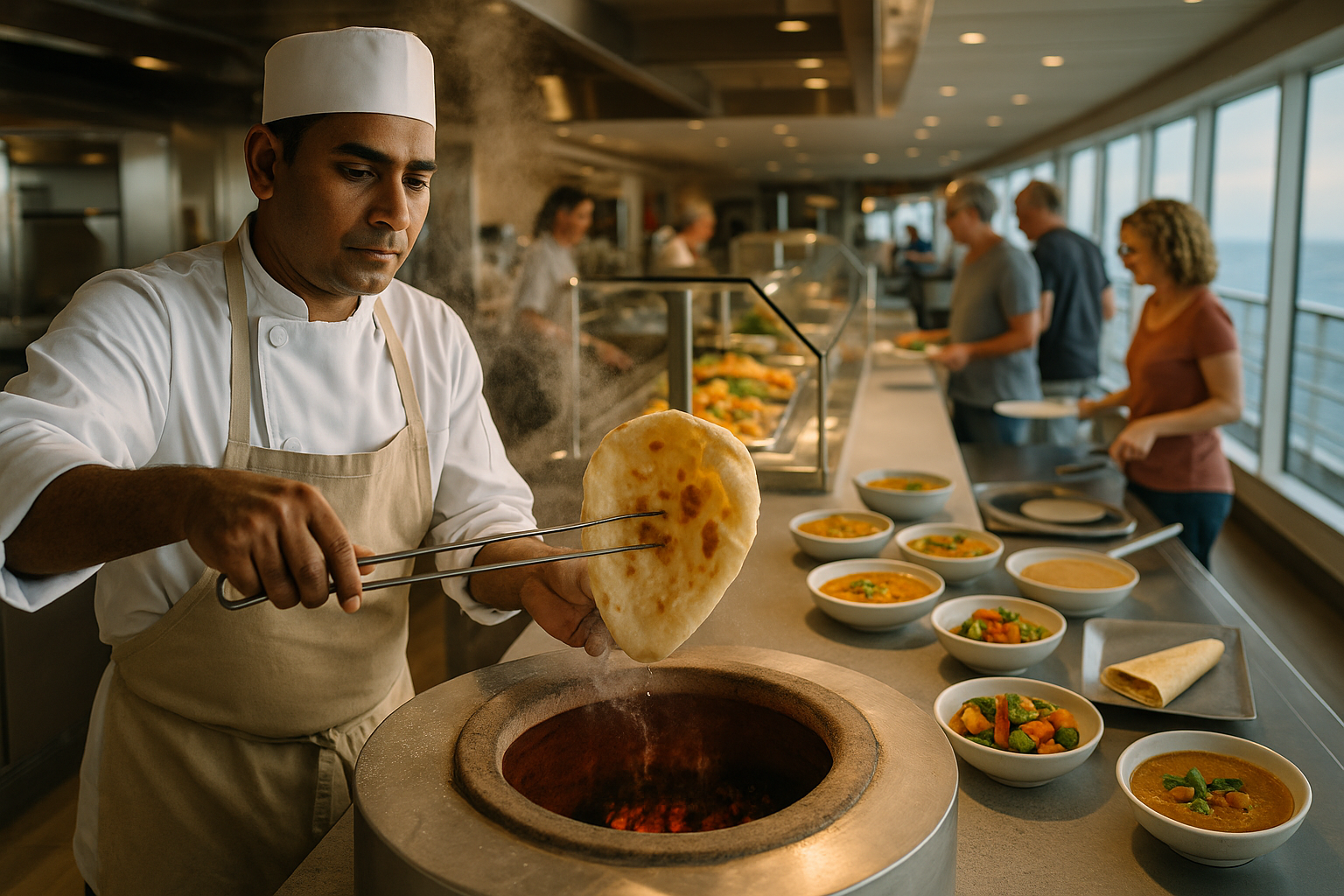
- Tandoor — Tandoor is a clay oven used to cook high‑heat items; tandoor stations typically produce naan, tandoori chicken, and kebabs, with authenticity and heat levels varying by ship and chef.
- Dosa counter — Dosa counter prepares dosa, a South Indian crepe made to order; dosas are usually served hot with sambar and chutneys and may showcase South Indian flavors.
- Chaat — Chaat stands prepare street snacks like pani puri, bhel puri, and samosa chaat; chaat setups often mirror street‑food festivals and offer fast, tangy assemblies.
- Curry/biryani station — Curry or biryani stations serve slow‑cooked regional curries and layered rice dishes; expect rotating regional selections but variable depth of authenticity by venue.
Tandoor ovens: what they are and how they're used onboard
A tandoor is a clay oven used to bake naan and grill kebabs.
Onboard a tandoor cooks naan and tandoori meats at very high temperatures; Carnival’s Masala Tiger describes using a traditional clay oven heated above 1000 degrees for naan and kebabs. Onboard installation requires dedicated ventilation, safe clearances, and trained chefs, and it requires operational procedures that address heat, smoke control, and staff safety.
How live cooking stations operate onboard — ordering, chef interaction, and food‑safety considerations
Live stations usually operate as made‑to‑order counters or timed demo windows.
Live stations let guests queue or request items from servers while chefs prepare dishes to order in view of guests, and chefs often explain preparation or offer brief demonstrations. Ships follow standard food‑safety protocols for made‑to‑order service, and operations may include single‑serve plating, protective barriers, and staff training; some specialty venues (for example, Carnival’s Masala Tiger) may operate a complimentary lunch buffet and a paid dinner service, so offerings and access may vary by ship.
Which cruise lines offer the most authentic Indian dining experience?
Assess authenticity by chef training, regional menu diversity, and robust vegetarian/Jain options; Royal Caribbean, Celebrity and Carnival often score highly on these signals.
Authenticity is defined by explicit, observable signals rather than marketing claims. Look for trained Indian chefs or chef training programs, dedicated Indian venues or regular Indian-themed nights, a range of regional dishes (North, South, coastal), the ability to customize spice levels, and clear vegetarian/Jain menu choices. These concrete signals let you evaluate offerings ship-by-ship and should guide pre-cruise questions to dining managers.
Criteria to judge authenticity at sea (trained chefs, regional menus, vegetarian/Jain options)
Key authenticity signals are trained Indian chefs, dedicated Indian venues, regional dish diversity, spice customization, and explicit vegetarian/Jain menu options.
You should evaluate each ship or itinerary against these steps: confirm whether Indian-trained chefs or specialized chef training is listed, check for a dedicated Indian restaurant or regular Indian buffet/station, review menus for regional items (dosa, butter chicken, coastal curries), ask about spice-level customization, and verify vegetarian/Jain options are explicit on menus. These practical checks mirror the indicators used by reviewers and guides.
- Trained chefs: verify chef training or specialty chef postings and on-board culinary events.
- Dedicated venues: check for specialty restaurants or consistent Indian stations in Windjammer/buffet or main dining.
- Regional menus & spice control: look for South Indian (dosa), North Indian (butter chicken), coastal dishes and notes on customizable spice levels.
- Vegetarian / Jain options: ensure menus list multiple vegetarian entrees and explicit Jain-friendly choices.
Based on those criteria, which cruise lines typically score highest and why
Royal Caribbean, Celebrity and Carnival typically score highest because they combine trained-chef programs or specialty venues, regional menu breadth, and notable vegetarian options.
Below are concise examples with one evidence point each.
- Royal Caribbean — Typically offers dedicated Indian menu items across Windjammer (buffet) and main dining, with notable vegetarian selections in buffet and main dining.
- Celebrity Cruises — Typically provides elevated/gourmet Indian offerings and regional dishes prepared with trained or specialty chefs.
- Carnival — Typically features a dedicated Indian specialty venue (Masala Tiger) that uses a traditional clay tandoor and includes a wide array of vegetarian options.
Can I request Jain or vegetarian Indian meals, and how do reservations and costs work?
Yes—cruise lines can accommodate vegetarian, vegan, and many Jain requests, though preparation and ingredient limits vary; you should request custom meals 48+ hours ahead when possible and verify whether specialty restaurants charge extra.
Ships commonly offer Indian dishes in main dining rooms and buffets and train chefs to handle customization, but strict religious ingredient rules or cross‑contamination limits might affect what can be prepared. Confirm specifics with the dining manager before sailing and use the cruise app or pre‑cruise contact to document restrictions.
Quick facts and actions:
- Accommodation: Yes—ships can prepare vegetarian, vegan, and many Jain options; always confirm with the dining team.
- Recommended lead time: You should request custom Indian meals 48+ hours in advance when possible (recommended).
- Who to contact: Use pre‑cruise forms or the cruise app, speak to the dining manager, or ask your server/head chef onboard.
- Cost examples (verify on your ship): Masala Tiger (Carnival) often has a complimentary lunch and a paid à la carte dinner; main course prices are reported around $15 with premium items higher (per reporting on The Carnival Cruise Blog).
Can cruise ships accommodate Jain, vegetarian, or vegan Indian meal requests?
Yes—ships can accommodate vegetarian, vegan, and many Jain Indian requests, but preparation methods and ingredient availability vary so you should confirm with the dining manager before sailing.
Cruise lines increasingly include vegetarian and vegan Indian options and train chefs to customize meals. Passengers can request special dishes through their server or by asking the head chef or dining manager; however, strict religious requirements or limited onboard pantry items may constrain some substitutions.
How and how far in advance should I request special Indian meals (pre‑cruise requests and custom meals)
Request special Indian meals at least 48+ hours before service when possible and contact the dining manager via the cruise app, pre‑cruise forms, or your server.
Follow these steps when making a request:
- Lead time: You should request custom Indian meals 48+ hours in advance when possible.
- Who to contact: Submit requests on pre‑cruise forms, via the cruise line’s app, or speak directly with the dining manager or your server/head chef.
- What to include: State whether the meal is Jain, vegetarian, or vegan; list ingredient restrictions, allergies, preferred spice level, date/time, and the number of diners.
- Onboard changes: Same‑day or shorter‑notice requests may be possible by asking your server or the head chef, but they may be less reliable.
Reservation, cost, and booking for specialty Indian venues (example: Masala Tiger lunch vs dinner pricing)
Specialty venues usually require reservations and may charge for dinner while some offer complimentary lunch; Masala Tiger commonly provides a complimentary lunch on select ships and a paid dinner service.
Book specialty Indian restaurants through the ship’s dining reservation system or app, at guest services, or on the cruise line’s dining page. What to expect price‑wise:
- Reservation: Reserve via the ship app or the cruise line’s dining page before or during your cruise.
- Masala Tiger example: Lunch is often included on some Carnival ships; dinner is an optional paid, à la carte service. Pricing reported for dinner mains is roughly $15 with premium items higher (per The Carnival Cruise Blog).
- Verify: Check the ship’s current dining page or ask guest services for up‑to‑date availability and prices.