A cruise is a packaged passenger voyage where a ship provides accommodation, meals and entertainment while following a set itinerary of port calls and sea days; this article compares Cordelia Cruises (India‑focused, coastal homeport sailings) with international cruise lines for Indian travellers.
Cordelia primarily homeports from Mumbai (with additional departures from Chennai, Kochi and Goa) and runs short 2–5 night coastal and regional routes; common examples are Mumbai–Goa 2‑night weekend sailings, Mumbai high‑seas/overnight cruises of 2–3 nights, Lakshadweep cruises (3–5 nights, typically from Mumbai or Kochi and subject to season/weather) and seasonal Chennai–Sri Lanka multi‑night itineraries. Most international lines typically only call into Indian ports rather than homeporting.
Cordelia fares are generally lower than international lines; indicative Mumbai–Goa 2‑night ranges are interior ~INR 31,000–45,000 pp, oceanview ~INR 36,000–55,000 pp, balcony ~INR 52,000–70,000 pp and suites ~INR 90,000–1,22,500 pp. Base fares usually include cabin, main‑restaurant meals, basic entertainment and taxes; specialty dining, shore excursions, spa, most drinks and gratuities are extra.
Cordelia emphasizes Indian‑focused menus with vegetarian and Jain options, Halal‑prepared food and no beef or pork cooked onboard. Cabins run Interior → Oceanview → Balcony → Suite by space and price. The Empress is a 1990‑built, refurbished vessel and may offer fewer mega‑liner amenities; Norwegian Sky (2026) and Norwegian Sun (2027) will join on long‑term charters. Domestic high‑sea/coastal sailings may accept Aadhaar per operator rules, but any foreign port calls require passport and visas/ETAs; drinks are not included and water allowances vary by fare tier.
Which itineraries and departure ports do Cordelia and international cruises operate from for Indian travellers?
Cordelia primarily homeports from Mumbai (also Chennai, Kochi, Goa) on short 2–5 night coastal and Lakshadweep/Sri Lanka routes; most international lines only call into Indian ports rather than homeporting.
Cordelia focuses on short coastal and regional voyages that use Indian ports as embarkation/disembarkation points, so travellers can board locally from Mumbai, and occasionally from Chennai, Kochi or Goa. International cruise lines more commonly include Indian ports as calls on longer itineraries or during repositioning seasons, which means they usually do not embark/disembark large numbers of local passengers in India.
Here are the common route families and their typical durations and seasonality:
- Mumbai–Goa: 2‑night coastal weekend sailings (frequent, weekend-oriented).
- High‑seas / overnight cruises from Mumbai: 2–3 nights (popular for casino and short-getaway formats).
- Lakshadweep cruises (embark from Mumbai or Kochi): typically 3–5 nights and may run seasonally; island visits can be weather-dependent.
- Chennai–Sri Lanka seasonal sailings: multi‑night international itineraries that operate in specific seasonal windows (often when repositioning permits).
Route choice affects trip planning because homeport sailings let you board and finish in the same Indian city (simpler ground transfers), while call-only itineraries usually require international flights, inbound/outbound transfers and different visa planning; passengers should check seasonality (Lakshadweep weather, Sri Lanka windows) and confirm embarkation port before booking.
Quick definition: what is a cruise (cruise travel)?
A cruise is a packaged sea voyage where the ship acts as accommodation, offering scheduled port calls or sea days, meals and onboard services over a set itinerary and duration. A cruise combines transportation and lodging aboard a ship for a planned route: voyages range from short 2–5 night coastal trips to longer regional or repositioning sailings, alternating port calls (visits) with sea days for onboard activities.
Which Cordelia routes depart from Mumbai, Kochi, Chennai and Goa — and what are their typical durations?
Common Cordelia sailings include Mumbai–Goa (2 nights), high‑seas/overnight cruises (2–3 nights), Lakshadweep cruises (3–5 nights) and seasonal Chennai–Sri Lanka multi‑night voyages. Most Cordelia departures originate from Mumbai, with additional embarkations from Chennai, Kochi and Goa depending on the itinerary. Mumbai–Goa is the staple 2‑night weekend product; high‑seas overnight formats run 2–3 nights; Lakshadweep voyages are longer (typically 3–5 nights) and may use Mumbai or Kochi as the homeport; Chennai becomes a base for seasonal international sailings to Sri Lanka when schedules shift.
Do international cruise lines homeport in India or only call into Indian ports — what that means for fly‑and‑cruise planning
Most international cruise lines only call into Indian ports; true homeporting in India is rare. When a line only calls, travellers normally need to arrange international flights and transfers to/from the nearest airport and may require visas for the country of embarkation or tendered shore visits. When a ship homeports (as Cordelia does in Mumbai), passengers can board locally and manage simpler ground logistics; passengers should verify visa rules and flight timing with the operator when a line only calls into India.
Which itineraries include Lakshadweep or Sri Lanka, and when do they operate?
Lakshadweep itineraries typically embark from Mumbai or Kochi and run as 3–5 night itineraries; Sri Lanka sailings are seasonal and often operate from Chennai during winter/seasonal windows. Lakshadweep cruises visit islands like Kavaratti, Kalpeni and Kadmat on multi‑night regional routes and may be suspended or adjusted in adverse weather, so dates can vary. Sri Lanka stops are offered on seasonal Chennai-based itineraries or during repositioning periods; travellers should verify the published sailing window and embarkation port before booking.
How do Cordelia and international cruise prices compare for similar durations and cabin grades?
Cordelia fares for similar durations are generally lower than international lines; price differences depend mainly on cabin grade and trip length (cost‑per‑night increases with higher cabins and premium itineraries).
Cordelia positions short coastal and Lakshadweep itineraries at a more affordable point than premium international lines, but upgrades (oceanview → balcony → suite) and longer trips can quickly narrow that gap. When comparing, always align on per‑person, double‑occupancy pricing, nights included, and whether taxes and onboard extras are in the base fare.
Example price comparisons for a 2‑night Mumbai–Goa and a 5‑night Lakshadweep sailing by cabin type
Indicative sample fares per person (double occupancy) for the two Cordelia routes are shown below; all figures are indicative.
- Mumbai–Goa (2‑night) — Mumbai–Goa indicative fares: interior ~INR 31,000–45,000 pp; oceanview ~INR 36,000–55,000 pp; balcony ~INR 52,000–70,000 pp; suite ~INR 90,000–1,22,500 pp. Compare like‑for‑like by using per‑person, double‑occupancy fares and checking whether the listed price already includes taxes (GST) and port fees.
- Lakshadweep (5‑night) — Lakshadweep indicative fares: interior ~INR 75,000–95,000 pp; oceanview ~INR 95,000–1,15,000 pp; balcony ~INR 1,15,000–1,40,000 pp; suite ~INR 1,80,000–2,50,000 pp. For longer itineraries, match the total nights and confirm whether tendered island visits or shore‑excursions are counted as included or extra.
How to interpret cost‑per‑night and inclusions when comparing value between Cordelia and international lines
Compare cost‑per‑night (fare ÷ nights) and then add the cost of excluded extras to judge true value. Cost‑per‑night gives a quick baseline; cost‑per‑night lets you see how much you pay for time aboard versus simply the cabin category.
Cost‑per‑night should be calculated on the same basis (per person, double occupancy, taxes included) and then you should add likely extras: drink packages, specialty restaurants, shore excursions, and any mandatory service fees. Cordelia typically includes main‑restaurant meals but does not include drinks; small inclusions (for example, complimentary bottled water allowances vary by ticket level) can shift value perception. International premium lines may include more amenities in the headline fare, so when comparing, treat headline fares as a starting point and explicitly add estimated extras to arrive at a true total cost.
What is included in a Cordelia cruise price (meals, taxes, cabins, and common extras)?
Base fare typically includes your cabin, main-restaurant meals, basic entertainment and taxes; specialty dining, shore excursions, spa, gratuities and most drinks are usually extras.
Cordelia’s base fare covers accommodation and complimentary dining in the main restaurants (Starlight and the Food Court), as well as standard onboard shows and port/tax charges. Extras — such as specialty restaurants, paid shore excursions, spa services, most beverages and service charges/gratuities — add to the onboard bill. Fare tiers can affect small inclusions (for example, bottled water allowances vary by ticket level), so always check the specific fare wording at booking.
Which items are typically included in the base fare and which are normally charged as extras (specialty dining, shore excursions, gratuities)?
The base fare typically covers your cabin, main-restaurant meals, basic entertainment and taxes; extras cover specialty dining, shore excursions, spa treatments, most drinks and gratuities.
Below is a quick checklist of what is typically included versus what normally costs extra.
- Included:
- Included — cabin accommodation (inside, oceanview, balcony depending on fare level).
- Included — main-restaurant meals in Starlight and the Food Court (complimentary buffet and main-dining service).
- Included — basic onboard entertainment and standard port taxes/fees.
- Included — a small complimentary bottled water allowance that varies by fare tier (standard, Upper, Premier).
- Typically extra:
- Specialty dining (e.g., Chopstix and International Grill require a surcharge).
- Shore excursions and guided tours at ports.
- Spa treatments, salon services and specialty wellness offerings.
- Most alcoholic and non‑alcoholic beverages beyond the included water allowance.
- Gratuities and any discretionary service charges that are not covered by the base fare.
Always treat these as general rules and confirm the exact inclusions shown on your Cordelia booking confirmation.
Do shore excursions, specialty dining or gratuities differ between Cordelia and international lines?
Cordelia charges for shore excursions, specialty dining and gratuities on a pay‑as‑you‑go basis similar to many international lines, but packaging and price levels may be lower given Cordelia’s market positioning.
Cordelia’s approach mirrors common industry practice — main dining and basic entertainment are in the base fare while extras are add‑ons — but the line targets mid‑market Indian travellers, so specialty‑dining options, excursion pricing and bundled packages may be simpler or priced differently compared with larger international operators. Specialty dining and excursions may be offered a la carte rather than in extensive bundle options; international lines might offer more frequent bundled packages (drink packages, excursion bundles, prepaid gratuity options) or different value perceptions. Travelers may want to compare what’s included and whether any prepaid packages or promotions are available before booking.
Which offers more authentic Indian food onboard: Cordelia Cruises or international cruise lines?
Cordelia offers deeper, more consistent Indian‑style menus and enforces Halal/no‑beef policies; international lines typically vary and often require pre‑requests for authentic Indian or Jain meals.
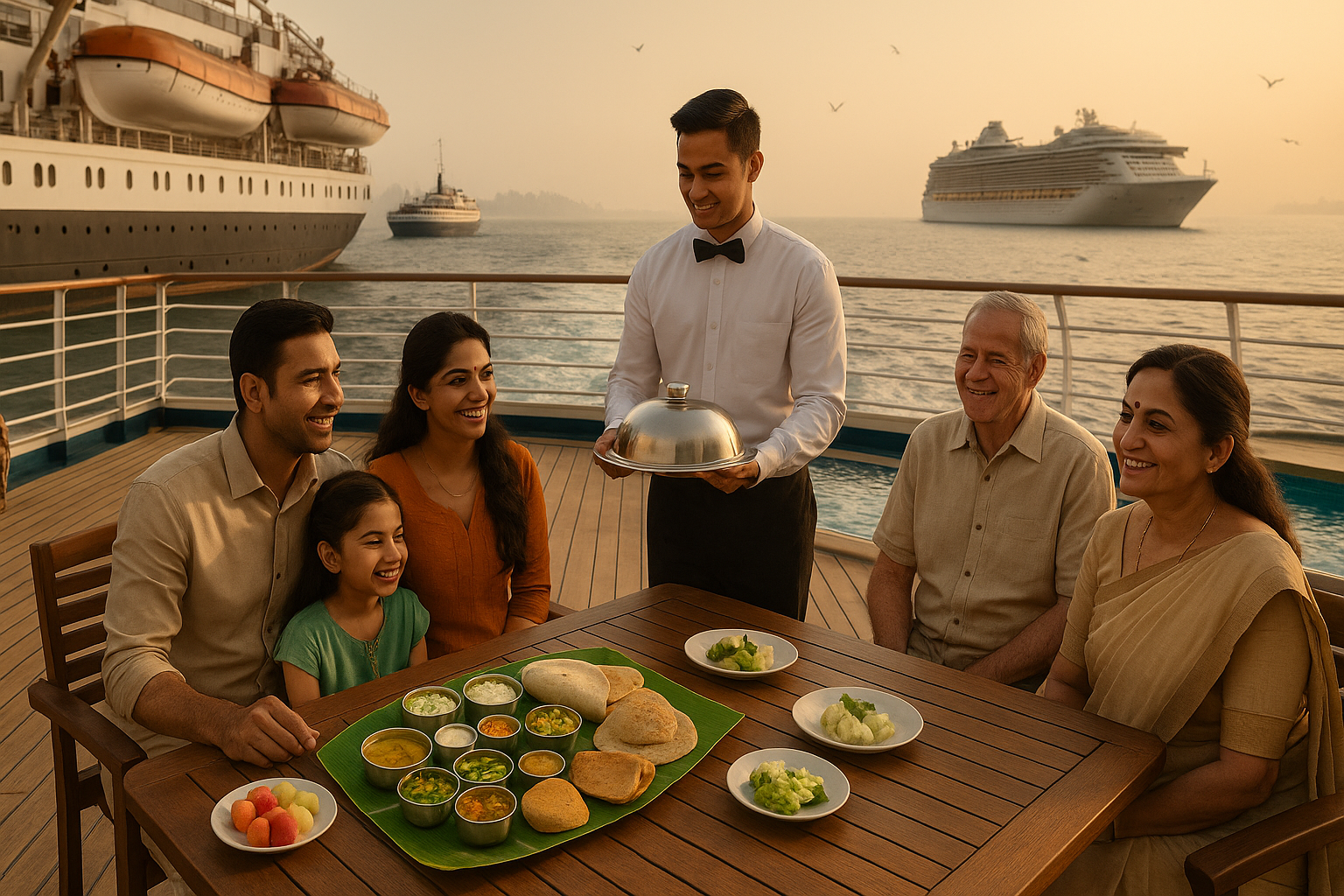
Cordelia provides Indian‑focused dining across its complimentary main restaurants (Starlight and Food Court), with vegetarian and Jain options available, and an operator‑stated policy that all food served is Halal while beef and pork are not cooked onboard. International cruise lines typically vary by brand and itinerary and might only have limited permanent Indian dishes.
Below is a quick comparison and a three‑step process to request special diets before sailing.
Quick comparison:
- Cordelia: Indian‑tailored menus in main restaurants, vegetarian and Jain options, Halal preparation and no beef/pork cooked; specialty dining (Chopstix & International Grill) is chargeable.
- Typical international lines: may offer limited Indian items on regular menus; authenticity and Jain support vary by ship and route and often depend on advance requests or special‑meal procedures.
Three‑step process for special‑diet requests:
- Request special meals at booking via the booking form, your travel agent, or by email.
- Request this at least 7–14 days before sailing to allow kitchen preparation.
- Request sample menus or photos and confirm preferences again at check‑in to verify menu authenticity.
Do Cordelia menus include vegetarian, Jain and Indian‑authentic dishes — and what is their halal/no‑beef policy?
Cordelia provides vegetarian and Jain options across its main restaurants and serves Halal‑prepared food while not cooking beef or pork onboard.
Cordelia’s fare includes complimentary dining in the main restaurants Starlight and Food Court, which the operator designs for Indian palates and lists vegetarian and Jain choices. Specialty restaurants such as Chopstix and International Grill carry extra charges. The line’s publicly stated operating practice is to serve Halal food and avoid cooking beef and pork on the ship; travellers should verify the latest menus before travel.
How do international cruise lines typically handle Indian diets — will you get authentic dishes or should you pre‑request special meals?
International lines typically offer limited permanent Indian options and you should pre‑request authentic Indian or Jain meals for best results.
Most international cruise lines include a few Indian‑style dishes on their standard multi‑cuisine buffet or main‑restaurant menus, but fully authentic or Jain preparations are not guaranteed shipwide. Authenticity tends to vary by line, ship, and itinerary (ships on Asian routes often have stronger Indian offerings), so travellers should treat a pre‑request as a necessary step to get specific Indian or Jain meals.
How to request vegetarian/Jain meals and verify menu authenticity before you book
Request special meals at booking, then confirm and verify with menu samples or photos before sailing.
- Request special meals on the booking form, through your travel agent, or by emailing the cruise line’s dining/special‑services team; request again at check‑in.
- You should request at least 7–14 days before departure so kitchens can source ingredients and prepare Jain/vegetarian menus.
- You can ask the line to send sample menus, photographs of plated dishes, or a written confirmation of Halal/no‑beef policy; verify the menu at embarkation and remind dining staff of any strict requirements.
For curated ship recommendations and a list of vessels known for authentic Indian dining, see Best Cruises for Indian Food Lovers: Top Cruise Ships with Authentic Indian Cuisine.
Which cabin categories are available and how should you decide whether to upgrade?
Typical cabin categories: Interior, Oceanview, Balcony and Suite; upgrade when you value space, private outdoor access, quieter nights or are celebrating an occasion. Cruise lines that sail from India (Cordelia Empress / Cordelia Sky and similar ships) normally offer these four tiers, with progressively higher privacy, space and onboard perks as you move up. Price differentials can be notable on short Cordelia sailings, so weigh the extra cost against how much you will actually use the space or balcony.
Which cabin types (Interior, Oceanview, Balcony, Suite) — short descriptions and typical pros/cons
Interior, Oceanview, Balcony and Suite are the common cabin types; each offers different space, privacy and price trade‑offs.
Typical cabin categories and quick pros/cons are:
- Interior — Interior cabins: budget option with no window, Interior cabins suit budget travellers or families prioritizing onboard activities over cabin time; trade‑off is less natural light, lower privacy when rooms are tight, and the lowest price.
- Oceanview — Oceanview cabins: Oceanview cabins have a window or porthole and suit travellers who want daylight and a sea view without higher Balcony cost; trade‑off is limited outdoor access and modest extra price over Interior.
- Balcony — Balcony cabins: Balcony cabins include private outdoor space and suit couples or anyone who values private sea views and fresher air; trade‑off is higher cost but quieter nights and more private relaxation opportunities.
- Suite — Suite: Suite cabins offer the most space, separate living areas and perks and suit families wanting room, guests celebrating special occasions, or those wanting added service; trade‑off is a much higher price for luxury and extras.
Is upgrading worth it? cost vs experience for balcony/suite upgrades
Upgrading is worth it when the cost‑per‑night fits your budget and you value private outdoor space, quieter nights, or have motion sensitivity. Upgrade decisions should weigh the additional nightly cost against how much you will use the balcony, extra space, or suite perks; upgrade choices often depend on cruise length and occasion. Indicative pricing shows meaningful premiums: TripCabinet lists Interior INR 35,000–45,000 and Balcony INR 55,000–70,000 per person for a 2‑night Mumbai–Goa cruise, so a Balcony upgrade often costs about INR 20,000–25,000 extra per person for the sailing (indicative).
Use this simple checklist to decide whether you should upgrade:
- You should upgrade if you value a private balcony for sunrise/sunset, need a quieter cabin, or have motion sensitivity — the experience gain is immediate and daily.
- You should upgrade for special occasions (honeymoon, anniversary, milestone birthday) where extra space and perks meaningfully improve the trip.
- You should skip the upgrade if the cruise is short (2–3 nights), you rarely use the cabin, or the upgrade premium feels large compared with other trip costs; compare the upgrade premium to your per‑night budget before deciding.
Onboard amenities, ship condition and safety: what to expect on Cordelia vs international ships
Cordelia offers standard amenities (pools, spa, casino) with Bollywood-focused entertainment on smaller, older ships; international mega‑liners provide larger pools, water parks, more specialty venues and a broader variety of shows.
Below are the main amenity and scale differences to expect.
- Cordelia: modest pool deck(s), onboard spa, casino, and Bollywood / Indian‑themed entertainment tailored to Indian tastes.
- International liners: larger main pools, multiple pool decks and often water parks, bigger multi‑treatment spas, many specialty restaurants and Broadway‑style or diverse entertainment venues.
- Scale: Cordelia’s ships are smaller in passenger capacity and public‑space footprint; international mega‑liners use the space to offer multiple simultaneous venues and attractions.
Safety/expectations note: Empress is a 1990‑built ship that underwent refurbishment; safety protocols remain regulated, but passengers should expect fewer large‑ship amenities than premium lines and should check onboard medical facilities and any health requirements before sailing.
Typical amenities & entertainment (pools, casino, spa, Bollywood shows) and how they differ between Cordelia and larger international ships
Cordelia provides pools, a spa, a casino and Bollywood shows, while larger international ships offer these features at a much larger scale and with additional attractions like water parks. Cordelia emphasizes Bollywood and Indian cultural programming to suit its market.
Common facilities and how Cordelia differs:
- Pools — Cordelia: single/modest pool decks; International: multiple pools, splash parks or water‑park features.
- Casino — Cordelia: onboard casino available during high‑seas segments; International: larger casinos with broader gaming floors.
- Spa — Cordelia: onboard spa services; International: larger spas with fuller wellness facilities and dedicated thermal/relaxation areas.
- Entertainment — Cordelia: Bollywood shows, Indian music and themed nights; International: larger production shows, varied acts and multiple nightly venues.
Ship age, refurbishment, safety and health considerations (is Empress 'aging' and what that means)
Empress is a 1990‑built ship and is therefore an older vessel that Cordelia purchased and refurbished before service. Empress was launched in 1990 and entered Cordelia service after a noted refurbishment; that older build year explains why public spaces and cabin layouts feel smaller and more traditional compared with modern mega‑liners. Passengers may notice fewer cutting‑edge amenities, narrower venues and older architectural lines, but refurbishment work improves appearance and systems. Safety and health protocols aboard commercial cruise ships are regulated; passengers should verify medical facilities, required vaccinations or health guidance and should bring any personal medications and sea‑sickness remedies when comparing Cordelia to premium international lines.
Fleet expansion note: near‑term additions/charters to watch for
Cordelia will add Norwegian Sky (joining 2026) and Norwegian Sun (joining 2027) on long‑term charters. Cordelia’s planned charters of Norwegian Sky and Norwegian Sun will increase capacity and may introduce larger onboard offerings and more diverse venues, but specific refits or program changes may vary and should be confirmed as ship refit and deployment details are announced.
Documents, logistics and final decision guidance: passports, visas, drinks and who should pick short coastal sailings
Domestic high‑sea/coastal sailings may accept national ID per operator rules, but any itinerary that calls at foreign ports requires a passport and relevant visas; drinks are not included on Cordelia.
Cordelia and other India‑based operators run purely domestic high‑sea/coastal sailings that can use Aadhaar or other national ID where the operator and port rules permit, but once a voyage visits a foreign port you must travel on a passport and hold any required visas or ETAs. Always verify documentation requirements with the cruise operator and the destination embassy well before booking.
When is Aadhaar/national ID sufficient and when will you need a passport and visas for a cruise from India?
Aadhaar/national ID can be sufficient for some purely domestic/high‑sea/coastal sailings per operator rules; passport and visas are required for any itinerary that visits foreign ports.
The rule is simple: domestic high‑sea/coastal cruises that do not call at foreign ports may accept Aadhaar or other national ID if the cruise line and embarkation port allow it (reader reports note this for some Cordelia sailings). Any itinerary that docks at or permits shore visits in another country requires a valid passport and may require visas or ETAs. You should verify passport and visa rules with the cruise operator and with the embassy/consulate of any foreign port well before departure; you should also confirm passport expiry requirements with the operator (many require six months validity).
Here is a short checklist of documents and actions you should complete before boarding:
- Carry Aadhaar/national ID plus a passport when booking if your itinerary might change to include foreign ports.
- Check passport validity and renew if needed; passport should meet the operator’s stated minimum validity.
- Ask the cruise operator whether the specific sailing is "domestic high‑sea/coastal" or includes international calls.
- For routes like Lakshadweep or special island permits, check operator guidance and any additional permit requirements.
- Keep printed copies of boarding passes, cruise documents, and emergency contact numbers from the operator and your embassy.
Do shore excursions to foreign ports require separate visas or additional documents?
Yes—shore excursions to foreign ports often require visas or an ETA, and travellers should check both the embassy/consulate and the cruise operator well before departure.
Shore excursions that land you in another country commonly need a tourist visa, an electronic travel authorization (ETA), or entry permit depending on your nationality and the port rules. The cruise operator or excursion partner may provide guidance and sometimes organise group visas, but this is not guaranteed. You should confirm visa requirements for each foreign port with the relevant embassy or consulate and with the cruise operator, and allow sufficient time for visa applications and processing before travel.
Are drinks included in Cordelia fares and what water allowances apply to different fare tiers?
No—drinks are not included on Cordelia; standard tickets include about 1L water/day, upper tiers include ~1.5L–2L/day depending on tier.
Drinks—including alcoholic and non‑alcoholic beverages—are chargeable on Cordelia Cruises. Here is the typical complimentary bottled water allowance by fare tier:
- Standard: 1 litre of bottled water per person per day.
- Upper: three 500ml bottles per person per day (1.5 L).
- Premier: four 500ml bottles per person per day (2.0 L).
If you need more bottled water, you can buy additional bottles onboard (reported price about Rs.100 per bottle) or drink the desalinated water provided free in the restaurants. You should buy a drink package onboard if you expect to consume multiple beverages throughout the sailing.
Who benefits most from short 2–5 night coastal sailings versus longer international cruises?
Short coastal sailings suit weekenders, families and first‑time cruisers; longer international cruises suit travellers wanting multi‑country itineraries and larger onboard facilities.
Consider these persona‑based recommendations and value notes:
- Weekenders — Weekenders should choose short coastal sailings because short 2–3 night itineraries suit quick getaways and require less planning; short coastal sailings deliver cruise‑experience value in a compact time and generally lower total cost.
- Families — Families should choose short coastal sailings when they want affordable, Indian‑centric dining and entertainment; short sailings often minimise logistics and keep kids engaged without the expense of a long trip.
- First‑time cruisers — First‑time cruisers should choose short coastal sailings to try cruising at lower cost and lower commitment before booking longer international voyages.
- Experience‑seekers / multi‑country travellers — Travellers wanting multi‑country itineraries and richer shoretime should choose longer international cruises, which may offer more varied ports, more onboard amenities, and better options for extended value per night on longer voyages.
Short coastal sailings typically present lower absolute prices and good cost‑per‑night value for brief trips, while longer international cruises may offer deeper itinerary diversity and different economies of scale for longer stays; you should pick the format that matches your time, passport/visa readiness, and appetite for onboard facilities.