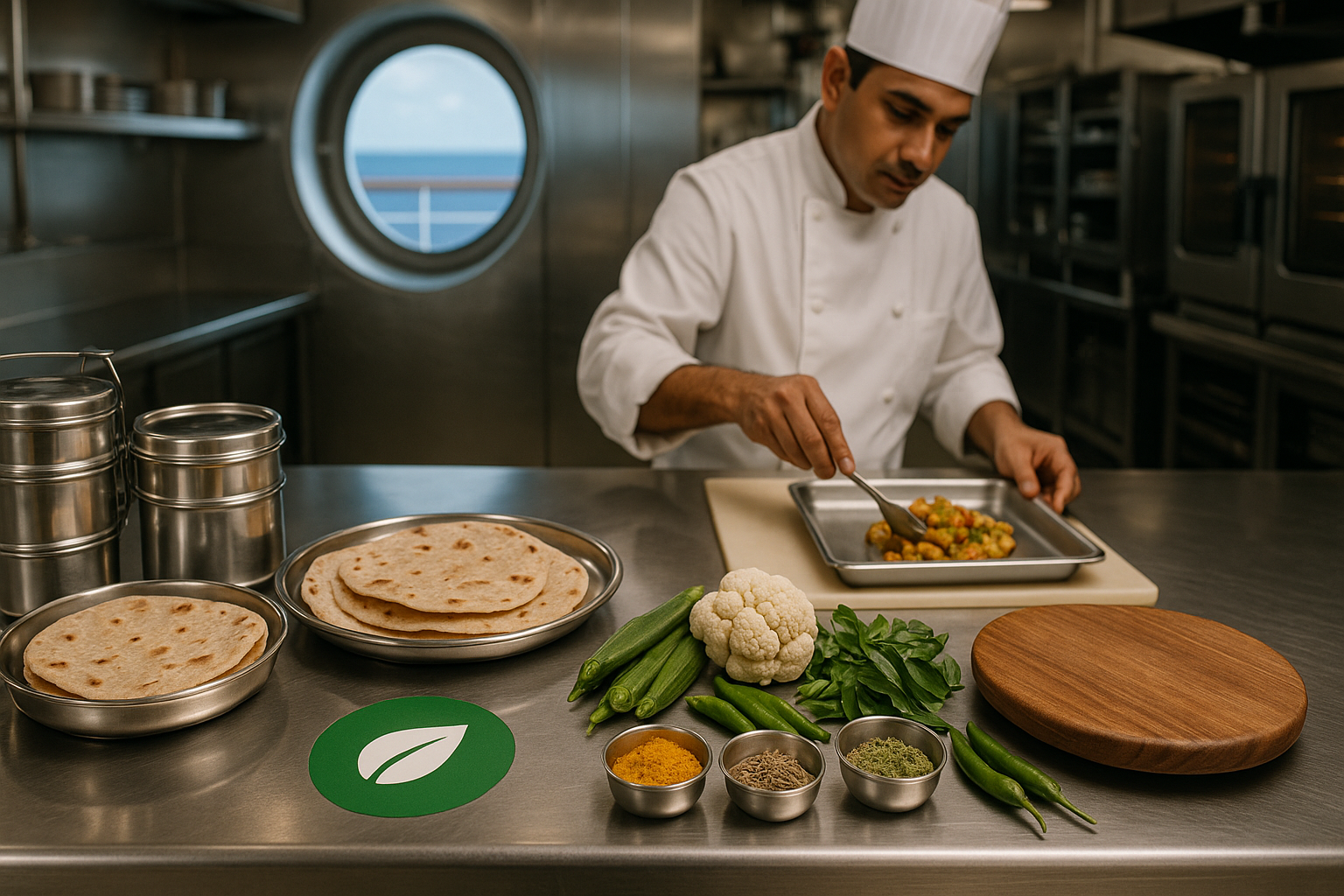
A separate vegetarian (plant‑based) kitchen on a cruise is a physically or operationally segregated galley area with separate prep lines, cookware, storage and labeling used to prepare only vegetarian and vegan meals, minimizing contact with animal products and reducing cross‑contamination. This guide identifies and verifies cruise product features and operational practices that indicate separate vegetarian/plant‑based kitchen operations and lower cross‑contamination risk for strict vegetarian and Jain travelers.
Coverage includes which lines and ships offer the largest plant‑forward programs (Oceania’s 250+ plant‑based items across main dining, buffets, specialty restaurants and juice bars on Marina and Riviera; SeaDream yachts’ daily five‑course plant‑based menu; Virgin Voyages’ Razzle Dazzle and its claimed separate plant‑based kitchen), a definition of genuine separation and its relevance, ship‑level examples with a short verification checklist, and the booking‑to‑embarkation workflow. A meeting with the maître d' or head chef on embarkation day is common to finalize preorders after notification at booking and follow‑up with a line’s special‑needs department or travel agent. Lead times vary: Holland America requires some Indian items with 24 hours’ notice; other lines may request two weeks’ notice or recommend notification up to two months in advance. Packing tips and compact FAQs present methods for verifying claims and reducing unexpected issues onboard.
Which cruise lines provide the most vegetarian or vegan menu items?
Oceania, SeaDream, Virgin Voyages, Celebrity, Holland America and Royal Caribbean typically offer the largest number of vegetarian or vegan menu items. Oceania operates a 250+ plant‑based program across multiple venues.
Cruise reviews and guides rank these lines highly based on observable menu-item counts, menu breadth (main dining, buffets, specialty restaurants) and venue variety (dedicated kitchens, juice bars). Offerings vary by ship and sailing; fleet variance and advance-notice policies determine the options available on a specific sailing.
Top metrics to judge a line’s vegetarian offering (menu items, dedicated venues, staff training)
Lines can be evaluated by menu breadth, dedicated venues/kitchens, visible cross‑contamination controls, staff training, and lead‑time/preorder policies.
The following metrics and their relevance for strict vegetarian or Jain needs:
- Menu breadth — Total number and variety of plant‑based dishes; a wider selection increases availability of everyday and culturally specific options and reduces the need for special requests.
- Dedicated venues/kitchens — Separate plant‑based kitchens or venues reduce cross‑use of equipment and simplify requests for fully vegetarian or vegan meals; they permit expanded specialty offerings (for example, Virgin’s plant‑based kitchen claims).
- Cross‑contamination controls — Clear labeling, separate preparation areas, and staff protocols reduce the risk of accidental animal‑product exposure, critical for strict diets and allergy avoidance.
- Staff training and crew attention — Trained crews and proactive chef/maître d’ engagement enable meal customization; SeaDream reviews document frequent chef follow‑ups on ships with attentive small‑ship staff.
- Lead‑time and preorder policies — Advance notice and next‑day preorder capabilities are often required for special plant‑based dishes; Cruise Critic and similar guides recommend contacting special‑needs teams and meeting the chef at embarkation.
Lines that rank highest across sources (Oceania, SeaDream, Virgin, Celebrity, Holland America, Royal Caribbean)
Lines commonly cited across multiple sources include the following, with each line's standout vegetarian/vegan strength:
- Oceania — Oceania offers a 250+ plant‑based program across main dining, buffet and specialty restaurants and even juice bars on larger ships.
- SeaDream — SeaDream is noted for daily five‑course plant‑based menus and high crew attention on small yachts.
- Virgin Voyages — Virgin Voyages features Razzle Dazzle and dedicated plant‑based kitchen programs and marked fleet initiatives for plant‑forward dining.
- Celebrity — Celebrity is noted for separate vegetarian/plant‑forward menus and targeted plant‑based tasting experiences on select ships.
- Holland America — Holland America provides a substantial vegetarian/vegan menu in main dining rooms (including a 22‑dish vegetarian/vegan menu noted fleetwide).
- Royal Caribbean — Royal Caribbean offers expanded fleetwide plant‑forward options in main dining and buffet venues and clearly labeled vegan items.
For more detailed vegetarian and Jain cruise ship food reviews, see Vegetarian and Jain Cruise Ship Food Reviews: Authentic Indian Cuisine Experiences at Sea.
How Oceania’s 250+ plant-based menu compares to other lines’ offerings
Oceania’s 250+ plant‑based items indicate a systematic, multi‑venue program larger than the typical rotating vegan sections on other lines.
The 250+ plant‑based scope covers the Grand Dining Room, buffets and specialty restaurants (and juice bars on Marina and Riviera), which operationally means multiple menus, daily choices and specialty‑venue options rather than a single “vegan entry” on a nightly menu. Other lines may match depth in different ways—SeaDream via curated five‑course plant‑based service, Virgin via dedicated plant‑based kitchens, and Celebrity/Holland America/Royal Caribbean via fleetwide plant‑forward menus—but actual offerings may vary by ship and sailing, so guests should check the specific ship and contact special‑needs or culinary teams before booking.
What is a separate vegetarian (plant-based) kitchen on a cruise and why does it matter?
A separate vegetarian kitchen is a physically or operationally segregated galley area with separate prep lines, cookware, storage and labeling to minimize contact with animal products and reduce cross-contamination.
This can mean a truly dedicated veg-only galley or a segregated workflow within a larger galley that keeps plant-based food and tools apart from animal products. Cruise lines such as Virgin promote dedicated plant-based kitchens to prevent cross-contamination, and travel resources like Cruise Critic advise passengers to meet the chef or maître d' and check labeling to confirm how separation is implemented. For strict vegetarians and Jain passengers, that segregation affects not only food content but ritual and allergy-level trust in the meal preparation process.
Key features that distinguish a separate vegetarian kitchen (separate prep lines, equipment, storage, labeling)
Look for separate prep lines, distinct cookware and utensils, sealed vegetarian storage, clear labeling, and staff protocols that prevent shared use.
- Separate prep lines and cooking stations (no shared worktops or simultaneous prep with animal products)
- Separate cookware, utensils and servingware (marked or color-coded to indicate veg-only use)
- Separate, sealed storage and ingredient bins labeled “vegetarian/vegan”
- Separate plating and dedicated serviceware to avoid shared-contact during service
- Separate operational workflows or prep times that keep vegetarian tasks isolated from meat/fish prep
- Clear labeling of vegetarian items and ingredient lists with allergen signage visible to passengers
- Staff protocols and trained crew; the ability to meet the chef or maître d' and pre-order meals to confirm preparation methods
Passengers should ask the special-needs team or maître d' about these features before sailing to verify genuine separation.
Does a separate vegetarian kitchen eliminate cross-contamination risks entirely?
No—separation greatly reduces shared-contact contamination but may not eliminate all risks; storage, shared serviceware, supply-chain items, galley airflow, and human error may remain vectors.
Separation markedly lowers the chance that animal products touch plant-based food during prep and cooking, but residual risks can persist. Cruise Critic warns vegans to meet the chef and preorder meals to avoid unintended animal ingredients, and other guides note that labeling and verification remain necessary even when lines advertise vegan options. Passengers should verify labeling, meet culinary staff on embarkation, and confirm procedures rather than assume zero risk.
Why separation matters for strict diets (Jain, vegan, allergy-level avoidance)
Physical separation reduces cross-contact risk for passengers whose diets prohibit specific foods — for example, many Jains avoid root vegetables — and for those who avoid any animal contact for ethical or medical reasons. Even trace residues or visible evidence of animal contact can violate religious rules or trigger allergic or clinical reactions. Industry sources such as Cruise Critic and CruiseDiscover recommend contacting the special-needs team and arranging a meeting with the chef or maître d' to verify ingredients, preparation methods, labeling, and storage. Passengers with these requirements should request written confirmation of segregation procedures before sailing.
Which cruise lines (and specific ships) operate separate vegetarian or plant-based kitchens or dedicated venues?
Boutique lines like SeaDream and select Virgin Voyages ships operate dedicated plant-based venues or claim separate plant-based kitchens; Oceania runs fleetwide plant-forward programs and juice bars on some ships.
The following documented lines and ship-level examples illustrate how this appears in practice:
- SeaDream Yacht Club — SeaDream yachts offer an evening five-course plant-based menu and comprehensive vegan provisioning on their small yachts.
- Virgin Voyages — Virgin operates Razzle Dazzle (a plant-based restaurant) and claims a separate plant-based kitchen on certain ships to limit cross-contamination.
- Oceania Cruises — Oceania runs a fleetwide plant-forward menu program and places vegan juice bars on larger ships such as Marina and Riviera.
Notable lines and boutique examples (Virgin Voyages, SeaDream Yacht Club, Oceania)
SeaDream Yacht Club, Virgin Voyages, and Oceania Cruises are the clearest high-profile examples documented.
- SeaDream Yacht Club — SeaDream yachts run a five-course plant-based menu nightly and stock vegan alternatives widely, enabled by the small-ship, high crew-to-guest model.
- Virgin Voyages — Virgin Voyages features Razzle Dazzle, a plant-based dedicated venue, and publicly claims a separate plant-based kitchen on its ships to reduce cross-contamination.
- Oceania Cruises — Oceania Cruises offers an expanded, fleetwide plant-forward program with hundreds of plant-based dishes and specialty vegan offerings across its ships.
Ship-level examples (Marina, Riviera, SeaDream yachts, Celebrity Ascent, Virgin ships)
Specific ship-level examples cited in reporting include these ship-level features.
- Marina (ship-level example) — Marina features a vegan juice bar on the pool deck serving raw, cold-pressed juices and smoothies made with homemade cashew milk.
- Riviera (ship-level example) — Riviera likewise hosts a vegan juice bar and expanded plant-based menu items.
- SeaDream yachts (ship-level example) — SeaDream yachts present a nightly five-course plant-based menu and wide vegan provisioning.
- Celebrity Ascent (ship-level example) — Celebrity Ascent’s Eden restaurant offers a multi-course plant-based tasting menu (seven-course plant-based tasting menu reported).
- Virgin ships / Razzle Dazzle (ship-level example) — Virgin’s Razzle Dazzle restaurant offers an extensive plant-based menu (reportedly 80+ dishes) and the line claims a dedicated plant-based kitchen on its ships.
Fleetwide vs single-ship implementations—how common is a dedicated kitchen across a line?
Dedicated vegetarian kitchens are uncommon across entire fleets. Most cruise lines provide plant-based menus or designate specific venues instead of operating separate galleys on every ship. Oceania's plant-forward program extends fleetwide and includes specialty juice bars on larger vessels; SeaDream's small-yacht model offers nightly plant-based menus. Virgin Voyages reports a separate plant-based kitchen on certain ships, but that separation is a ship-level or marketing designation rather than an industry-standard fleetwide implementation. Dedicated galleys are typically limited to boutique ships or specific venues, and availability varies by ship and sailing.
Checklist: What to ask the cruise line to verify a ship truly has a separate vegetarian kitchen
Ask for clear, verifiable evidence before booking to confirm a truly separate vegetarian kitchen.
- Ask for photos or galley schematics showing a physically separate vegetarian/plant-based kitchen or prep area.
- Ask for the written policy that defines “separate kitchen” and whether it applies fleetwide or only to specific ships/sailings.
- Ask for confirmation of separate storage areas (cold rooms/pantry) and labeled, dedicated cookware/utensils for vegetarian prep.
- Ask for details on staff training and procedures to prevent cross-contamination (who trains staff, documentation).
- Ask for examples of onboard menu labeling and sample plant-based menus (including specialty venues like Razzle Dazzle or Eden).
- Ask to speak with the head chef or maître d' on embarkation to verify practices and request advance meal planning.
What is the process for requesting special vegetarian, vegan or Jain meals on a cruise?
Notification of dietary requirements at booking allows for provisioning and menu planning. Confirmation with the cruise line's special-needs department or via a travel agent before departure, followed by reconfirmation onboard, completes the pre-sailing process. Lead times and communication channels vary by line; early notification and a recorded special-needs contact or form facilitate arrangements.
Here is a concise step-by-step overview of the booking-to-boarding process and expected procedures:
- Quick overview: notification at booking → pre-sail confirmation → meeting with dining leadership on boarding day → daily preorders.
- Booking: indicate the dietary designation at reservation (for example, "vegetarian", "vegan", "Jain") and request that the special-needs contact be recorded.
- Pre-sail follow-up: confirm menu options and any lead-time requirements with the cruise line's special-needs department or through a travel agent.
- Boarding day: a meeting with the maître d' or head chef to review dietary preferences and confirm onboard preorder procedures.
- Daily preorders: many ships require preorder of special dishes, commonly by the evening before service, to allow adequate preparation.
Who to contact and when (booking, special needs department, travel agent, pre-embarkation)
Notify the cruise special needs department at booking, confirm arrangements with the travel agent, and reconfirm with onboard dining staff (maître d' or chef) during boarding.
- At booking: notify the cruise line and indicate dietary requirements on the reservation; request the special needs department phone number or online form.
- After booking (pre-sail): follow up with the special needs department, or have the travel agent follow up, to confirm available accommodations and lead-time requirements.
- Final check: reconfirm with the special needs department or the travel agent before travel and consult the maître d' or head chef once onboard to review arrangements.
Lead times and preorders: typical requirements for Indian/Jain and other special menus (24 hours–2 weeks examples)
Lead times for special vegetarian, Indian and Jain meals differ by cruise line: some dishes require 24 hours' notice, others require up to two weeks, and some sources recommend up to two months for extensive provisioning.
Cruise lines set varying lead times for special provisioning. For example, Holland America requires Indian food to be ordered 24 hours in advance. Some ships or itineraries require two weeks' notice for more complex regional or religious menus. The precise window should be confirmed with the cruise line's special-needs or special-diet department for the relevant sailing.
- Example lead-time cases:
- Holland America: Indian food ordered 24 hours in advance.
- Some ships/itineraries: Indian/Jain or elaborate special-diet requests may ask for two weeks' notice.
- Some booking guidance advises informing the cruise line up to two months before sailing for extensive provisioning.
Embarkation day: meeting the maître d' or chef and how onboard pre-ordering works
On embarkation day passengers typically meet the maître d' or head chef to confirm dietary preferences and to pre-order meals for the following day. The maître d' or head chef conducts a brief review of dietary needs, ingredient restrictions, and preferred dishes. Kitchens commonly request next-day meal preorders (often submitted the night before) so staff can prepare appropriate alternatives. A written list of dietary requirements, allergy details, and booking/confirmation information expedites confirmation during that meeting.
What to know before cruising with strict vegetarian or Jain dietary requirements?
Advance notification to the cruise line, confirmation of ingredient and preparation protocols, and packing of non‑perishable staples (for example, dairy‑free milk or concentrates) improve the likelihood of adherence to strict vegetarian or Jain requirements.
Cruise lines can accommodate strict diets. Requirements should be communicated prior to boarding and reconfirmed during embarkation. Common procedures include notification of dietary needs to the special‑needs or dining team at booking, an initial meeting with the maître d' or head chef on the first day, and verification of whether dishes require pre‑ordering. The lists below summarize diet‑specific concerns, verification steps, and permitted packing.
- Diet‑specific: notification that the passenger follows a strict vegetarian or Jain diet; Jain restrictions commonly exclude root vegetables and require strict cross‑contamination avoidance.
- Verification steps: confirmation of ingredients and preparation methods with kitchen staff; inquiry about allergen labeling, segregated preparation areas, and separate utensils.
- Packing: sealed, non‑perishable staples and dairy‑free milk or concentrates are commonly acceptable; verify each cruise line's policy on bringing food onboard.
Special considerations for strict Jain diets and which lines are known to accommodate them
Jain diets prohibit root vegetables and require strict avoidance of cross‑contamination. Jain‑specific menus on cruise ships typically require advance notification; Holland America and some specialty and luxury operators have historically accommodated Jain/Indian requests with advance notice.
Requests commonly specify "no root vegetables" and include instructions regarding galley measures to prevent cross‑contact with animal products. Some lines require Indian or Jain items to be ordered in advance; Holland America may request Indian items be ordered 24 hours prior to service.
Advance confirmation is recommended on whether a ship can prepare strictly separate vegetarian dishes or provide dedicated utensils, pans, and storage for Jain meals. Verification of galley procedures for labeling and ingredient segregation reduces cross‑contamination risk.
How to verify ingredients and avoid hidden animal products (ingredient checks, ask the chef, allergen labels)
Verification methods include requesting staff confirmation of ingredients with the chef or maître d', obtaining written ingredient lists, checking allergen labels, and selecting dishes prepared in segregated venues or on confirmed separate prep lines.
Verification steps before and during meals:
- Staff confirmation of ingredients with the chef or maître d' should be obtained prior to service.
- An initial meeting with the head chef or maître d' on embarkation day can be used to review daily menu options and ordering procedures.
- Written ingredient lists should be requested; servers can be asked to indicate allergen labeling on buffet and menu items.
- Confirmation should include whether a dish was cooked on the same surface or with the same oil as meat or fish and whether measures were taken to prevent cross‑contact.
- Pre‑ordering of specialty Indian/Jain items may be required by some lines; a typical minimum lead time is 24 hours.
Pre-trip packing and allowed snacks (dairy-free milks, staples) and policy caveats
Non‑perishable staples, dairy‑free milk or concentrates, and sealed snacks are typically allowed; permissions and restrictions vary by cruise line and port.
Common items and policy notes:
- Sealed dairy‑free milk cartons or shelf‑stable powdered alternatives; extras for coffee and tea.
- Non‑perishable staples and snacks (nuts, granola bars, sealed crackers) for embarkation day and unexpected menu gaps.
- Small quantities of familiar condiments or spice mixes in sealed packaging, subject to line restrictions.
- Policies differ by carrier and destination; cruise-line published food-and-beverage policies or travel-agency documentation provide specifics. Packed items should be declared at embarkation when required.
Supplementary: cross-contamination protocols, certifications, and quick FAQs (booleans)
Cruise kitchens use separate utensils, designated prep lines, labeled menus/stations, trained staff, and separate storage to reduce cross-contamination; fully separate vegetarian kitchens exist on select boutique ships but are not universal.
Quick yes/no FAQ entries follow with short caveats.
Cross-contamination protocols cruise lines use (separate utensils, prep lines, staff training, labeling)
Protocols include separate utensils and cookware, designated prep lines, labeled menus/stations, staff allergen training, and separate storage for vegetarian ingredients.
Below are common measures, what they accomplish, and how passengers can ask to confirm them:
- Separate utensils and cookware — prevents direct food-contact cross-contact between meat and plant-based items; ask the maitre d' or head chef whether the galley uses designated tools for vegetarian service.
- Designated prep lines and plating stations — reduces aerosol and splash cross-contact at busy stations like buffets; request to see how the buffet or station is set up or ask staff how vegetarian plates are handled.
- Labeled menus and clearly marked stations — helps frontline staff and guests identify vegan/vegetarian items; look for leaf symbols or “vegan” labels and ask crew to confirm ingredients.
- Staff allergen and plant-based training — improves correct handling and substitution decisions; ask if the ship provides crew training for vegetarian/vegan diets (lines like Virgin and Royal Caribbean report staff training rollouts).
- Separate storage and delivery procedures — limits shared containers and transport cross-contact; ask whether vegetarian ingredients are stored separately and whether the chef prepares vegetarian items on request.
Do any cruise lines operate entirely separate vegetarian kitchens? (Yes/No + examples and caveats)
No — most major lines do not operate entirely separate vegetarian kitchens; yes on select boutique ships such as Virgin Voyages and SeaDream, verify ship-by-ship.
- Example: Virgin Voyages is reported to operate a dedicated plant-based kitchen on certain ships, improving separation and consistency.
- Example: SeaDream Yacht Club offers consistent multi-course plant-based service that implies a dedicated service model on its small yachts.
- Caveat: these implementations are ship- or brand-specific and are not guaranteed fleetwide; always verify for the exact ship/sailing.
Can passengers bring personal vegetarian/vegan food onboard? (Yes/No + tips and line-specific caveats)
Policies on bringing personal vegetarian or vegan food vary by cruise line and port; line and port regulations should be verified prior to sailing.
- Cruise line and travel agent policies differ; Cruise Critic recommends confirming allowances directly with the cruise line.
- Sealed, non‑perishable items in original packaging are commonly permitted; some ports or security checkpoints require declaration.
- Certain cruise lines and embarkation ports prohibit specific foods or alcohol; allowances depend on both line policy and port regulations.
Are dedicated vegan restaurants or plant-based menus always charged as specialty dining? (Yes/No + examples)
No — some plant-based offerings are available in main dining rooms and buffets at no extra charge; some specialty vegan venues or tasting menus require a cover charge. Policies vary by cruise line: vegetarian menus in main dining rooms or buffets are often included, whereas dedicated vegan restaurants or curated tasting menus are frequently priced separately. Dining inclusions for a specific ship are listed at booking.
Certifications (VegeCert) and other verification signals—how to use them
Certifications such as VegeCert indicate adherence to formal plant-based standards but are uncommon in cruise foodservice. When present, certifications can confirm menu composition, ingredient sourcing, and handling standards (CruiseDiscover cites VegeCert as a verification signal). Certifications are not present across all fleets. Direct verification from the ship’s special-diet team is recommended: meet the chef or maitre d' and obtain confirmation of labeled menus and handling protocols before relying solely on a certification.