A cruise wedding is a hospitality event staged aboard a passenger ship where onboard catering, venues and operations are customized to deliver Indian, vegetarian and Jain (sattvik) culinary and ceremonial requirements across multi-day wedding functions. This guide follows a root-to-supplementary flow: it starts with dining and menu customization, then broadens to ports and sourcing, itinerary length and function timing, ship scale and venue allocation, charter options, and finally booking and planner logistics.
Cruise weddings can feature fully customized vegetarian and Jain/sattvik menus—thalis, regional banquets, sattvik plates and live stations—implemented by the ship’s galley or a private catering kitchen via written specifications and event orders. Jain/sattvik menus avoid root vegetables and require segregated prep areas, labelled event orders and allergy protocols to prevent cross-contact. Common categories include North Indian thali, South Indian banquets, Gujarati/Rajasthani specialties, chaat/live stations, mithai platters and mocktail bars.
Top Indian ports are Mumbai, Goa, Kochi, Chennai and the Andamans. Monsoon and high-heat seasons affect deck events and ingredient availability, so planners should prefer covered venues in monsoon months and lighter chilled items in heat. Typical itineraries run 2‑night, 3‑night and 5‑night trips (2‑night: ceremony + reception; 3‑night: add a pre-wedding event; 5‑night: full multi-day celebrations). Small river yachts suit ~56–112 guests; mid-size liners have ~350–700 rooms; large liners carry 700–2000 pax and can accommodate 400–500+ with room blocks. Ballrooms suit formal plated meals, decks suit buffets and thali stations, and private restaurants suit intimate or VIP dining. Exclusive ship hire gives full venue and catering control but costs more; partial‑charter offers dedicated spaces on regular sailings at lower cost. Request Jain/sattvik menus in writing at booking and reconfirm 6–8 months before sailing, specifying prohibited ingredients, the guest dietary roster and required prep/service segregation.
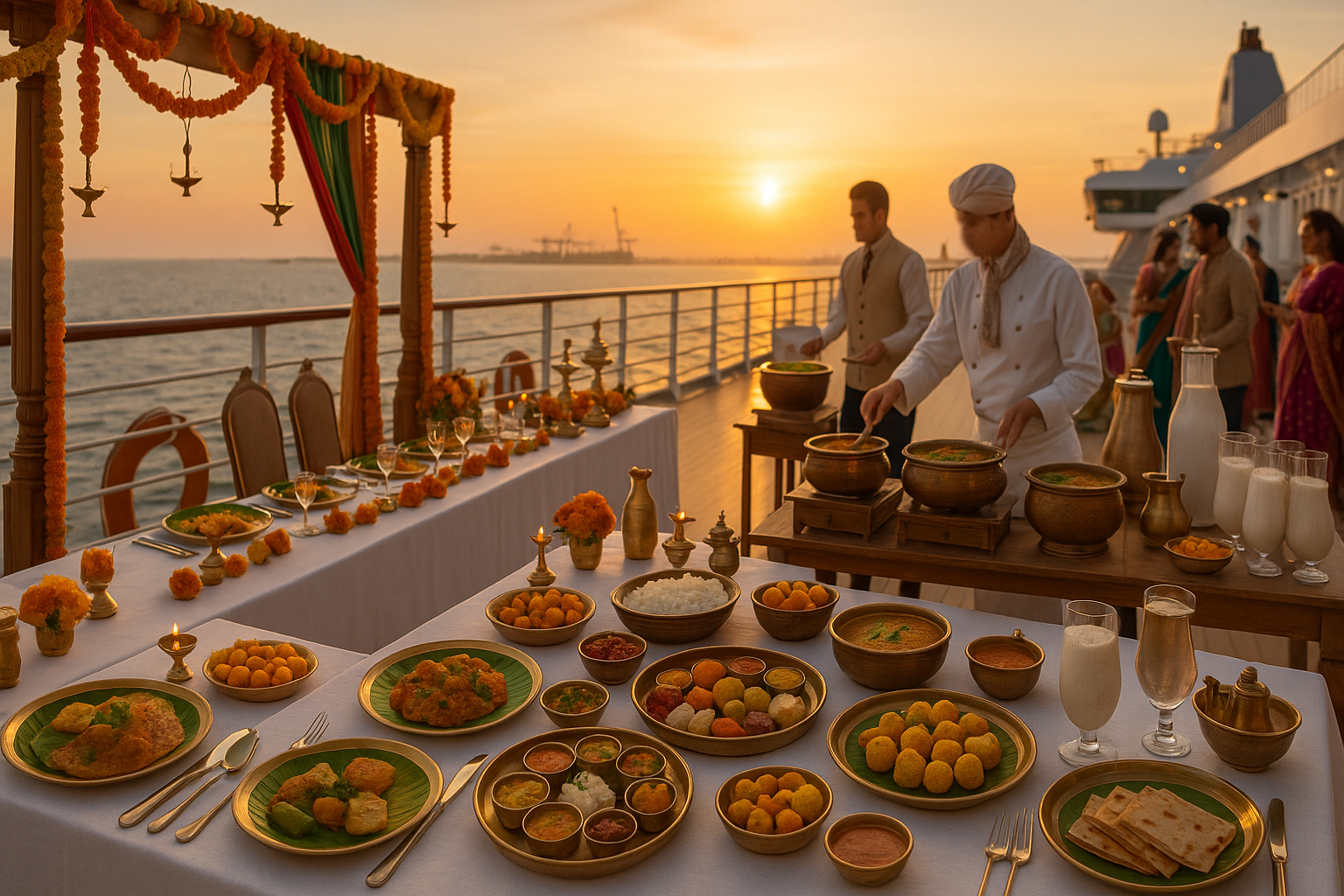
What vegetarian and Jain menu options can be customized for Indian wedding cruises?
Cruise weddings can feature fully customized vegetarian and Jain (sattvik) menus—thalis, regional banquets, sattvik plates—and the ship’s galley or a private catering kitchen implements them via written specifications and event orders.
Onboard planners and the galley coordinate multi-day menus across events so traditional Indian food and exclusive group arrangements can be delivered; private venues and exclusive catering may be requested for wedding groups.
Below are common menu categories that can be customized on a cruise wedding:
- Thali (plated multi-dish thali): North Indian thali with dal makhani, paneer curry, jeera rice and rotis — suitable for a formal reception or plated dinner.
- South Indian banquet: dosa, idli, sambar, coconut chutney and vegetable kurma — suitable for a morning brunch or south-Indian themed function.
- Gujarati / Rajasthani specialties: undhiyu, dal, sweet chutneys, bajra rotla or gatte ki sabzi — suitable for a festive sangeet or mehendi buffet.
- Jain/sattvik plates: sattvik dal, mixed vegetable curries made without root vegetables, plain rice and rotis — suitable for religious ceremonies and guests requiring strict Jain/sattvik compliance.
- Live stations and chaat counters: pani puri, pav bhaji, kebab-style vegetarian skewers — suitable for sangeet, cocktail hour, or late-night bites.
- Afternoon high-tea or light brunch: South and North Indian fusion small plates, sandwiches, fruit chaat — suitable for post-ceremony brunches and farewell events.
- Desserts and mithai platters: traditional Indian sweets and plated desserts — suitable for reception dessert service or dessert stations.
- Beverage pairings and mocktail bars: Indian masala chai, lassi variations and themed mocktails — suitable across all events and multi-day celebrations.
How are vegetarian and Jain menus designed differently on cruise ships?
Jain/sattvik menus avoid root vegetables and require separate preparation and service flows; ships implement this via segregated prep areas, labelled event orders and allergy protocols.
Jain/sattvik menus are handled in the galley with clear labelling and segregated prep times or areas to prevent cross-contact. The galley and onboard event teams follow allergy protocols and use separate serviceware when requested. Planners should request written segregation, labelled event orders and explicit allergy protocols so the galley staff can accommodate strict Jain/sattvik rules; exact procedures may vary between cruise lines.
What popular vegetarian thali and regional dishes can be included for wedding functions?
Common options include North Indian thalis, South Indian banquets, Gujarati/Rajasthani specialties and sattvik plates, tailored to events like sangeet, reception and brunch.
Sangeet is well suited to interactive items and snack stations, while receptions commonly use plated thalis or banquet buffets.
- North Indian thali: paneer butter masala, dal makhani, jeera rice, assorted breads — suitable for a formal reception thali.
- South Indian banquet: masala dosa, vegetable sambar, coconut chutney, steamed idli — suitable for a wedding brunch or morning ceremony.
- Gujarati thali: shaak, kadhi, farsan, sweet dish and rotla — suitable for festive mehendi or sangeet buffets.
- Rajasthani spread: gatte ki sabzi, dal baati churma (vegetarian versions), bajra rotis — suitable for themed receptions.
- Jain/sattvik plate: no root vegetables, sattvik dals and seasonal above-ground vegetables, plain rice and chapati — suitable for religious ceremonies and guests requiring Jain/sattvik observance.
- Street-food & live stations: chaat, pav bhaji, veg tikka grills — suitable for cocktail hours and late-night entertainment.
- Brunch/light fare: Indian fusion small plates, fresh fruit chaat, spiced lassis — suitable for post-wedding brunches or departures.
How far in advance and how do I request Jain/sattvik menu accommodations?
Request Jain/sattvik menus in writing at booking and reconfirm 6–8 months prior; specify prohibited ingredients, prep segregation and service needs.
You should submit written specifications when you book the cruise wedding and reconfirm them 6–8 months before sailing, because cruise wedding planners and onboard teams coordinate multi-day event orders and guest requirements.
Written specifications checklist (include these items in your booking materials):
- Written specifications: list prohibited ingredients (explicitly note “no root vegetables” for Jain/sattvik).
- Guest dietary roster and allergens: provide names and specific needs so the galley can plan quantities.
- Prep and service segregation: request segregated galley prep times/areas and labelled event orders; ask for separate serviceware and dish-labelling.
- Private venue or exclusive catering request: confirm if a private venue or exclusive food service for the wedding group is available.
- Menu confirmation timeline: confirm menus at booking and reconfirm 6–8 months out, then again closer to departure as needed.
- Tasting and final approvals: request a tasting or sample menu review if the cruise line or planner offers it (availability may vary).
You should keep these requests written and send them via your planner or the cruise’s event contact so the galley and onboard teams can implement the Jain/sattvik and vegetarian accommodations.
What destinations and ports in India are best for hosting a cruise wedding?
Top Indian ports for cruise weddings include Mumbai, Goa, Kochi, Chennai and the Andamans—each supplying distinct regional ingredients and cultural themes for menus and ceremonies.
Below is a short port → regional cuisine map highlighting menu opportunities.
- Mumbai → regional cuisine: coastal Maharashtrian flavours; can provide coastal seafood, Malvani spices and cosmopolitan ingredient access for fusion menus.
- Goa → regional cuisine: coastal Konkan/Goan; can provide fresh seafood, kokum and coconut-based elements ideal for relaxed beach‑style receptions.
- Kochi → regional cuisine: Kerala backwater cuisine; can provide coconut, Malabar spices, freshwater and marine fish for traditional Kerala menus.
- Chennai → regional cuisine: Tamil / South Indian; can provide rice-based dishes, coastal fish and South Indian spice profiles for classical ceremonies.
- Andaman → regional cuisine: island seafood and tropical produce; can provide exclusive island seafood and tropical fruit accents for intimate or high-end shore events.
Which ports are best for sourcing authentic regional cuisine for wedding menus?
Mumbai, Kochi, Goa, Chennai and the Andamans map to distinct cuisines—Mumbai (coastal Maharashtrian), Kochi (Kerala backwater), Goa (coastal Konkan/Goan), Chennai (Tamil/South Indian), Andaman (island seafood and exclusive venues).
Below is a practical port→regional cuisine map and sourcing opportunities you can use when planning menus.
- Mumbai — regional cuisine: coastal Maharashtrian. Mumbai can provide broad supplier access (fresh seafood and regional spices) because it is a major port and hospitality hub.
- Kochi — regional cuisine: Kerala backwater. Kochi can provide coconut-based ingredients, Malabar spices and local fish that suit authentic Kerala feasts.
- Goa — regional cuisine: coastal Konkan/Goan. Goa can provide Goan-style seafood, vinegars/cashew flavours and coconut elements for distinctive coastal menus.
- Chennai — regional cuisine: Tamil / South Indian. Chennai can provide rice-centric dishes, coastal fish and South Indian spice blends for traditional ceremonies.
- Andaman — regional cuisine: island seafood. Andaman can provide island-caught seafood and tropical fruit accents for exclusive shore-side meals and specialty tasting menus.
How do weather and seasonality at each port affect wedding scheduling and menu choices?
Monsoon and high-heat seasons affect deck events and ingredient availability; plan sheltered venues and easy-to-serve menu formats in humid or rainy seasons.
Deck events are most vulnerable to seasonal weather: the southwest monsoon can make open‑air decks impractical in Goa, Mumbai and Kochi, while summer heat around Chennai and Andaman can stress chilled preparations. Planners should prefer covered venues or indoor ballrooms for monsoon months and schedule outdoor ceremonies in drier months. Local produce and fresh catches may be seasonal and may be limited at peak monsoon, so menus may rely on preserved, chilled or easily sourced alternatives. For high heat, menus should favour lighter, cold or quickly served items and food-hygiene practices that reduce holding time.
What port facilities and terminal logistics should group organisers expect?
Expect spacious terminals, group check-in and the option to request dedicated managers; allow extra time for provisioning and staggered embarkation for large groups.
Terminals at major ports present roomy boarding areas where you board the cruise ship, and cruise companies can assign dedicated managers to assist your group — organisers should submit guest details and documents ahead of time to speed group check-in. Ground transport and coach drop-off logistics at the port can affect arrival windows, so planners should schedule coach timetables and allow buffer time for traffic and security checks. Provisioning and catering deliveries need coordination with the ship’s provisioning team and port authorities; organisers should request staggered embarkation and extra lead time so catering deliveries and equipment arrive and clear terminal processing before event start times.
What are the typical cruise wedding itinerary durations (2-, 3- and 5-night options)?
Indian cruise itineraries commonly run 2-night, 3-night and 5-night trips; 2-night suits core ceremony + reception, 3-night adds a pre-wedding function, and 5-night accommodates full multi-day celebrations.
CruiseWeddingIndia explicitly lists 2-, 3- and 5-night itineraries as the common choices in India, and operators such as Cordelia Cruises offer short 2- and 3-night sailings that couples often use for weddings. Choose the length by the number of rituals you want aboard, guest availability, and whether you plan shore excursions.
How are wedding functions typically distributed across 2-, 3-, and 5-night itineraries?
2-night: ceremony + reception; 3-night: adds mehendi or sangeet and welcome events; 5-night: full sequence including pre- and post-wedding events and shore excursions.
Below are typical sample schedules showing how functions can be placed on each itinerary length.
- 2-night: Embarkation day — welcome/orientation; Overnight — wedding ceremony on deck followed by reception in a banquet or ballroom; Disembark morning.
- 3-night: Embarkation day — welcome cocktail and orientation; Middle day — mehendi or sangeet (theatre or deck) and guest activities; Final night — wedding ceremony + reception; Itinerary may include a short shore stop.
- 5-night: Embarkation — welcome events and meet-and-greet; Days 2–3 — pre-wedding functions (mehendi, sangeet, haldi) spread across venues; Day 4 — main ceremony and grand reception; Day 5 — post-wedding brunch/farewell and optional shore excursions during port calls.
These sample schedules are typical options and can be adjusted; cruise planners and travel specialists can customize function order and venues to fit your chosen ship and ports.
Which itinerary length is best for intimate weddings versus multi-day destination celebrations?
2-night is best for intimate ceremonies; 3-night is suitable for mid-size groups wanting one pre-wedding event; 5-night is recommended for full multi-day destination celebrations.
A 2-night itinerary reduces logistics and guest time away and may lower overall costs, but it limits how many separate rituals you can host. A 3-night itinerary provides space for a single pre-wedding function (welcome night, mehendi or sangeet) while keeping the trip short. A 5-night itinerary supports multiple pre- and post-wedding events, varied menus, and shore excursions, but it may increase planning complexity, catering variety, and guest time commitment. You should match the itinerary to guest availability, ritual priorities, and how much leisure (shore visits, excursions) you want to include.
Which cruise ships or itineraries can accommodate large wedding groups (400–500+ guests) versus intimate groups (50–150)?
Match guest lists to ship bands: all‑suite river yachts (exclusive hire to 56–112 guests) suit intimate groups; mid‑size liners (350–700 rooms) suit hundreds; large liners (700–2000 pax) can host 400–500+ guests.
River yachts and small vessels (Antara Cruises’ all‑suite Ganges voyagers) are built for intimate, exclusive hire celebrations and keep the entire group together. Mid‑size liners—those reporting 350–700 rooms—offer multiple venues and cabin inventory that suit mid‑to‑large groups but may require careful venue allocation. Large liners with capacities reported at 700–2000 pax provide the cabin and ballroom scale needed for 400–500+ guests but may necessitate formal room blocks and venue exclusivity to avoid mixing with regular passengers.
What ship sizes and room counts correspond to small, medium and large wedding groups?
Small river yachts: ~56–112 guests; mid‑size liners: 350‑700 rooms; large liners: 700‑2000 pax.
Below are the numeric bands, typical ship types, and which guest‑list sizes they suit.
- Small river yachts — All‑suite river vessels (Antara example) with exclusive‑hire limits reported to 56–112 guests; best for intimate multi‑day celebrations where all guests stay together.
- Mid‑size liners — Ships with roughly 350–700 rooms (as noted for Indian liners); suit groups of a few hundred where multiple venues and staggered dining are feasible.
- Large liners — Vessels reported at 700–2000 pax; can accommodate 400–500+ guests if planners secure sufficient room blocks and reserve large ballrooms or decks.
How does guest count affect dining setups and venue allocation onboard?
Guest count determines service style and space needs: small groups may use private restaurants or plated service, while larger groups may require buffets, multiple seatings, or reserved ballrooms and decks.
Onboard food is typically served in large restaurants, but you may request private dining or exclusive use of a venue for your group. For groups over a few hundred, expect buffets or multiple seating waves in main dining rooms to manage throughput; reserving a theatre, ballroom, or an entire deck may be necessary to keep events private and on schedule. Private venues and exclusive hires may require advance negotiation with the cruise line and formal room‑block commitments.
What cabin and accommodation types are typically offered for wedding groups?
Typical cabin categories are inside (~100 sq ft), mid‑category with balcony (~150+ sq ft), oceanview, and suites (200–300 sq ft).
Below are cabin categories, the typical sizes reported in research, and recommended group rooming strategies.
- Inside cabin — ~100 sq ft; lowest category and often quite compact; planners should avoid relying solely on the lowest category for wedding blocks.
- Oceanview — commonly a step up from inside and often grouped with mid‑category inventory; sizes may align with the 150+ sq ft mid range.
- Balcony (mid‑category) — 150+ sq ft; offers extra comfort and features (balcony, extra bed); planners should block a second room category (not just the lowest) to give guests reasonable options.
- Suite — 200–300 sq ft; suites should be allocated to VIPs, the wedding party, or key family members to ensure comfort and event support.
How do accommodation, onboard amenities and dining venues affect menu customization and guest experience?
Onboard amenities and venue types—galleys, ballrooms, decks and private restaurants—directly shape feasible menu complexity and guest flow; luxury services (butler, spa) enhance VIP experiences.
Ships consolidate accommodation, catering and entertainment, so planners must design menus around physical kitchen limits, service models and the venues available.
What onboard amenities and services (spa, live shows, butler service) can be arranged for wedding groups?
Common wedding amenities include spa packages, live shows/DJs, butler or concierge VIP service and onboard photographers; these can be bundled with catering for experience packages.
Below are amenity-to-effect bullets showing how each amenity can be bundled with catering:
- Spa → pre-wedding wellness packages can be bundled with welcome brunches or post-ceremony recovery meals to create relaxation-focused guest itineraries.
- Live shows / DJs / Bollywood acts → Sangeet and reception dinners can be bundled with live entertainment to reduce external artist logistics and combine performance timing with plated or buffet service.
- Butler / concierge service → butler service can be bundled with private in-suite dining, VIP plated service or reserved-table service in private restaurants for high-tier guests.
- Photography / videography → onboard photographers can be bundled into full-day catering packages that cover cocktail, ceremony and reception meal timing for smooth shot scheduling.
- Decorators & entertainers → decorators and themed entertainers can be bundled with catering (menu theming, plated-course sequencing) to create cohesive cultural programs.
How do onboard kitchen capacity and food-service models influence menu complexity?
Galley capacity and service model determine menu complexity: small galleys favor set plated or station service, large galleys can support multi-regional banquets or custom thali stations.
A ship’s galley size and equipment limit how many separate live-cook elements and extensive regional menus it can execute simultaneously. Large-guest service requires tight timing, pre-plating or station set-ups to keep courses hot and synchronized.
Private kitchen requests may be accommodated on some ships when clients request exclusive use of a galley or a separate prep area, but use of a private kitchen may be restricted and may increase costs. For most events the ship’s galley and its galley-managed restaurants handle production; planners should therefore favor menu formats that match the galley’s throughput. For scale, planners should prefer limited-choice plated menus, plated-thali or managed station/buffet formats rather than fully à la carte menus; specific ships may allow greater complexity and may require advance menu trials.
How should planners allocate onboard venues (decks, ballrooms, private restaurants) for different meal types?
Planners should match plated, formal meals to ballrooms; buffet and thali stations to spacious decks or banquet halls; and private restaurants to intimate or VIP dining.
Ballrooms should be used for formal plated receptions and multi-course dinners because their layout supports tables, plated service circulation and formal staging. Ballrooms allow predictable guest flow and a controlled service line for plated or plated-thali service.
Decks should be used for large buffets, thali stations and cocktail-style receptions because decks provide open space for food stations, guest movement and live entertainment; decks may require covered or wind-protected setups depending on weather. Decks also suit culturally lively events (Baraat arrivals, sangeet dancing) where guest circulation is high.
Private restaurants should be reserved for small-group rehearsals, VIP meals or tasting dinners where the service can be exclusive and butler or private-kitchen options may be negotiated. Private restaurants may also provide an easy way to separate vegetarian/Jain flows or host intimate post-wedding brunches. Venue availability may vary by ship, so planners should confirm room dimensions and service rules early and should plan guest flow and cultural serving needs accordingly.
Which cruise lines and charter options allow private ship hire or exclusive wedding charters?
Options include exclusive ship hire (full control), partial-charter packages (shared sailings with dedicated spaces) and river-charters (smaller all-suite vessels); providers include Antara (river), Cordelia and international liners depending on scale.
Exclusive ship hire gives you sole use of the vessel and venue scheduling, partial-charter packages offer reserved or dedicated spaces on a regular sailing, and river-charters use smaller all-suite ships that can include private riverbank receptions. Availability, pricing and vendor rules may vary by operator and should be checked with the provider.
Below is a quick comparison of charter types to help decide which fits your wedding size and priorities.
- exclusive hire → control: full venue and catering control; cost: highest (per-quote); guest-suitability: intimate to mid-sized bespoke events (example river numbers below).
- partial-charter → control: limited to dedicated areas and shared public spaces; cost: lower than exclusive hire; guest-suitability: mid-sized groups who prioritize savings over total exclusivity.
- river-charter → control: high on intimate settings and bespoke landings (riverbanks); cost: moderate to high depending on bespoke services; guest-suitability: small-to-medium bespoke weddings with riverbank receptions.
What are the differences between exclusive ship hire and partial-charter wedding packages?
Exclusive hire gives full venue and catering control but costs more; partial-charter offers lower cost with restricted autonomy over shared spaces and vendor choices.
Exclusive hire gives complete control of ceremony timing, all onboard venues and often the catering/vendors because the whole ship is reserved for your group. Partial-charter offers dedicated spaces (ballroom, deck or private dining) on a regular sailing but you share the ship’s public areas and some vendor choices remain with the operator. The trade-off is straightforward: exclusive hire gives maximum privacy and flexibility but is more expensive, while partial-charter reduces cost and complexity at the expense of full autonomy; couples should request a detailed quote to compare actual costs and inclusions.
Which providers in India offer private riverbank or all-suite charters suitable for Indian weddings?
Representative providers include Antara Cruises (river, private riverbank receptions), Cordelia Cruises (ocean-liner weddings), and international liners for large-scale bespoke options.
The following examples show typical offerings and scale possibilities.
- Antara Cruises — private riverbank receptions and bespoke exclusive river-charters; example package quotes show exclusive ship hire up to 56 guests: $30,000 and up to 112 guests: $60,000, and Antara can arrange riverbank parties as part of bespoke charters.
- Cordelia Cruises — ocean-liner wedding packages that can be customised for ceremonies and receptions on deck or in ballrooms; ocean liners like Cordelia Cruises may be better for larger guest lists and multi-day sailings.
- International liners — major international cruise lines can provide large-scale bespoke charters and ballroom-capable ships that may accommodate hundreds to thousands (many liners commonly carry 700–2,000 passengers); these can be used for very large wedding groups but will usually require full-charter negotiations.
All provider capabilities, exact guest limits and pricing are offered per-quote and can vary by itinerary, so planners and couples should request written proposals to confirm riverbank permissions, catering options, and final guest capacities.
Booking, pricing, planner and logistics considerations (including menu requests and ceremony feasibility)
Expect booking windows of roughly 6–8 months for best rates; costs vary widely by ship, guest count and exclusivity; planners handle menus, logistics and group check-in support.
Below are practical points you should use when planning:
- Price bands (example): entry-level packages can start around ₹2 crore, exclusive bespoke hires can reach premium figures (examples reported up to ₹50 crore); river‑charter examples include Antara Cruises’ bespoke charters at roughly $30,000 (up to 56 guests) and $60,000 (up to 112 guests).
- Planner services: menu coordination, vendor and ship liaison, décor and entertainment coordination, permits, guest check‑in and group-rooming management.
- Group check‑in logistics: request dedicated managers, pre‑submit guest lists and documents, and use staggered embarkation to speed boarding.
- Quick boolean FAQs: Vegetarian/Jain menus — Yes. Traditional ceremonies (Mehendi, Sangeet, Baraat) aboard — Yes (with permissions/space checks). Group check‑in support — Yes.
What price bands should couples expect and what factors most influence cost?
Price bands range from entry-level packages to luxury bespoke hires; examples include entry packages from ~₹2 crore and premium packages reported up to ₹50 crore, with exclusive‑hire charters priced in the tens of thousands USD.
Cruise wedding pricing is highly variable and couples should treat published figures as illustrative. The primary cost drivers are:
- guest count (per‑guest catering and cabins scale costs) — primary cost driver,
- exclusive hire of the ship or private venue (ballroom, deck or full-ship charter) — primary cost driver,
- menu customization and specialty cuisine (Jain/vegetarian requirements, private kitchens) — primary cost driver,
- entertainment and live acts (DJs, bands, Bollywood productions) — primary cost driver,
- décor, mandap installation and technical rigging for decks/ballrooms — primary cost driver,
- duration and itinerary (2–5 night itinerary choices affect accommodation and F&B), cabin categories and shore excursions.
These items together determine whether a wedding resembles an entry-level package, a mid-range group booking, or a high‑end bespoke charter (examples: Cordelia Cruises, Antara Cruises, international lines).
What planner services are typically included and when should couples engage a planner?
Planners typically handle menu coordination, vendor and ship liaison, décor and entertainment coordination, permits, guest check‑in and group-rooming support; couples should engage a planner 6–8 months before the wedding.
Below is a typical checklist of planner services you should expect:
- Menu coordination and dietary management (including vegetarian/Jain specifications).
- Vendor management and on‑board vendor coordination (photography, florists, entertainers).
- Ship liaison and permit handling (port authority permissions, deck use approvals).
- Décor, mandap design and technical rigging for decks/ballrooms.
- Guest-rooming plans, group rates negotiation and booking consolidation.
- Group check‑in and embarkation coordination with dedicated managers.
- Budget management and supplier negotiation (planners can secure group discounts and, when booked early, can reduce costs significantly; some operators report savings up to ~40% with early group negotiation).
Planners should be engaged in the 6–8 months booking window to secure better cabin categories, negotiate group rates, and manage permissions and bespoke requests.
Are vegetarian-only and Jain-specific menus available, and how do I request them?
Yes — vegetarian-only and Jain-specific menus are available; request them in writing at booking and provide clear ingredient lists and prep requirements.
To request them you should:
- request them in writing when you book the event and include a detailed guest dietary list,
- specify prohibited items (onions, garlic, root vegetables for Jain menus) and acceptable substitutions,
- ask for segregated prep or private dining/kitchen areas if available and for confirmation of cross‑contact controls,
- confirm whether the ship will provide in‑house chefs or allow external caterers for specialized meals, and reconfirm all menu details shortly before embarkation.
Request them early and reconfirm with the ship’s culinary team and your planner to avoid last‑minute issues. To begin reservations and secure menu commitments, visit Book Cruises with Indian Cuisine Included: Indian, Vegetarian, and Jain Menu Options.
Can traditional Indian and Jain wedding ceremonies (Mehendi, Sangeet, Baraat) be hosted on a cruise, and what permissions or space considerations apply?
Yes — Mehendi, Sangeet and Baraat can be hosted aboard on decks or in ballrooms, but organisers should confirm mandap anchoring, deck capacity and port/ship permissions.
Practical considerations and constraints you should check:
- mandap anchoring: mandap structures may need special fixing methods and may be restricted on public decks; confirm acceptable anchoring and wind‑safety requirements,
- space and capacity: Baraat (procession) may require wide, unobstructed deck space or a theatre/lobby route; Mehendi needs flat, shaded space for seating and artists, and Sangeet may need a theatre or ballroom with sound and lighting rigging,
- permissions: organisers should obtain ship approval and, for any activity on a public deck or shore stop, confirm port authority rules and timing restrictions,
- décor and rigging: heavy décor or pyrotechnics may be prohibited; ask the ship for their technical and safety limits.
Confirm mandap, sound and procession plans with the ship and port authorities early in the 6–8 month planning window.
Do cruise wedding packages typically include check-in and boarding support for large groups?
Yes — many packages include group check‑in support with dedicated managers, pre‑submitted guest lists and staggered embarkation to ease boarding.
Operational steps that typically simplify group boarding are:
- dedicated managers should be requested at booking to act as the single point of contact at the terminal and on board,
- pre‑submit guest lists, passport/ID and travel documents well before sail date so the cruise line can pre‑clear passengers,
- use staggered embarkation slots to avoid long queues and to allow group luggage handling, and
- coordinate arrival transfers so guests arrive at the terminal in planned waves.
Request dedicated managers at contract stage and submit guest details within the planner’s 6–8 month timeline to ensure smooth check‑in.