This guide defines the cruise as the travel product of cruise ship travel and examines the availability and quality of North Indian cuisine across cruise lines, onboard dining venues, menus, and dietary accommodations. Major lines—Royal Caribbean, Celebrity, Carnival, Norwegian, Princess, and Holland America—regularly offer Indian cuisine in main dining rooms, buffets, or on select specialty restaurants.
Offerings appear in three formats: rotating Indian options in the main dining room (included with your fare), Indian stations in ship buffets (Windjammer, Lido, Marketplace) — Royal Caribbean, Carnival and Norwegian often feature these — and deeper, more authentic menus in specialty restaurants that may charge a cover fee and commonly require reservations. Expect North Indian staples such as butter chicken, dal makhani, rogan josh, biryanis, tandoori items (paneer tikka, tandoori chicken), naan/roti, and desserts like gulab jamun.
Cruise lines commonly provide vegetarian dishes (dal, paneer, chole, rajma, vegetable biryani); Jain-compliant meals can be requested but exclude root vegetables and require advance notice. You should place special-meal requests at least 48+ hours before sailing via the cruise line app, pre-cruise forms, or guest services and follow up on embarkation day. For a branded example, Masala Tiger is a Carnival specialty on select ships (Carnival Celebration, Jubilee, Mardi Gras) featuring tandoor-cooked items and typically requiring reservations.
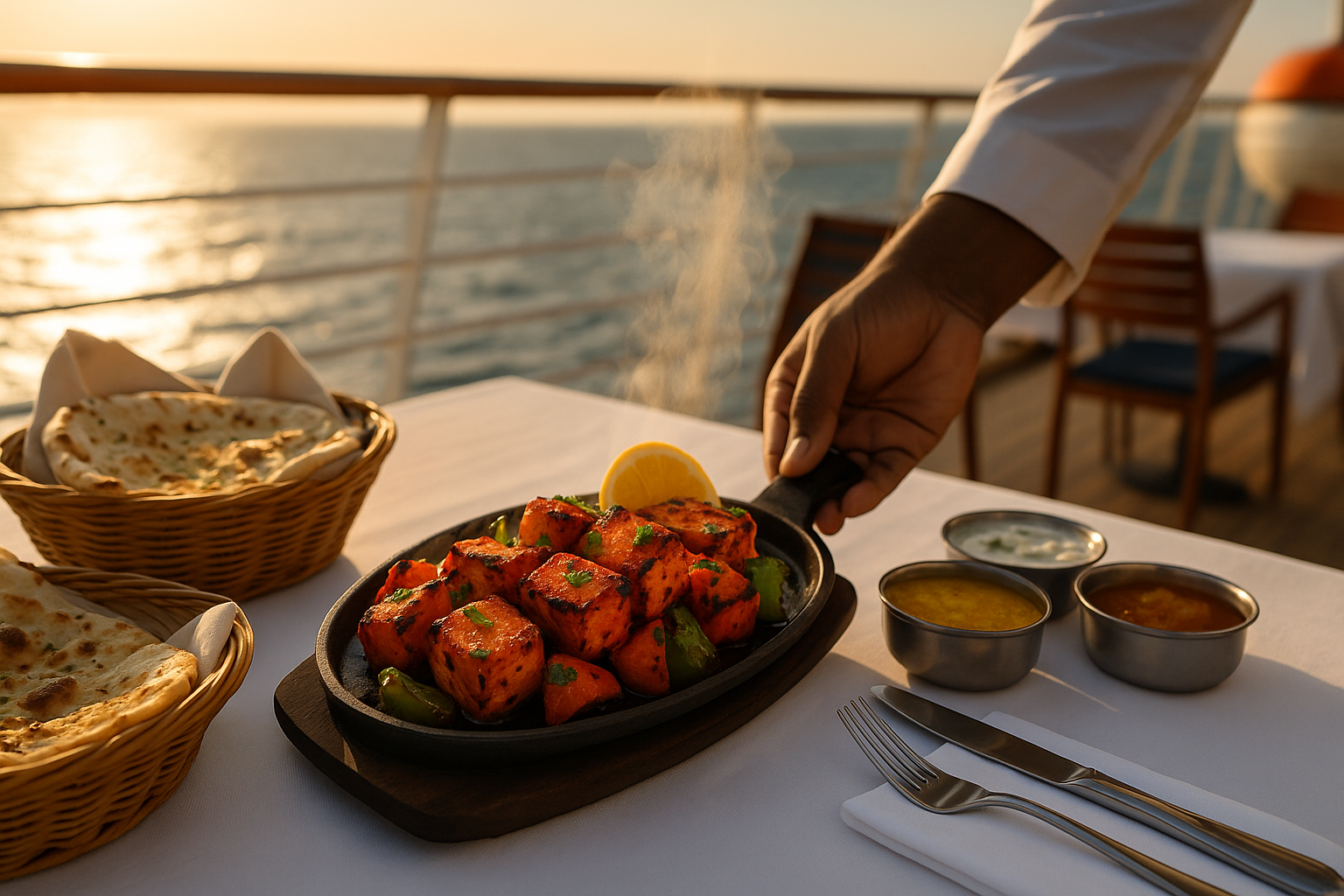
Which cruise lines offer Indian cuisine on their ships?
Major lines—Royal Caribbean, Celebrity, Carnival, Norwegian, Princess, and Holland America—regularly offer Indian cuisine in main dining rooms, buffets (Windjammer/Lido/Marketplace) or on select specialty restaurants, though availability varies by ship and itinerary.
Offering Indian cuisine typically means a mix of formats: dishes on the rotating main dining room menu, options at the ship buffet (Windjammer/Lido/Marketplace), and more focused menus in specialty restaurants. Availability can depend on passenger demand, the ship’s region, and whether a cruise is a themed or India/Asia itinerary; some operators place Indian dishes on every sailing, while others do so only on select ships or sailings.
Top cruise lines that offer Indian food (quick list and what they provide)
Below is a quick ranked list of major cruise lines that commonly offer Indian cuisine and what they typically provide:
- Royal Caribbean — Indian dishes appear in the main dining room and Windjammer buffet; select ships may offer dedicated Indian menus or specialty restaurants.
- Celebrity — Elevated Indian dishes appear in main dining and in specialty venues on some sailings, with vegetarian and regional options.
- Carnival — Indian dishes appear in main dining and the Lido/Marketplace buffet; select ships feature the Masala Tiger specialty restaurant.
- Norwegian — Indian options appear in main dining rooms and buffets; some ships may dedicate buffet stations to Indian cuisine.
- Princess — Indian dishes commonly appear in the buffet (Horizon) and nightly main-dining rotation, especially on relevant itineraries.
- Holland America — Indian-inspired entrees appear on rotating main-dining menus and buffets, often with good vegetarian choices.
For a broader overview of ship-level availability, dining options, and what Indian travelers can expect, see Indian Restaurants on Cruise Ships: Availability, Options, and Dining for Indian Travelers.
How to judge and pick the 'best' cruise line for Indian food (criteria)
Judge lines by authenticity, menu variety, presence of specialty restaurants, chef training, consistency across sailings, and itinerary alignment. Menu variety is especially important; a line with greater variety should offer both regional dishes and street-food-style options, while specialty restaurants indicate deeper commitment to authentic preparation. You should also check whether the line lists trained Indian chefs or dedicated Indian menu nights, and whether Indian dishes appear consistently across ships or only on certain sailings.
How itineraries and themed sailings affect Indian dining availability
Itineraries to India/Asia or sailings with a large Indian diaspora passenger mix increase the likelihood that a ship will offer Indian cuisine. Themed or charter sailings—Bollywood, Holi, or India-focused cruises—typically expand menus and introduce more authentic offerings, cooking demos, and events, while crossover itineraries may only include occasional Indian dishes. Availability may therefore vary by route and by whether the cruise is marketed for an India/Asia audience.
What onboard dining venues serve North Indian food on cruise ships?
North Indian dishes appear in main dining rooms, buffets/stations (Windjammer/Lido/Marketplace), specialty restaurants, and pop‑up or themed events; experience and cost vary from included main‑dining options to cover‑charge specialty venues.
Below are the typical venue types where you'll find North Indian food onboard and how experience and cost differ.
-
Main dining room: Main dining rooms typically include rotating Indian options that are included with your cruise fare. Expect simpler plating and menu adaptations for broad appeal; vegetarian choices are commonly available and special‑diet requests (including Jain or vegetarian variations) may be accommodated on select ships.
-
Specialty restaurants: Specialty restaurants provide deeper, more focused Indian menus and more authentic presentation (tandoor items, regional dishes) and may offer trained Indian chefs. These venues often charge a cover charge or extra fee and present food with a higher level of plating and service compared with included venues.
-
Buffet stations (Windjammer/Lido/Marketplace): Buffet stations offer casual, self‑serve Indian sections that are variable by ship and day; Windjammer (Royal Caribbean), Lido/Marketplace (Carnival), and buffet sections on Norwegian often feature Indian stations. Buffet options are generally included with your fare but are less consistent in depth and authenticity than specialty restaurants.
-
Pop‑ups, theme nights and events: Pop‑up dinners, Bollywood/Holi nights, and regional food festivals appear as one‑off or scheduled events and may be included or run as part of a themed sailing. These events can offer authentic dishes and live elements but occur on select sailings only.
Main dining room vs. specialty restaurants vs. buffet stations
Main dining rooms typically include rotating Indian options; buffets offer casual, variable Indian stations; specialty restaurants provide deeper, often cover‑charged Indian menus.
Main dining rooms present included Indian entrees on a rotating evening menu with utilitarian plating and broad seasoning. Buffet stations give casual, all‑you‑can‑sample access to multiple Indian items but vary ship‑to‑ship and day‑to‑day. Specialty restaurants focus on authenticity, extended menus, and elevated presentation; they may charge a cover or supplemental fee and often showcase tandoor or chef‑driven preparations. Vegetarian selections tend to be more plentiful in buffets and main dining, while specialty restaurants should offer a fuller range including meat‑centric regional dishes on select ships.
Which lines include Indian stations in buffets (Windjammer/Lido/Marketplace)?
Royal Caribbean (Windjammer), Norwegian (buffet sections), and Carnival (Lido/Marketplace) often include Indian stations, but ship‑level and itinerary variation applies.
Notable examples that often feature Indian buffet stations include:
- Royal Caribbean — Windjammer Cafe frequently offers Indian selections on many ships.
- Carnival — Lido Marketplace on several ships lists Indian items and has specialty concepts such as Masala Tiger on select vessels.
- Norwegian Cruise Line — buffet sections on some ships often dedicate an area to Indian dishes.
- Princess and other mainstream lines — may include Indian items in the buffet depending on passenger mix and itinerary.
Expect "often" and "may" to apply: the presence and depth of an Indian station can change by ship, itinerary, and season.
Do specialty Indian restaurants require reservations or a cover charge?
Specialty Indian restaurants commonly require reservations and may have a cover charge; reserve via the cruise app or the reservations desk in advance.
Specialty Indian venues on modern ships frequently operate like other specialty restaurants: they limit seating, require reservations, and charge a cover fee or a la carte supplement on many lines. You should reserve early through the line’s app, the onboard reservations desk, or pre‑cruise booking tools, especially for popular dinner times and shorter cruises. Policies vary by operator and ship, so check the ship’s dining pages or app for exact rules and any promotional inclusions.
Live cooking demos, themed nights, and cultural events
Live cooking demos and themed Indian nights occur on select ships and themed sailings; check daily schedules, the cruise app, or event pages for times.
Select operators and specialized themed sailings (for example, Bollywood‑themed cruises) run cookery demonstrations, Thali or street‑food stations, and Bollywood/Holi nights that highlight North Indian cuisine. These events may be scheduled as part of the ship’s daily program or offered as marquee events on specific itineraries. You should check the ship’s daily planner, the cruise app, or pre‑sail event listings to find demonstrations and themed dinners on your sailing.
What North Indian dishes can I expect on cruise menus?
Expect North Indian staples like butter chicken, dal makhani, rogan josh, biryanis, tandoori items (paneer tikka, tandoori chicken), naan/roti, and desserts like gulab jamun.
Cruise menus often feature these North Indian classics in main dining rooms, buffets and specialty venues (for example Carnival’s Masala Tiger); chefs may temper spice levels and richness for broader palates and offer vegetarian or vegan variants on request.
Common North Indian curries and gravies
Common North Indian curries and gravies on cruises include butter chicken, dal makhani, rogan josh and biryanis.
Below are frequent curry-style menu items and how they appear in cruise-friendly versions:
- Butter chicken — creamy tomato-based chicken that may be made milder and lighter on cream for cruising; vegetarian paneer or vegan mock‑chicken versions may be offered.
- Dal makhani — slow-cooked black lentils that often appear as a milder, less oily cruise-friendly dal; naturally vegetarian and often adaptable to vegan (ask about butter/cream).
- Rogan josh — Kashmiri-style lamb curry that may be pared down in heat or richness onboard; some ships substitute chicken for wider appeal.
- Biryani (various styles) — layered spiced rice with meat or vegetables; cruise biryanis may be less intensely spiced and commonly offered as chicken, lamb, vegetable, or vegetarian options.
Tandoori, kebabs, breads and accompaniments
Tandoori items, kebabs, breads and chutneys commonly appear on cruise menus.
Introduce the list with a note about equipment and preparation: some ships feature a tandoor in specialty restaurants (for example Carnival’s Masala Tiger), while others may use grills or ovens to achieve similar results.
- Tandoori chicken — marinated, charred chicken that may be cooked in a clay tandoor where available or grilled as a cruise-friendly alternative.
- Paneer tikka — marinated, skewered paneer that is a common vegetarian tandoori-style option and may be offered vegan if plant-based paneer is available.
- Seekh kebab — spiced minced meat skewers that may be served grilled; vegetarian kebab alternatives (spiced soya or vegetable) may appear on menus.
- Naan and roti — leavened naan and whole‑wheat roti/pulka are standard breads; naan is often richer (butter or ghee) while roti is a leaner, often vegan-friendly bread.
- Chutneys and pickles — mint chutney, tamarind chutney and achar are common accompaniments; chutneys may be vegan and are used to balance flavors.
Desserts and accompaniments commonly paired with North Indian meals
Desserts and accompaniments commonly paired with North Indian meals include gulab jamun, kheer, raita and pickles.
Typical sweet and savory finishers you may find on board (offerings may vary by ship):
- Gulab jamun — syrup-soaked milk dumplings served warm or at room temperature; traditionally dairy-based (not vegan unless specially made).
- Kheer — creamy rice pudding flavored with cardamom and nuts; usually vegetarian and may be adapted for vegan diets on request.
- Raita — yogurt-based cooling side with cucumber or spices; important to note it is dairy unless a non-dairy version is provided.
- Indian pickles and achar — tangy, spiced condiments that often accompany North Indian plates and are typically vegan.
What vegetarian and Jain Indian dining options are available on cruises?
Cruise lines commonly provide vegetarian options (dal, paneer dishes, chole, rajma, vegetable biryani); Jain meals can be requested but require advance notice and specific root-vegetable exclusions.
Cruise dining typically includes Indian-inspired vegetarian dishes across main dining rooms, buffets, and on select specialty restaurants. Expect daily vegetarian choices on many ships, rotating menus, and the option to ask servers or the dining team for Indian items not printed on the menu. For strict Jain needs, proactive communication is essential to get compliant preparation.
Typical vegetarian dishes and thali options
Typical vegetarian options include dal, paneer butter masala, chole, rajma, vegetable biryani, dosa/idli, and full thali-style platters on select ships.
Below are common vegetarian items and typical thali components you should find on select ships:
- Dal (lentil preparations such as dal tadka or dal makhani) — commonly offered in main dining rooms and buffets.
- Paneer dishes (paneer butter masala, paneer tikka) — appears on specialty menus and themed nights.
- Chole (chana masala) and rajma (kidney bean curry) — staple vegetarian curries in mains and buffet stations.
- Vegetable biryani and plain/jeera rice — served as entrees or buffet rice stations.
- South Indian items (masala dosa, idli with sambar/chutney) — available on some ships for breakfast or regional-theme meals.
- Thali components (a platter with dal, 1–2 vegetable curries, rice/biryani, roti/naan, pickles/raita, papad, and a dessert) — offered as a thali experience on select sailings or specialty venues.
- Desserts (gulab jamun, kheer) — included with Indian menus or buffet dessert stations.
Note: vegetarian items are often labeled on menus and appear in buffets, but availability is ship- and itinerary-dependent.
How cruise lines support Jain, vegan, and other dietary requirements
Cruise lines will prepare Jain-compliant or vegan meals on request; Jain-compliant means no root vegetables.
To request Jain, vegan, or other special diets, request special-diet meals through the cruise line’s pre-cruise dietary form, app, or by contacting dining/special-needs before sailing, and you should allow at least 48+ hours lead time. Specify “Jain-compliant” and explicitly state the key restriction of no root vegetables (no potato, onion, garlic, carrots, beets, etc.), and ask whether the kitchen uses oil or ghee so you can request vegan substitutions. Cross-contact may occur in galley or buffet areas, so you should ask to speak with the dining manager or head chef to verify preparation methods and to reduce risk. Cruise lines may accommodate substitutions and special prep, but confirmation and advance requests improve the chance of accurate, compliant meals.
Are vegetarian/Jain options equally available across cruise lines?
Availability varies: some cruise lines are more reliable for daily vegetarian/Jain options while others require advance requests.
Royal Caribbean and Celebrity are frequently cited as more consistent in offering daily vegetarian and regional Indian choices and dedicated Indian menu items; Princess and Holland America often include Indian-inspired vegetarian entrees and themed nights. Carnival and Norwegian commonly provide Indian sections in buffets or specialty restaurants (for example, Carnival’s Masala Tiger on select ships), but availability and Jain-specific handling may require advance requests. Because availability varies by ship and itinerary, you should request special diets ahead of time and confirm onboard with the dining team.
How to get Indian meals on your cruise: pre-cruise requests, reservations, and practical tips
Request special Indian meals 48+ hours ahead via the cruise app, pre‑cruise support forms, or guest services; reserve specialty restaurants and check daily menus to maximize authenticity.
This approach connects pre-cruise_request, reservation, and specialty_restaurant planning so you arrive knowing where and how to eat Indian food onboard.
How far in advance and how to place pre-cruise meal requests
You should request special Indian meals at least 48+ hours before sailing using the cruise line app, pre‑cruise support forms, or guest services.
Many sources recommend 48+ hours as the lead time and note that cruise apps and guest services are the usual channels. Follow up on embarkation day if you haven’t received confirmation.
Use the following checklist when you submit a pre-cruise_request.
- Include sailing dates, passenger name(s), and booking/reservation number.
- State dietary restrictions (vegetarian, Jain, halal) and any allergies.
- Specify preferred spice level and any dishes you want (e.g., biryani, dal, tandoori).
- Indicate preferred dining location (main dining room, buffet, or specialty restaurant) and party size.
- Ask guest services to confirm any specialty_restaurant reservations or cover‑charge requirements and provide contact info for follow up.
Follow these short steps to place the request:
- Open the cruise line app or pre‑cruise form and select “special dietary request” or equivalent.
- Paste or type the checklist details above into the request field.
- If available, call guest services to confirm the request and to ask about specialty restaurant booking windows.
Are Indian dishes available in the main dining room every night?
Often available on many lines but varies by ship and sailing; check daily menus or ask the dining team for confirmation.
Main dining rooms and buffet venues frequently include Indian options on rotation, but offerings differ by itinerary and ship. Ask your server or the head chef and monitor the ship’s daily menu in the app for the most reliable info.
Tips for maximizing authenticity and spice preferences
Ask for customized spice levels, request chef contact or special preparation, attend themed events, and book specialty Indian restaurants when authenticity matters most.
These tactics should improve authenticity but may depend on the ship’s chef and available ingredients.
Use these practical steps to increase authenticity:
- Ask servers to note your desired spice_level and to flag the head chef; you should be specific (mild, medium, hot).
- Request a chef visit or tasting via guest services if you want to discuss authentic preparation and ingredients.
- Attend Indian-themed nights, cooking demos, or cultural events; these may feature more authentic regional recipes.
- Book specialty_restaurant venues early for tandoor cooking and focused menus when authenticity is a priority.
- Provide examples (a favorite dish or heat level) so the kitchen can reproduce what you expect; results may vary by ship.
Masala Tiger and other branded specialty restaurants: where to find them and what to expect
Masala Tiger is a Carnival branded specialty on select ships (Carnival Celebration, Jubilee, Mardi Gras) featuring tandoor‑cooked items; expect reservations and possible cover charges.
Masala Tiger emphasizes high‑heat clay‑oven (tandoor) cooking and signature items like tandoori chicken, kebabs, naan and a broad set of vegetarian sides; book early and check the Carnival dining page or your ship’s specialty dining list for availability.
Quick yes/no reference (short definitive answers with brief qualifiers):
- Can I request Indian food after boarding? Yes. You can request it via guest services or your dining server, but you should request 48+ hours ahead for best results.
- Are Indian dishes guaranteed every night in the main dining room? No. Availability often varies by ship and sailing; check daily menus or ask the dining team.
- Do specialty Indian restaurants require reservations or cover charges? Yes. Specialty restaurants like Masala Tiger usually require reservations and may have cover charges; book in advance.