Cruise, specifically cruise ship travel, is the main entity and this guide covers packing and pre‑travel requirements for Indian cruise travelers—with focused advice for families, vegetarians (including Jain diets), and children. Pack by cruise length—short (2–4 days), medium (5–8 days), long (9+ days)—and prioritise outfits, laundry options, and footwear accordingly. Short trips: one outfit per day plus one formal look, underwear and socks equal to days plus one extra, one comfortable pair and one dress shoe or sandal. Medium trips: use quick‑dry fabrics and packing cubes, plan to re‑wear tops (50–70% reuse), include 1–2 formal looks and a small laundry plan. Long trips: adopt a capsule wardrobe and a laundry strategy (onboard service or sachets), bring extra underwear/socks and at least two footwear options. Carry a valid passport, required visas/e‑Visas, cruise ticket/boarding pass, travel insurance and prescription documentation with paper backups and encrypted digital scans; if you remain onboard you may not need an entry visa but disembarkation rules vary by nationality and port. Most lines provide vegetarian or Jain meals if requested before boarding and confirmed at check‑in; pack sealed shelf‑stable backups (spice sachets, instant dal/khichdi, tea bags, snacks). Update routine vaccines and consult a provider at least a month before travel; consider Hep A/B, Japanese encephalitis, malaria prophylaxis and rabies as itinerary dictates. Use topical repellents with DEET or picaridin for best personal mosquito protection, with nets/plug‑ins as complements. For connectivity, eSIMs give affordable port data and instant setup, ship Wi‑Fi is typically costly with limited at‑sea bandwidth, and local SIMs give best shore coverage. For infants plan heuristically about 6 diapers per day with a 20–50% buffer and two spare full outfits per child per day.
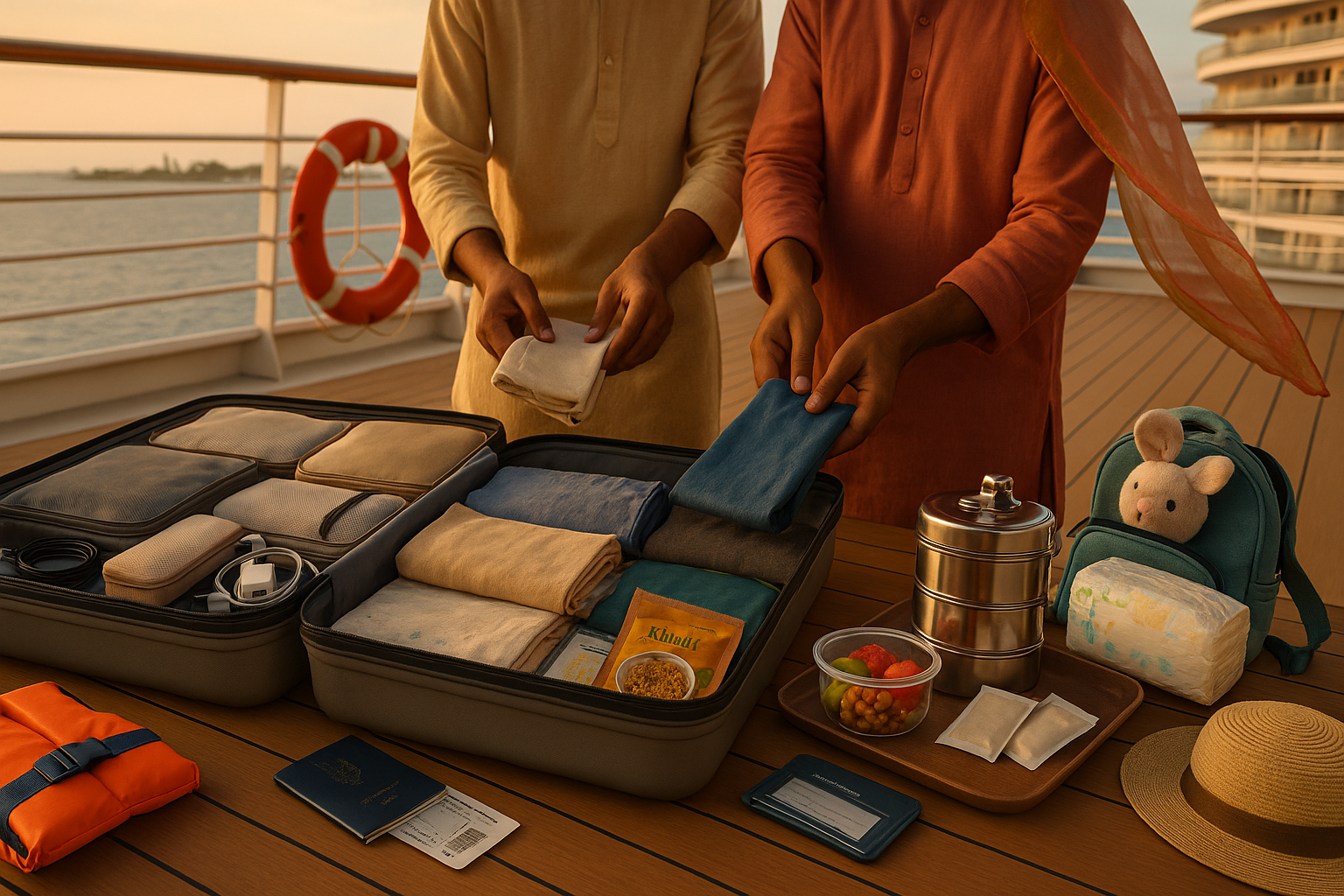
What should Indian cruise travelers pack for different cruise durations and ports?
Pack by cruise length—short (2–4 days), medium (5–8 days), long (9+ days)—and add port-specific gear for tropical beach, warm urban, cooler climates, and active shore excursions. Frame packing as a function of the itinerary first (onboard days, formal nights, shore excursions), then layer items by climate and activity.
How should I adjust my packing for short, medium, and long cruises?
You should adjust packing by trip length: short (2–4 days), medium (5–8 days), long (9+ days).
Short (2–4 days): pack one outfit per day plus one formal outfit and small toiletry/meds kit; underwear and socks equal to days plus one extra. This is a heuristic for short cruises when laundry is unnecessary. Bring one pair of comfortable shoes and one dress shoe/sandal.
Medium (5–8 days): plan to re-wear tops and light layers and pack 50–70% of outfits as reusable pieces; include quick-dry fabrics and packing cubes. This is a heuristic; you should include 1–2 formal looks, one set of active/shores-excursion gear, and a small laundry plan (hand-wash items or use onboard laundry).
Long (9+ days): pack basics and a laundry strategy (onboard laundry service, capsule wardrobe, or laundry sachets). This is a heuristic; bring extra underwear and socks, at least two footwear options, one active set, and one extra casual outfit per 4–7 days as backup.
Prioritisation rules you should follow: double-up on essentials (undergarments, chargers, prescription meds, universal adapter, portable charger) and items hard to replace at ports (prescription meds, specialty footwear). Leave bulky duplicates and excessive formalwear if your cruise has few formal nights; you may buy common toiletries or a cap ashore if needed.
What essential items change by port type: tropical beach, urban warm, cooler climates, and active shore excursions?
The following list shows port-specific must-haves and how shore-excursion gear differs by stop.
- Tropical beach: Pack swimwear, reef-safe sunscreen, a lightweight cover-up, water shoes or flip-flops, and a dry bag. Tropical beach stops should also include a refillable water bottle and a sun hat for long beach days.
- Warm urban: Pack breathable tops, a sun hat, comfortable walking sandals or sneakers, a daypack, and modest cover-ups for cultural sites. Warm urban ports should also include a small crossbody or money belt for safe touring.
- Cooler climates: Pack light layers, a windbreaker or light fleece, closed shoes, and a scarf; plan for cooler evenings on deck. Cooler climates should also include a compact umbrella or rain layer if the region is changeable.
- Active shore excursions: Pack hiking shoes or sturdy sandals, quick-dry socks, a small first-aid kit, insect repellent, and a compact daypack with water and snacks. Active shore excursions should also include a suitable change of clothes and waterproof protection for electronics.
How many of each clothing, medicine, and snack item should I pack per person?
Per person heuristics: underwear and socks—one per day plus one extra; tops and bottoms—plan to re-wear (pack roughly 50–70% of days as separate outfits on medium trips); active/excursion set—one full set per person; formalwear—one outfit for short trips, 1–2 for longer cruises. These are heuristics, not guarantees.
Pack medicines per person as daily-dose basics plus extras: carry prescription meds for the full itinerary plus an extra 2–3 days' supply, and a small OTC kit (antacid, anti-diarrheal, paracetamol, motion-sickness remedy, topical antiseptic). This is a recommended rule-of-thumb; you should not rely on finding specific brands in every port.
Pack snacks per person as 1–2 small portions per day for travel gaps or shore excursions (energy bars, nuts, or preferred vegetarian options). For last-minute changes, plan to bring resealable bags, travel-sized laundry detergent, a compact sewing kit, a universal adapter, and a portable charger so you can adapt to unexpected delays, extra shore excursions, or lost luggage.
What travel documents and e‑visa requirements do Indian cruise passengers need?
Carry a valid passport, any required visas or e‑visas for your nationality and itinerary, your cruise ticket/boarding pass, travel insurance, and prescription documentation.
For most international cruises you must present originals at embarkation and immigration; you should also keep paper backups and digital scans to speed check‑in and handle lost‑document scenarios. Below is a short checklist of the documents to have ready and a brief note on timing and exceptions.
Short checklist of documents to carry:
- Passport (original) — keep in your carry‑on and present at embarkation and immigration.
- Visa / e‑Visa — any entry visa, e‑Visa, or transit visa required by your nationality for the ports of call.
- Cruise ticket / boarding pass and booking reference (print and digital).
- Travel insurance certificate — include policy number and emergency contact; travel insurance should cover medical emergencies and trip disruptions.
- Prescription medicines and a doctor’s note or original prescription for controlled drugs.
- Paper photocopies — at least one copy of passport bio page, visa page, cruise ticket, insurance policy; store separately from originals.
- Encrypted digital scans — password‑protected PDFs of passport, visa, ticket, insurance, and prescriptions stored on your phone and in a secure cloud, with offline copies available.
- Emergency contacts and cruise‑line contact details (keep a printed card and a phone contact).
Timing and exceptions:
- Apply for any required visa or e‑Visa well before travel to allow for processing and potential issues.
- Short‑dock or transit situations may have different rules: if you remain onboard during a port call you might not need an entry visa, but if you plan to disembark even briefly you may require an e‑Visa or other entry permission. Port authority and nationality rules can vary. Check official consulate or cruise line.
What documents should I carry, copy, and store digitally before boarding?
Carry originals (passport, visas, cruise ticket) and keep paper copies plus encrypted digital scans accessible offline.
Below is what you should have and how to organise it for embarkation:
- Originals (carry‑on): passport, valid visa/e‑Visa, cruise ticket/boarding pass, government ID. Keep these in a clear document wallet in your hand luggage.
- Paper copies: at least two paper copies of passport bio page, visa page, cruise ticket, insurance certificate, and prescriptions; store one copy with you and one in a separate bag or with a travel companion.
- Digital scans: create password‑protected PDF scans of passport, visa, cruise booking, insurance, and prescriptions; store them on your phone and in a secure cloud, and download offline copies so they are accessible without internet.
- Insurance & prescriptions: include a PDF of the insurer’s contact/claim number and a physician’s note for prescription medicines; carry originals of prescriptions for controlled drugs.
- Organisation tips: assemble a single “embarkation” folder (physical and digital) with all documents and the cruise‑line contact. You should keep originals on your person during check‑in and store backups separately to reduce risk of loss.
Do I need a separate e‑Visa if my cruise only docks briefly in India?
Maybe — e‑Visa needs depend on whether you disembark and on your nationality and the port authority’s rules.
If you remain onboard for the entire port call you may not need an entry visa, but many ports require an e‑Visa or entry permission for anyone who leaves the ship. Rules and transit exceptions vary by nationality and by port, so verify the e‑Visa requirement with the cruise line (for example, Cordelia Cruises or Royal Caribbean) and check the Indian consulate or port authority for a definitive answer; check official consulate or cruise line.
What Indian dining and vegetarian options are available onboard cruises?
Most lines provide vegetarian options and can accommodate Indian or Jain requests if you request special meals before boarding; verify menus with the cruise line and confirm at check-in.
Cruise ships typically offer a mix of main dining rooms, buffet stations, limited a la carte/specialty options, and room service that include vegetarian choices; lines with Indian-focused sailings may add themed menus. Menus vary by cruise line, ship, and itinerary, so you should check the ship’s sample menus and ask how vegetarian or Jain requests are prepared. Always request special meals before boarding and confirm at check-in to ensure the kitchen has your request on file.
Follow this short process to secure vegetarian or Jain meals:
- Notify at booking — request vegetarian or Jain meals when you reserve and ask the line to show sample menus or dining options.
- Provide documentation — send a short written dietary brief listing allergies, dislikes, and any strict exclusions (for example, note if Jain rules apply).
- Confirm at check-in — reconfirm the request when you check in and confirm with dining staff onboard that your meal note is active.
Pack sealed, commercially packaged backups as needed and check cruise and port rules for perishables and liquids.
- Single-serve spice sachets (masala, garam masala) and tea bags.
- Instant meal mixes (dal/soup/khichdi sachets) and dry chutney or pickle powder in sealed packs.
- Packaged snacks (namkeen, roasted nuts, biscuits) and ready-to-eat lentil/bean snacks.
- Small travel salt/pepper or powdered condiments in factory-sealed containers.
How do I request vegetarian or Jain meals before my cruise and onboard?
Notify the cruise line at booking, reconfirm at check-in, carry a short written dietary brief (ingredients to avoid), and confirm with dining staff onboard.
- Notify at booking — request vegetarian or Jain meals as soon as you book and ask whether the line posts sample menus for your ship and itinerary.
- Email a written dietary brief — include allergies, foods to avoid, and any Jain-specific exclusions so the galley has clear instructions.
- Confirm at check-in — check your booking note during embarkation and confirm at check-in that the request is recorded.
- Confirm with dining staff onboard — on your first meal, tell your waiter or maître d’ your requirements and ask how those dishes are prepared; confirm any changes directly with dining staff.
For a detailed overview of dining offerings and how Indian cuisine is served onboard, see Cruises with Indian Cuisine: What to Expect Onboard for Indian Travelers.
What snacks, condiments, or small food items should I pack as a backup for Indian tastes?
Pack sealed, non-perishable single-serve spice sachets, dry chutneys, instant mixes and familiar snack packs, and check cruise and port rules for perishables and liquids.
Pack sealed, commercially packaged items and check restrictions before you sail.
- Single-serve spice sachets and tea/masala chai bags.
- Instant dal/soup or ready-mix meal sachets and dry chutney/pickle powder in sealed pouches.
- Packaged snacks: namkeen, roasted peanuts, biscuits, and energy bars.
- Small sealed condiment packets (salt, pepper, powdered spices) rather than liquids.
Check cruise and port rules for liquids or fresh perishables before boarding to avoid confiscation.
Which items should families, vegetarians, and kids specifically pack for an Indian cruise?
Families should pack child safety items, extra clothing and medicines, entertainment, and vegetarian backup foods; vegetarians should register diet needs and bring shelf-stable staples for shore stops.
What essential items should families pack to keep children safe, fed, and entertained onboard?
Pack diapers, spare clothes, medications with prescriptions, compact entertainment, and familiar snacks to keep children safe, fed, and entertained onboard.
Parents should carry child ID and discuss muster/meeting points before sailing; check whether your cruise line (for example Cordelia Cruises or MSC) provides life-jackets, nursery/childcare, or onboard laundry services. Medicines should remain in original packaging with prescriptions.
Use this checklist for children and family logistics:
- Pack diapers and changing supplies: disposable diapers, travel wipes, diaper cream, portable changing mat, and disposal bags.
- Pack spare clothes: 2–3 changes in carry-on, swimwear, light jacket, and an extra set for evenings.
- Pack medications and health kit: prescribed meds in original bottles, age-appropriate paracetamol/ibuprofen, oral rehydration salts, thermometer, and basic first-aid.
- Pack safety items: child ID card or lanyard with emergency contact, adhesive name labels, small night-light, and a familiar life-jacket if you prefer (check ship provisions; life-jackets may be provided).
- Pack feeding items: sippy cup/bottle, formula or expressed milk (confirm perishables rules), familiar snacks, and resealable bags.
- Pack entertainment: tablet with downloaded films, headphones, colouring/activity books, small toys, and a power bank.
- Pack paperwork and logistics: photocopies of passports, cruise boarding documents, emergency contacts, and a short family meeting plan for muster drills.
What vegetarian-specific food items and meal-planning tips should vegetarians bring or request?
Bring sealed, shelf-stable vegetarian staples (instant dals, spice sachets, snack packs) and log vegetarian or Jain special-diet requests at booking, reconfirm at check-in, and remind dining staff onboard.
You should register dietary needs early and reconfirm at check-in or with the main dining-room host; for strict Jain requests (no onion/garlic) give clear written notes. Be mindful that some ports restrict fresh foods, so prefer sealed, shelf-stable backups.
Pack the following backup foods and follow these steps:
- Bring sealed shelf-stable staples: instant dal/lentil sachets, ready-to-eat vegetable/chana pouches, instant oats, tea bags, nut butter, and energy bars.
- Bring spice and flavour sachets: small packets of turmeric, garam masala, salt, and chili to season bland meals.
- Pack excursion snacks: sealed namkeen, roasted chana, dry fruits, and snack packs for long shore days.
- Log dietary requests: log vegetarian/Jain preferences when booking, reconfirm at check-in, and remind the head waiter or main-dining staff onboard.
- Check perishables and customs: verify the cruise line’s allowance for bringing food and note port restrictions on fresh produce.
- Use onboard options: should request vegetarian dishes in specialty restaurants and may ask for separate preparation for strict diets.
How many diapers, medications, spare clothes, and entertainment items should I plan per child per day?
Use heuristics: plan daily-use counts plus a 20–50% buffer for delays or itinerary changes; the numeric examples below are estimates.
Parents should plan conservatively for sea days, long transfers, or delayed luggage and should check the cruise’s nursery/childcare and laundry options before sailing.
Plan to the following per-child, per-day estimates (heuristics) and carry contingency supplies:
- Diapers: plan to 6 diapers per day (heuristic) for typical infants; adjust up for newborns or heavy wetters and carry a 20–50% buffer plus one extra day.
- Medications: plan to bring each child’s daily prescribed dose plus one extra day (heuristic); carry OTC antipyretic/anti-diarrheal appropriate for age in original packaging and prescriptions.
- Spare clothes: plan 2 spare full outfits per child per day (heuristic) for messy days or swims; include pajamas and one extra set for unexpected delays.
- Entertainment items: plan 2–4 compact items per child per day (heuristic) — one screened download, one quiet toy/activity, and one active toy — plus chargers and a power bank.
- Contingency: plan to pack supplies for at least 1 extra sea/shore day (heuristic) and confirm onboard laundry or mini-market availability to refill essentials if needed.
Before you sail, what health and vaccination precautions should Indian cruise passengers take?
Update routine vaccines, consider destination-specific shots, consult a healthcare provider at least a month before travel, and pack a compact health kit with prescriptions and OTC basics.
Get routine vaccines up to date and review destination recommendations from the CDC for India before a cruise that visits Indian ports or nearby countries. Short cruises to urban areas usually carry lower risk for some diseases, but shore excursions, rural stops, or overnight stays off-ship can change your needs. Consult a clinician for personalised advice about malaria prophylaxis, rabies risk, or Japanese encephalitis.
Quick checklist — vaccines and health‑kit items to address before sailing:
- Vaccines (CDC-recommended signals):
- Routine vaccines: MMR (measles-mumps-rubella), influenza, varicella (chickenpox), DTaP/Tdap/Td (diphtheria-tetanus-pertussis), polio, shingles, and COVID-19 as eligible.
- Destination‑specific: Hepatitis A (recommended for unvaccinated travellers); Hepatitis B (recommended for many travellers); Japanese encephalitis (for prolonged/rural stays or high-risk activities); cholera vaccination may be considered for travel to areas with active transmission; rabies vaccination may be considered for high‑exposure travellers.
- Health‑kit items (compact essentials you should pack):
- Prescription medicines in original labeled bottles and printed copies of prescriptions and a list of medical conditions/medications.
- Small first‑aid kit, oral rehydration salts, antidiarrhoeal (eg, loperamide), electrolyte powders, antiseptic wipes, adhesive bandages.
- Motion‑sickness medication, antihistamine/anti‑itch cream, topical antibiotic ointment, fever/pain reliever (eg, paracetamol/ibuprofen), insect repellent (DEET or picaridin), sunscreen. Timing note: visit a travel clinic or your healthcare provider at least a month before travel; malaria medicine regimens may require starting multiple days before departure depending on the drug, so consult your clinician.
Which vaccines and medicines are recommended before a cruise and when should I schedule them?
Get routine vaccines up-to-date and consider Hepatitis A/B, Japanese encephalitis, and malaria prophylaxis; schedule a clinic visit at least a month before travel and consult a provider for personalised malaria and rabies advice.
The CDC advises all travellers be current on routine immunizations before international travel and recommends Hepatitis A for unvaccinated travellers to India and Hepatitis B for many travellers. Japanese encephalitis vaccination is recommended for travellers spending a month or more in endemic areas or who will do rural/outdoor activities. Cholera or rabies vaccines may be considered for specific high‑risk situations. For malaria prevention, the CDC advises prescription prophylaxis for travellers to certain parts of India; depending on which antimalarial is chosen, you will need to start it multiple days before travel and continue during and after the trip. Consult your healthcare provider to match vaccines and medicines to your itinerary and health status.
What should I pack in a cruise travel health kit (prescription meds, OTC, documentation)?
Pack prescriptions in original labeled containers, carry a small first‑aid kit plus oral rehydration salts and antidiarrhoeals, and bring printed prescription copies and vaccination records.
You should carry prescription medicines in their original bottles and pack a printed list of medications and doses, plus a photocopy of important medical documents and travel insurance details. Pack a compact first‑aid kit with adhesive bandages, antiseptic, tape, and scissors; antidiarrhoeal medication (loperamide) and oral rehydration salts for dehydration; motion‑sickness tablets or patches; fever/pain reliever; antiseptic cream and antihistamine/anti‑itch cream for bites. Also pack insect repellent, sunscreen, hand sanitizer, and any medical devices you use (inhalers, glucose monitor). Keep all essential medicines in your carry‑on and carry proof of prescriptions.
Suggested packing list you should use:
- Prescriptions: original bottles, printed copies, doctor contact, list of allergies/conditions.
- First‑aid & OTC: adhesive bandages, antiseptic wipes, antibiotic ointment, paracetamol/ibuprofen, antihistamine, antacid.
- Gastrointestinal & hydration: oral rehydration salts, loperamide, probiotic or physician‑recommended stomach remedy.
- Motion & bites: motion‑sickness medication, insect repellent (DEET/picaridin), topical anti‑itch cream.
- Documentation: vaccination record, prescription copies, travel insurance and emergency contacts.
Which protects you more from mosquito‑borne illnesses on a cruise: topical repellent or nets/plug‑ins?
Topical repellents provide the best personal protection; nets and plug‑ins protect sleeping areas and are best used together with repellents and screens or air‑conditioning.
Topical insect repellents containing DEET or picaridin protect exposed skin and are most effective for personal protection during day and evening outdoor activities and shore excursions. Bed nets are highly effective for sleeping in unscreened or open accommodations ashore, especially in rural areas; plug‑in mosquito devices can reduce indoor mosquitoes in enclosed cabins or hotel rooms but depend on room sealing and proximity. The CDC recommends preventing bug bites by using repellents, staying in accommodations with screens or air conditioning, and using bed nets when sleeping in areas without adequate screening. For cruise travellers, use repellent on shore excursions and rely on screened/air-conditioned ship cabins plus nets or plug‑ins if you sleep in unscreened lodging — the methods work best together.
Essential packing tools, electronics, and onboard attire
Choose carry-on vs checked by cruise length, use packing cubes and a daypack, bring a universal adapter and power bank, weigh eSIM vs ship Wi‑Fi and local SIM for connectivity, and prioritise casual outfits unless formal nights are scheduled.
Below are the essentials grouped by luggage/organisation, electronics/connectivity, and attire/dress-code.
- Luggage & organisation
- Use packing cubes to compress and organise clothing for quick access and mixed wardrobes.
- Use a daypack for shore excursions and shipboard carry; use one carry-on for short cruises and choose checked luggage for longer voyages.
- Use luggage locks and label bags; coordinate shared items (toiletries, medicines, plug strips) when travelling as a family or group to avoid duplication.
- Electronics & connectivity
- Use a universal adapter and portable charger; Hindustan Times lists reliable examples such as Portronics Juicemate Go, Ceptics, Boat, and Destinio as all‑in‑one travel adapters you can consider.
- Use power banks and spare charging cables; keep chargers in your daypack for embarkation day.
- Use eSIM, ship Wi‑Fi, or a local SIM depending on port vs at‑sea needs (see below for a quick guide).
- Attire & dress code
- Use versatile casual outfits as your baseline and pack one or two smart/formal pieces only if your cruise schedule lists formal nights.
- Use lightweight Indian formal options (light sarees, stitched kurta sets) that travel well and pair with simple footwear and minimal jewellery.
What packing tools and luggage choices make cruise packing most efficient?
Use packing cubes, a daypack, and one carry-on for short cruises; choose checked luggage for long cruises and coordinate shared items when travelling as a family or group.
- Use packing cubes to separate tops, bottoms, swimwear, and formal wear for fast access.
- Use a lightweight daypack (6–25L) for excursions and daily essentials like water, sunscreen, and chargers.
- Use one carry-on for short cruises (embarkation/early-disembarkation ease); choose checked roller luggage for longer trips with more outfit variety.
- Use luggage locks and an external luggage tag; use a shared toiletries bag and a single electronics kit to reduce duplicate items across family/group travellers.
- Consider packing cubes that compress and fabric shoe bags to keep shoes separate and clothes clean.
What are the cost, coverage, and reliability differences between eSIMs, ship Wi‑Fi, and local SIMs at ports?
eSIMs give affordable port data and instant setup; ship Wi‑Fi covers onboard services but is costly with limited at‑sea bandwidth; local SIMs give best port coverage but require swapping and may not work at sea.
Compare and consider:
- eSIM — Cost: generally low for short data packages; Coverage: works in port areas where local towers exist; Reliability/latency: similar to local mobile networks at ports. Choose eSIM for quick, low-cost port data without swapping SIM cards.
- ship Wi‑Fi — Cost: typically high and metered or daily‑pass based; Coverage: available across the ship (including many services), but at‑sea bandwidth is limited; Reliability/latency: higher latency and slower speeds, especially during peak use. Choose ship Wi‑Fi if you need to stay connected onboard for video calls or access cruise apps and you cannot use mobile data.
- local SIM — Cost: low once purchased, good data volumes; Coverage: excellent at port locations but usually no service at sea; Reliability/latency: good on shore. Choose local SIM for extended time ashore or multi‑day stays in one country.
Quick decision guide: choose eSIM for convenience and short port data needs, purchase a local SIM if you plan long stays ashore, and buy ship Wi‑Fi only if you need consistent onboard internet access despite higher cost and limited bandwidth.
How do I set up an eSIM and which devices are compatible for cruise travel?
Buy an eSIM plan compatible with your unlocked device before departure, install via QR code or provider app, and keep offline maps or a local SIM as a backup.
- Explain: You should confirm your device supports eSIM and is unlocked; buy the eSIM from a reputable provider before you sail.
- Install: install the eSIM using a QR code or provider app and test it on land before embarkation; install and activate while you still have reliable cellular/Wi‑Fi.
- Backup: download offline maps, boarding passes, and critical documents; keep your phone in airplane mode at sea and use ship Wi‑Fi when needed, or carry a local SIM as a fallback for port use.
Which is more important for cruise packing: formal evening wear or versatile casual outfits?
Prioritise versatile casual outfits unless your cruise lists formal nights; check the cruise line schedule for formal nights and pack lightweight Indian formal wear options if required.
- Rules of thumb: prioritise casual, mix‑and‑match clothing for daytime activities and shore visits; check the cruise line’s daily programme or booking confirmation to see if formal nights are scheduled.
- Formal nights: if the itinerary includes formal evenings, pack one dressier outfit (cocktail dress, blazer) or a lightweight saree/kurta set that resists creasing.
- Adapting Indian wear: choose breathable, travel‑friendly fabrics and pre‑pleated or stitched sarees/kurta sets to save space; pair with simple shoes and a shawl to cover shoulders when needed.
Hygiene, water safety, ship policies, and quick FAQs
Compare portable bidet, toilet spray and toilet paper for convenience and sanitation; prefer bottled water or filtered bottles on excursions, and always verify cruise-line rules on hygiene devices and food before packing.
Quick comparison:
- Hygiene options — portable bidet, toilet spray, toilet paper: portable bidet gives the strongest rinse and sanitation but takes more space; toilet spray is compact and versatile for ship and shore; toilet paper is simplest but may not always be available ashore.
- Water choices — filtration water bottle vs bottled water for shore excursions: use a filtration water bottle for repeated refills in reliably safe ports; choose sealed bottled water where water quality is uncertain or authorities advise bottled/treated water.
What are the pros and cons of carrying a portable bidet, toilet spray, or toilet paper on a cruise?
Portable bidet gives the strongest sanitation but is bulkier; toilet spray is compact and convenient; toilet paper is simplest but may be unavailable ashore. The following bullets compare portability, sanitation, packing convenience, use cases, and storage/cleaning tips.
- Portable bidet — Pros: best rinse and comfort for users who prefer water-based cleaning; works well in cabins and shore bathrooms when space allows. Cons: larger than a spray bottle, takes luggage space; some models require filling and drying. Consider emptying, drying fully, and packing in a padded pouch or resealable bag to avoid leaks.
- Toilet spray — Pros: compact, handheld, and easy to store; recommended by travel writers for Indian travellers who prefer water-based cleaning. Cons: requires a water source and occasional cleaning; might need a discreet carrying case. Consider a travel-sized neoprene sleeve and rinse the nozzle after use.
- Toilet paper — Pros: universally accepted, very compact, disposable or travel-roll options exist. Cons: some public restrooms or local shore stops may not supply it. Consider carrying a few travel rolls or folded tissues in a resealable bag for discreet disposal.
When should I use a filtration water bottle versus bottled water during shore excursions?
Use filtration bottles in reliably safe ports and for repeated refills; choose sealed bottled water in high-risk or uncertain water-quality areas and when local guidance advises bottled/treated water. Below are effectiveness notes, scenarios to prefer bottled water, and practical refilling and storage tips.
- Filtration water bottle — Use when tap water is from municipal systems you trust or at taps marked safe; filtration bottles are ideal for multi-day excursions and reduce plastic waste. They might not remove all viruses, so use treated water if you need higher-level protection.
- Bottled water — Choose sealed bottled water when water safety is uncertain, in rural ports, or where CDC-style guidance warns to avoid local water; bottled water is safest for brushing teeth or if you’re prone to stomach issues.
- Practical tips — Refill a filtration water bottle from potable sources or ship water stations; keep sealed bottled water in your daypack with an intact seal; avoid ice made from tap water unless you confirm it’s safe.
Are there cruise-line rules or restrictions about bringing portable hygiene devices or food items?
Yes — many lines restrict batteries, large electronics, and perishables; always check the cruise line’s official prohibited items list before packing. Cruise operators commonly list prohibited items and have specific rules for carry-on batteries, power devices, and outside food or perishables, so check and confirm the cruise line’s prohibited items page and contact their customer service for any portable hygiene devices you plan to bring.
Quick boolean FAQs (yes/no):
- Can I bring a portable bidet on board? — Yes (check battery/power rules if electric; pack empty and dry).
- Can I carry a toilet spray in carry-on luggage? — Yes (ensure no pressurized containers and store discreetly).
- Can I bring a filtration water bottle on excursions? — Yes.
- Can I bring outside perishables or cooked food to the ship? — No (often restricted; check the cruise line’s prohibited items).